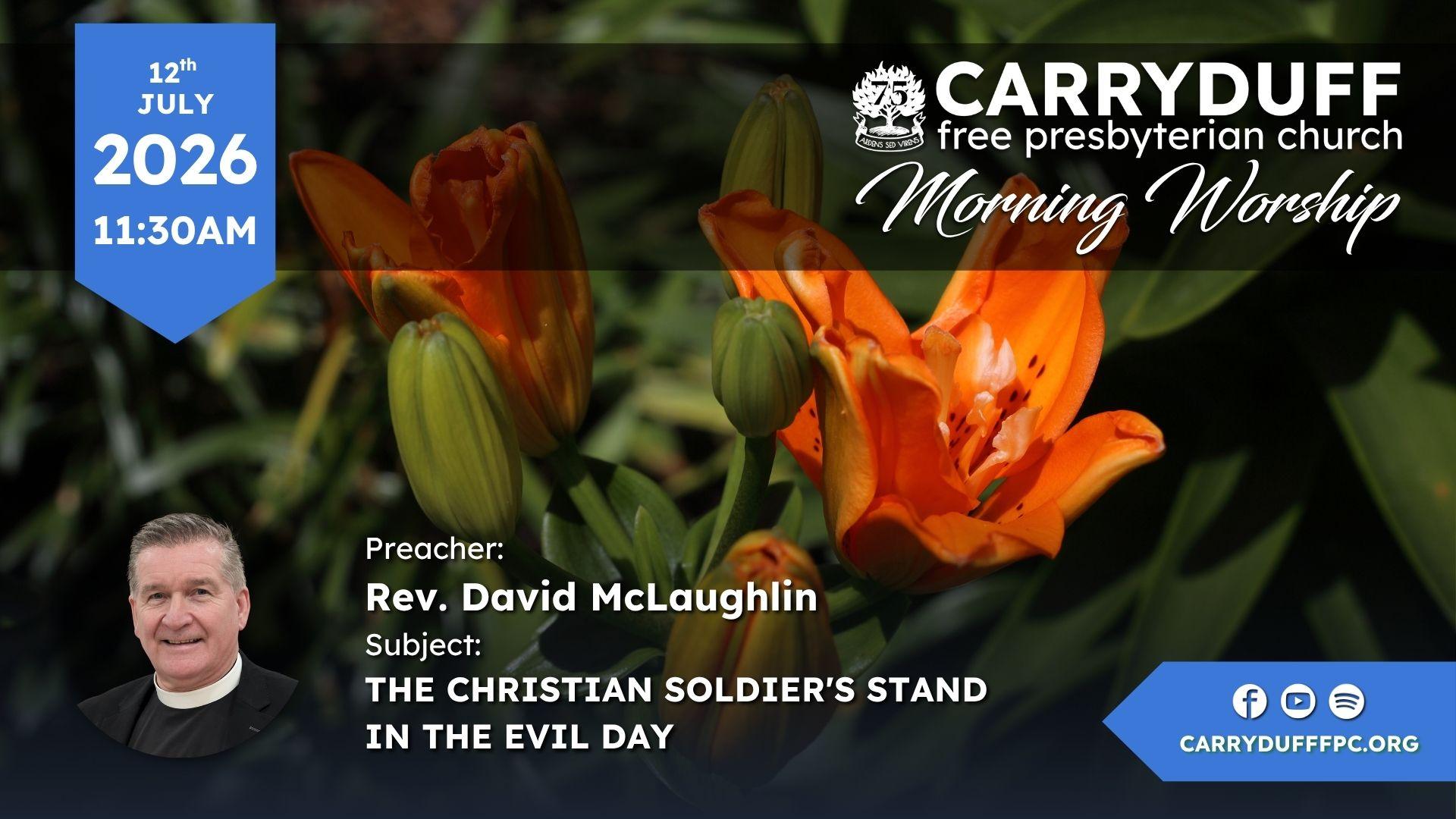

Date: SUN 11:30am 12th July 2026
Preacher: Rev. David McLaughlin
Bible Reference: Ephesians 6:13
Podcast
A Summary of “The Christian Soldier’s Stand in the Evil Day”
Introduction and Historical Context
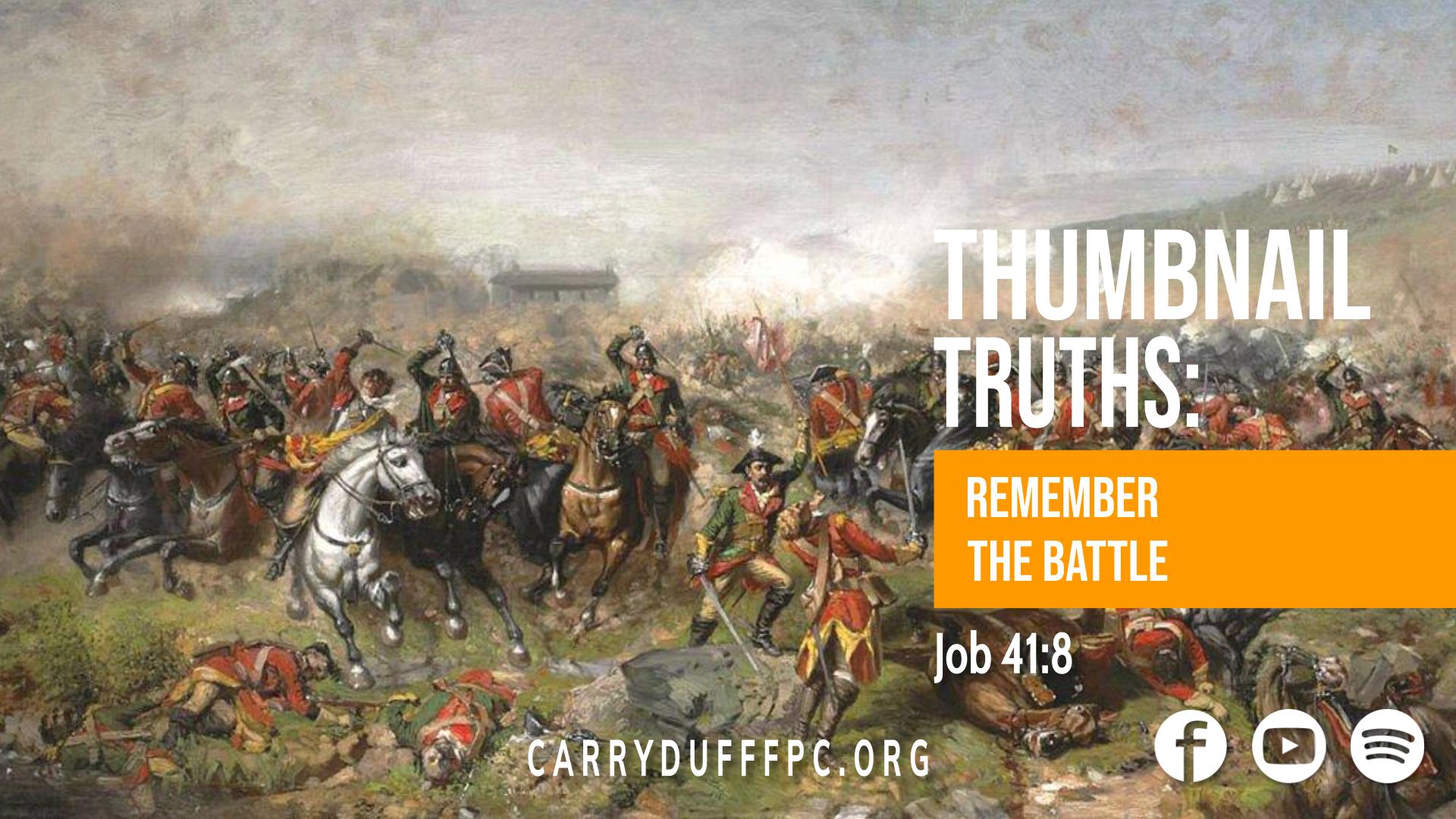
The sermon, delivered on the 12th of July, takes as its text Ephesians chapter 6, verse 13: “Wherefore take unto you the whole armour of God, that ye may be able to withstand in the evil day, and having done all to stand.” The preacher opens by acknowledging the historical significance of the date for Ulster Protestantism, commemorating the victory of the Williamite forces at the Battle of the Boyne 336 years prior. This victory is framed not as a mere military triumph, but as the providential means by which the truths of the Protestant Reformation were preserved in the land.
However, the preacher immediately pivots from historical commemoration to present application. The critical question is not what forefathers achieved, but what the present generation is standing for. The message is directed to all within the loyal orders, the Christian church, and indeed every citizen of the United Kingdom.
The central thesis is established early: the Christian’s greatest battlefield is not the Boyne, Aughrim, or the Somme. The true battle, as described in Ephesians 6:12, is a spiritual one—a wrestle “not against flesh and blood, but against principalities, against powers, against the rulers of the darkness of this world, against spiritual wickedness in high places.” The Apostle Paul’s call is not to political triumph but to spiritual steadfastness and faithfulness to the truth. The imperative is simple: “having done all to stand.”
Three Foundational Questions
The sermon is structured around three questions derived from the text.
1. The Peril We Face: Why Must We Stand?
The preacher identifies three dimensions of the peril confronting the Christian soldier.
A Present Darkness
Paul uses the definite article—”the evil day”—indicating not a single day but seasons when evil intensifies and its attacks against the church become particularly bold. This condition has existed since the Fall of man, with Satan as the “god of this world.” However, the present generation is living in a particularly acute evil day.
The evidence cited for this present darkness in the United Kingdom and specifically Northern Ireland includes:
- The abundance of sin, iniquity, immorality, and idolatry in every city, town, village, and hamlet.
- Biblical truth being “trampled down in the streets.”
- Society being described as adrift—politically, culturally, societally, and spiritually—with the root cause identified as a spiritual problem.
- The prevalence of atheism (“there is no God”), agnosticism, hedonism (“every man did that which was right in his own eyes”), and relativism.
- A wholesale rejection of biblical authority and inerrancy, characterised by the mindset of Pharaoh: “Who is the Lord that I should obey him?”
- The redefining of biblical teaching on marriage through the Westminster Parliament.
- The introduction of abortion regulations in Northern Ireland from 1 April 2020. The preacher cites specific figures: 11,192 babies “murdered in the womb” in Northern Ireland between 1 April 2020 and 31 March 2025, with 2,899 in the 2024–2025 year alone.
- High-profile murders cited as evidence of societal breakdown, including a mother and her two daughters in Bedfordshire, an American woman in Killarney, and a woman murdered in her home in Dartmoor.
- Moral confusion regarding the definition of womanhood, directed pointedly at the current Prime Minister.
- The explosion of the “LGBTQ+ brigade” and the rise of Satanic worship, occult practices, Ouija boards, and horoscopes.
- The neglect of Lord’s Day worship and declining attendance at the house of God.
- The treatment of truth as intolerant, fulfilling Isaiah’s prophecy: “Woe unto them that call evil good and good evil.”
A Personal Devil
The preacher affirms belief in a literal, personal devil—not a caricature in a red suit with a pitchfork, but a being who appears in Scripture under three guises: the subtle serpent, the roaring lion, and the angel of light. Lucifer, the son of the morning, led a rebellion in heaven and was cast out. He is described as strong, subtle, and a schemer.
His primary tactic is revealed in the Garden of Eden: “Hath God said?” The strategy is to cause doubt about the Word of God, which then leads to denial of the Word, and finally to disobedience. This same tactic was employed against Christ in the wilderness, where the devil quoted Scripture but twisted it out of context. The preacher asserts that this identical method is being used against the contemporary church, and it is working. The devil’s goal is to undermine biblical inerrancy, authority, and infallibility. His footprints and handiwork are discernible across the landscape of modern church compromise.
A Persistent Danger
The Christian’s warfare is not momentary but lifelong—a daily, continual, constant struggle with no respite and no mercy. Citing 1 Peter 5:8, the preacher emphasises the need for sobriety (a right frame of mind) and vigilance (eyes wide open), because the adversary “as a roaring lion, walketh about, seeking whom he may devour.”
The Christian life from conversion to death is a struggle on three fronts:
- Against remaining indwelling sin (in thought, word, and deed).
- Against an ungodly, anti-Christian world that seeks to squeeze believers into its mould.
- Against the arch-enemy, Satan, and his demonic minions.
The preacher warns that there will never be a day when a believer can declare self-sufficiency. Christians are prone to defeat, error, wickedness, discouragement, and losing heart. Many of God’s people are “ready to throw in the towel.”
2. The Provision We Find: What Way Do We Stand?
The text commands believers to “take unto you the whole armour of God.” The provision is examined under three headings.
A Created Armour
The armour is “of God”—divine in origin. Paul does not instruct believers to manufacture it; God supplies it. It is not handmade or of human origin. However, it is only effectual for those in a saving relationship with God, having received Christ by faith as Lord and Saviour.
The preacher is explicit: the Lord’s battles cannot be fought with carnal and worldly weapons. “The sword and the gun is not part of the Lord’s arsenal.” Discipline, dedication, and delight in traditions and religious services are insufficient. The armour must be put on by faith, which means living a life of faith—a life of dependence on God, delight in God, and discipline by God.
The illustration of David and Goliath is employed: Saul’s armour did not fit David and had to be removed. God invisibly clothed David with a divinely created armour of strength, courage, and faith, and the victory over Goliath was won.
A Complete Armour
The word “whole” is emphasised. The armour is called the whole armour of God because Satan will attack every area. Every piece is necessary:
- Truth
- Righteousness
- Faith
- Salvation
- The gospel
- The Word of God
- Prayer
If one piece is neglected, Satan will find an opening. He attacks the mind with error if the helmet of truth and salvation is not worn. Error is identified as the greatest enemy of truth. Because biblical authority has been rejected, biblical morality has been replaced with public opinion, personal preference, and sentiment: “I think, I feel, I like.”
The image of a soldier in the ancient battlefield wearing only a breastplate and helmet, neglecting the rest, is invoked to illustrate vulnerability. The preacher observes that many Christian soldiers in Northern Ireland have fallen, many are wounded, many minds are full of error, many hearts are full of discouragement, and many homes are divided because personal opinion has been elevated above the Word of God.
A Consecrated Armour
The armour must be personally applied and personally worn. Without it, the believer remains unprotected. It is taken and put on by faith in the Lord Jesus Christ. The call is to every individual—man, woman, boy, or girl—to be clothed in this armour as preparation for taking a stand.
3. The Purpose We Are to Fulfil: What Will Be the Result If We Don’t Stand?
The text’s command is “having done all to stand.” The purpose is examined through three aspects.
A Call to Resist
The emphasis is on standing—not advancing, not retreating, but standing. The word suggests steadfastness, holding firm, refusing to yield. The preacher issues a series of imperatives:
- Do not move when the pressure comes.
- Do not bend when others compromise.
- Do not go quiet because the truth matters.
Biblical examples are marshalled:
- Joseph, who resisted Potiphar’s wife, asking, “How then can I do this great wickedness, and sin against God?”
- Daniel, who, when forbidden to pray, knelt three times a day and prayed as he had always done.
- The three Hebrews, who told Nebuchadnezzar that God was able to deliver them, “but if not, be it known unto thee, O king, that we will not serve thy gods, nor worship the golden image which thou hast set up.”
A Call to Persevere
Standing requires conviction. The preacher traces a lineage of perseverance:
- Daniel did not cease praying.
- The three Hebrews would not bow.
- Stephen refused to deny Christ as he was stoned.
- Paul would not alter the gospel to please men.
- The Reformers refused to recant, epitomised by Martin Luther at the Diet of Worms in April 1521: “Here I stand. I can do none other. My conscience is captive to the Word of God. So help me, God. Amen.”
The application turns to the congregation with searching questions: Do we stand for biblical authority and the infallibility of the Scriptures? Do we stand for family worship? Do we stand for holy living?
The Cost of Standing
Standing has always been expensive. The roll call of those who paid the price is recited:
- John the Baptist lost his head.
- Stephen lost his life.
- Paul faced imprisonment twice.
- Robert Murray McCheyne lost his health.
- The Scottish Covenanters shed their blood, staining the heather with martyr’s blood.
Compromise is easy. Going AWOL is easy. But Paul’s testimony in 2 Timothy 4:7–8 stands as the model: “I have fought a good fight, I have finished my course, I have kept the faith.” In this evil day, when truth is rejected, sin is celebrated, and the church is full of worldly compromise, the words of John Owen resonate: “Be killing sin or sin will kill you.” One compromise in one area never remains small and never remains alone—it opens the door to treason against Christ.
The believer is not alone in this stand. The Lord stood with Daniel, with Stephen, and with Paul, who testified, “The Lord stood by me.” Victory is not measured by popularity but by persistence, perseverance, and proclamation.
The Principle We Follow: How to Stand
The sermon closes with an evangelistic appeal. A soldier must first join the army. To stand as a Christian soldier, one must be found in Christ. By nature, people are not born soldiers but sinners. The new birth is essential: “Marvel not that I say unto thee, ye must be born again.”
The gospel is outlined:
- All have sinned and come short of the glory of God (Romans 3:23).
- Sin entered the world through one man, and death by sin (Romans 5:12).
- Human righteousness is as filthy rags in God’s sight.
- The best that anyone has, is, or can offer is filthy before a holy God.
- But Jesus Christ has come—born for sinners, living for them, dying for them, and rising again for them.
- Only in Christ can anyone stand. Only in Christ can anyone be strong.
Concluding Illustration: The Hymn “Stand Up, Stand Up for Jesus”
The sermon concludes with the story behind the hymn, written by the Reverend George Duffield in 1858. His friend, the Reverend Dudley Atkins Tyng of Philadelphia, was engaged in a major revival campaign, speaking boldly for Christ with hundreds being converted. At one of the closing rallies, Tyng declared, “I’ll give my right arm for Jesus.” Days later, a farming accident tore off his right arm, and as he lay dying with Duffield at his bedside, his final words were: “George, tell my brethren in the ministry, wherever you meet them, to stand up for Jesus.”
The preacher applies this directly: the call is not to stand for tradition, the name of a lodge, or culture, but to stand for Jesus Christ and the Word of God alone. The plea is for those present to make a pledge on this Twelfth of July: “Lord, help me to stand up for Jesus.”