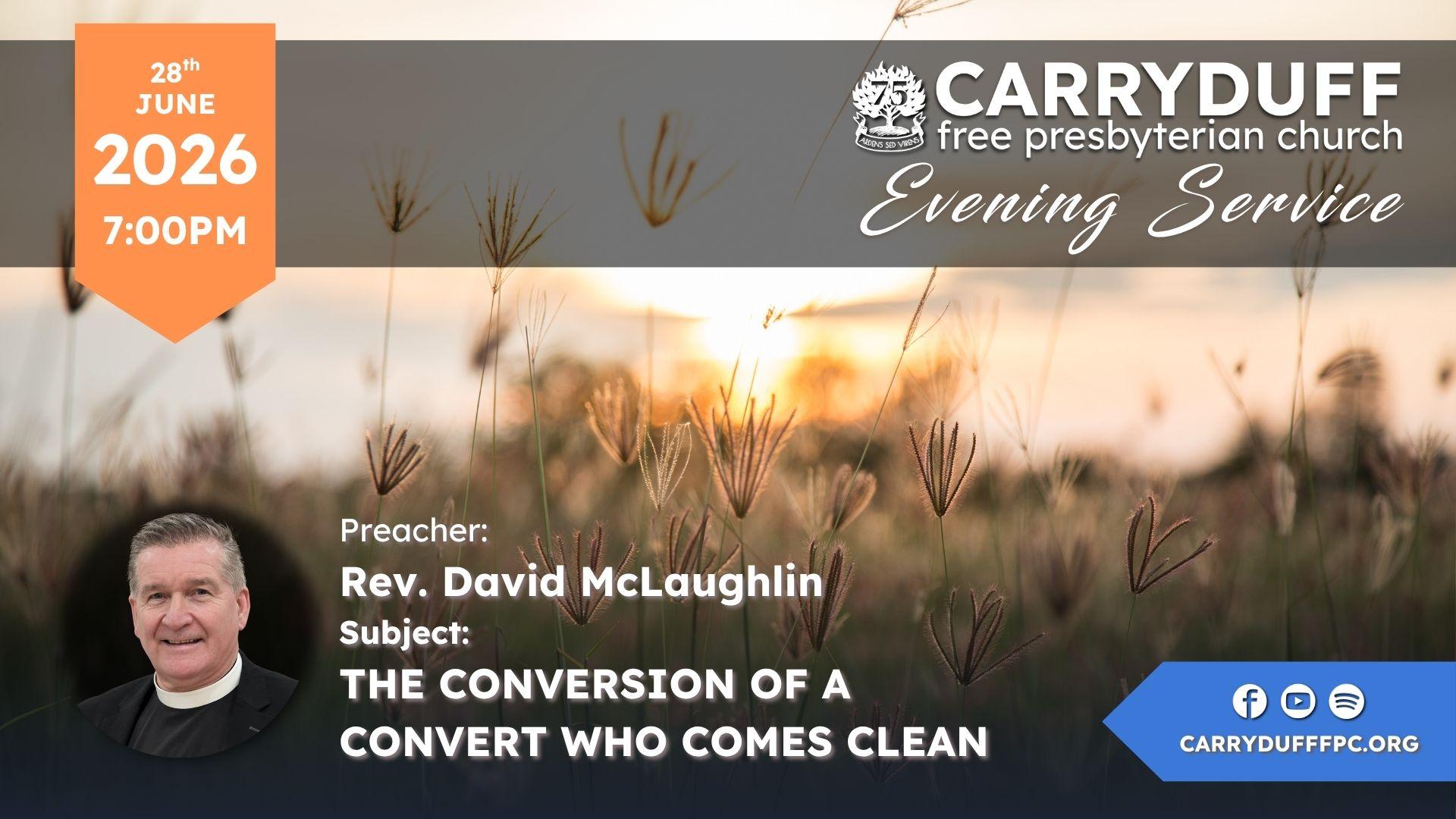

Date: SUN 7:00pm 28th June 2026
Preacher: Rev. David McLaughlin
Bible Reference: Psalm 32:5
Podcast
Sermon Summary
Introduction and Context
The sermon is based on Psalm 32, which the preacher describes as a penitential psalm written by David approximately eleven months after his grievous sins of adultery with Bathsheba and his arrangement of the death of her husband, Uriah the Hittite. The preacher emphasises that this is not mere poetry but personal testimony, written under the inspiration of the Holy Spirit. It records the experience of a man who attempted to hide his sin and discovered, in doing so, an intensifying inner torment—both bodily and mental.
The central text is Psalm 32:5: “I acknowledge my sin unto thee, and mine iniquity have I not hid. I said, I will confess my transgressions unto the Lord; and thou forgavest the iniquity of my sin. Selah.”
The preacher frames the message around four main points, each exploring a different dimension of sin, confession, and forgiveness.
The Blessedness of Sins Forgiven (Verses 1–2)
Before reaching the main text, the preacher draws attention to the opening verses of the Psalm, which describe the happiness of the man whose sins are forgiven. Three images are used to describe divine forgiveness:
- Sin carried away — like rubbish removed from sight.
- Sin covered over — concealed from view by the precious blood of Christ.
- Sin cancelled out — like a great debt wiped clean by the justice, holiness, love, and grace of God.
These verses establish the tone: forgiveness is not a grudging act but a source of profound blessedness.
The Cost of Silence (Verses 3–4)
David then describes what his silence cost him. The preacher quotes verses 3 and 4:
“When I kept silence, my bones waxed old through my roaring all the day long. For day and night thy hand was heavy upon me: my moisture is turned into the drought of summer.”
The preacher draws out several consequences of unconfessed sin:
- It does not remain dormant; it decays the soul.
- It presses upon the conscience.
- It robs the believer of the joy of God’s salvation.
- It impacts bodily health and mental well-being.
- It dulls the mind to real peace.
- It turns prayer into a spirit of heaviness, so that one thinks, “I cannot pray.”
- It transforms worship into hypocritical emptiness in the presence of God.
The word “roaring” is examined. The preacher wonders whether David, as king, appeared perpetually cross and irritable to his courtiers, shouting and barking at those under his rule. Whatever the case, there was no peace—only inward torment.
Point One: The Concealment That Corrupts the Soul
The preacher’s first major point concerns the human instinct to hide sin. David’s words, “mine iniquity have I not hid,” imply that in his past experience, he had indeed hidden it. This, the preacher argues, is the natural tendency of fallen man.
Biblical Examples of Concealment
- Adam hid among the trees of the Garden of Eden when God called.
- Cain went out from the presence of the Lord.
- Achan hid stolen gold and a Babylonian garment in his tent.
- Ananias and Sapphira conspired together to conceal the true price of their field and lied to the Holy Ghost.
Every descendant of Adam, the preacher insists, shares this same instinct. Sin is hidden in the heart and mind, and if not there, it is concealed by deliberate action.
How We Hide Sin
The preacher identifies several specific methods by which people conceal their sin:
- By silence — simply refusing to confess it before the Lord.
- By excusing it — calling it a weakness rather than wickedness, a distinction the preacher insists is vast.
- By calling it a sport — quoting Proverbs 10:23, “It is a sport to a fool to do mischief.” Sin is treated as a bit of fun rather than an offence against God.
- By comparison — measuring oneself against other men and concluding, “He or she is worse than me. I would never do that. I am not a murderer, a thief, or an adulterer.”
- By delay — promising oneself that one day repentance will come, but that day is always tomorrow, and tomorrow never arrives. The preacher quotes Proverbs: “Boast not thyself of tomorrow, for thou knowest not what a day may bring forth.”
- By pretending religion — maintaining outward respectability: attending worship, singing hymns, bowing in prayer, carrying a Bible, even instructing others in the things of God, all whilst hiding sin in the heart. The preacher laments that there are thousands of religious hypocrites who wear a mask.
- By denying it to oneself — refusing to acknowledge that a sin is indeed a sin.
Yet nothing is hidden from God. The preacher quotes Numbers 32:23: “Be sure your sin will find you out.” He also references Psalm 139:7: “Whither shall I go from thy spirit? Or whither shall I flee from thy presence?”
The Destructive Nature of Unconfessed Sin
The preacher is emphatic: unconfessed sin is not static or dormant. It is destructive and depraved. Drawing from David’s experience, he lists its effects:
- It affects the body — David’s bones waxed old; he looked aged, lacked physical strength, and felt weak and in bodily pain.
- It corrodes the conscience — one tells oneself it did not happen.
- It hardens the heart.
- It dims spiritual perception.
- It causes cover-ups.
- It drains the prayer life.
- It makes God and Christ seem distant.
- It corrupts grace.
- It distorts testimony.
- It causes the enemies of God to blaspheme, especially among religious hypocrites.
The preacher quotes John Owen: “Be killing sin, or sin will kill you.”
He also quotes J.C. Ryle: “Sin is the most expensive thing in the world.” Reflecting on the prodigal son, he notes that sin takes you further than you want to go, costs you more than you want to pay, and keeps you longer than you want to stay. The prodigal lost joy, peace, and forgiveness—far more than whatever pleasure he gained from wine, women, and song.
Proverbs 28:13 is cited as a summary: “He that covereth his sins shall not prosper: but whoso confesseth and forsaketh them shall have mercy.”
Point Two: The Confession That Converts the Soul
The second point turns to David’s confession itself: “I acknowledge my sin unto thee. I said, I will confess my transgressions unto the Lord; and thou forgavest the iniquity of my sin.”
The preacher notes carefully what David did not say. He did not say, “I acknowledge my faults,” or “my weaknesses,” or “my humanness.” He said, “I acknowledge my sin.”
Defining the Terms
The preacher distinguishes three biblical words used in the text:
- Sin — a falling short, missing the mark. He uses the image of an archer aiming at a target and falling far wide. Romans 3:23: “For all have sinned and come short of the glory of God.”
- Transgression — the breaking of God’s law. 1 John 3:4: “Sin is the transgression of the law.” The preacher argues that people have little consciousness of sin because they have little consciousness of the law of God; the Ten Commandments have been largely hidden from them.
- Iniquity — the perverseness of the human heart. Jeremiah 17:9: “The heart is deceitful above all things, and desperately wicked.” Romans 8:7: “The carnal mind is enmity against God: for it is not subject to the law of God, neither indeed can be.”
The human heart, when faced with the commandments of God, rebels with dogged perseverance. It loves sin, loves darkness, and wants to pursue its own way. Left to himself, man is poor, lost, dead in sin, diseased, and dark in soul.
Sin Is Primarily Against God
The preacher stresses that David is dealing with God, not merely with consequences. Many people are sorry when caught—like the thief, the murderer, or the adulterer. Many regret exposure. Many fear judgment but not guilt. David, by contrast, is concerned with guilt. He knows he has sinned against God.
The preacher points to Psalm 51, the sister psalm to Psalm 32, where David says: “Against thee, thee only, have I sinned, and done this evil in thy sight.” To confess sin is to agree with God about what sin is—not softening it, not excusing it, not renaming it, not managing it, but bringing it into the light and saying, “Lord, this is my sin.”
True Repentance
The preacher quotes the Westminster Shorter Catechism’s definition of repentance unto life:
“Repentance unto life is a saving grace, whereby a sinner, out of a true sense of his sin, and apprehension of the mercy of God in Christ, doth with grief and hatred of his sin turn from it unto God, with full purpose of and endeavour after new obedience.”
He then clarifies what repentance is not:
- It is not merely sorrow for sin — Judas was sorry but did not truly repent.
- It is not merely fear — Felix trembled but was not converted.
- It is not merely confession — Pharaoh said “I have sinned,” and Saul said “I have sinned,” yet neither truly repented.
True repentance includes:
- Opened eyes that see the total depravity of sin.
- Opened eyes that see the beauty of God’s mercy in Christ.
- Grief over sin.
- Hatred for sin.
- A turning from sin to God.
The Missing Doctrine
The preacher laments that modern evangelical pulpits speak of happiness, success, discovering God’s purpose, and help for life’s struggles. These are not wrong subjects, but one thing is missing: the doctrine of repentance.
He warns that God keeps an exact account of every secret thought, every word uttered, and every deed carried out, written in a book bearing each person’s name. Men think too highly of themselves because they have a shallow view of sin, a shallow view of Christ, a shallow view of the gospel, a shallow view of the cross, and a shallow view of heaven and hell. This has led to shallow conviction, shallow conversion, and shallow confession.
Point Three: The Contrition That Cleanses the Soul
The third point is brief but climactic. David says, “I said, I will confess my transgressions unto the Lord.” This is the moment of true confession—a man with grief over sin, hatred of it, turning from it to God.
The result is immediate and total: “Thou forgavest the iniquity of my sin.” The preacher emphasises the completeness of this forgiveness:
- No delay — no probation period.
- No negotiations — no bargaining with God.
- No partial pardon — not some sins, not most sins, but all sins.
Forgiveness was not earned or purchased by tears. The preacher illustrates this with two New Testament examples:
- The prodigal son — the moment he said, “I have sinned against heaven and in thy sight,” the father ran to meet him, placing a robe on him, shoes on his feet, and a ring on his finger.
- The publican in the temple — who prayed, “God be merciful to me, the sinner,” and went home justified.
The gospel pattern is always the same: humiliation before exaltation, brokenness before blessedness. John Flavel is quoted: “Sin is the wound, and only Jesus Christ is the remedy.”
The greatest sorrow one can know this side of eternity is sorrow for sin. The greatest joy is the knowledge of a full, free, and forever pardon.
Point Four: The Cross That Covers the Soul
The final point addresses the ground of forgiveness. Psalm 32 is described as a gospel psalm. Verses 1 and 2 describe the blessedness of the man whose sins are forgiven—carried away, covered over, and cancelled out. But the preacher insists that this forgiveness points forward to the cross.
The word “Selah,” appearing at the end of verses 4 and 5, means “pause” or “think about it.” The preacher urges the congregation to consider: upon what ground can God forgive sin?
The answer is the shed blood of Christ. Hebrews 9:22: “Without shedding of blood is no remission.” David’s forgiveness was a purchased forgiveness, bought at the cross. Every Old Testament sacrifice pointed forward to Calvary.
At the cross:
- Sin was exposed.
- Sin was experienced — Christ bore it.
- Sin was expiated — it was removed.
The preacher quotes 2 Corinthians 5:21: “For he hath made him to be sin for us, who knew no sin; that we might be made the righteousness of God in him.” The guilt and punishment of all who trust Christ was placed on Christ’s account. He was treated as the greatest lawbreaker who ever lived.
The mercy that flows from the cross is not mere sentimentality. Grace does not compromise justice or holiness. It is blood-bought forgiveness. Isaiah 53 is quoted: “He was wounded for our transgressions, he was bruised for our iniquities: the chastisement of our peace was upon him; and with his stripes we are healed.”
The preacher concludes with the call of the gospel: come to Christ, confess to Christ. 1 John 1:9: “If we confess our sins, he is faithful and just to forgive us our sins, and to cleanse us from all unrighteousness.” When the sinner, full of guilt and hatred for sin, cries out in sincerity and faith, Christ covers the soul with His precious blood and grants the knowledge of sins forgiven.
Concluding Application
The sermon closes with searching questions:
- Have you come to Christ?
- Have you confessed your sin before Him?
- Do you know the covering of the blood as you have knelt at the cross?
- Are you hiding sin, or are you being honest with God?
The preacher returns to the fourfold structure:
- The concealment that corrupts the soul — do not hide sin.
- The confession that converts the soul — acknowledge it before God.
- The contrition that cleanses the soul — are you broken, full of a sense of guilt and hatred for your sin?
- The cross that covers the soul — come and kneel at the cross, and receive a full, free, and forever pardon.
David’s opening words are repeated: “Blessed is he whose transgression is forgiven, whose sin is covered.” The happiness of laying one’s head on the pillow knowing that sins are forgiven is the blessing offered to all who come clean about their sin.