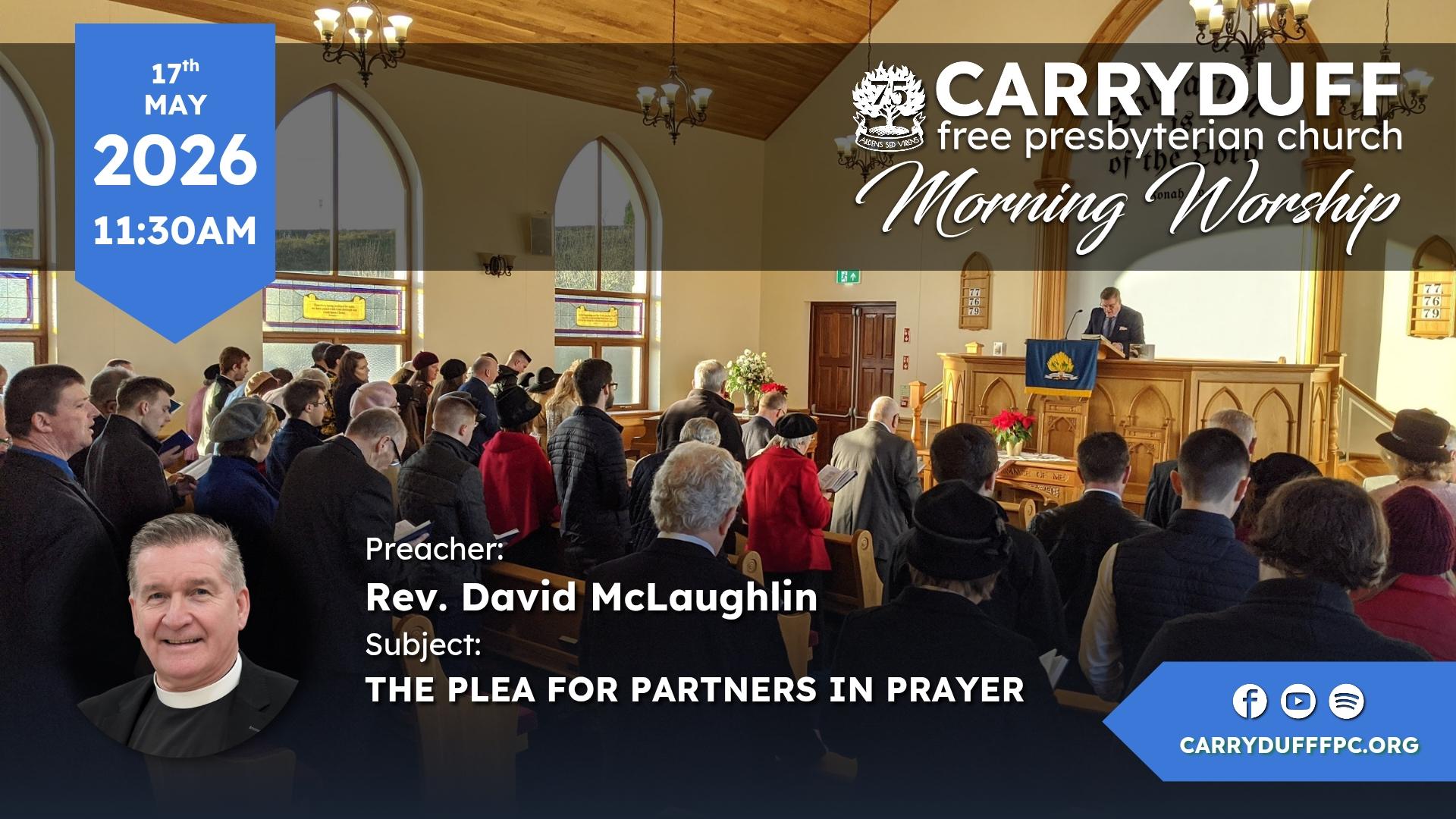

Date: SUN 11:30am 17th May 2026
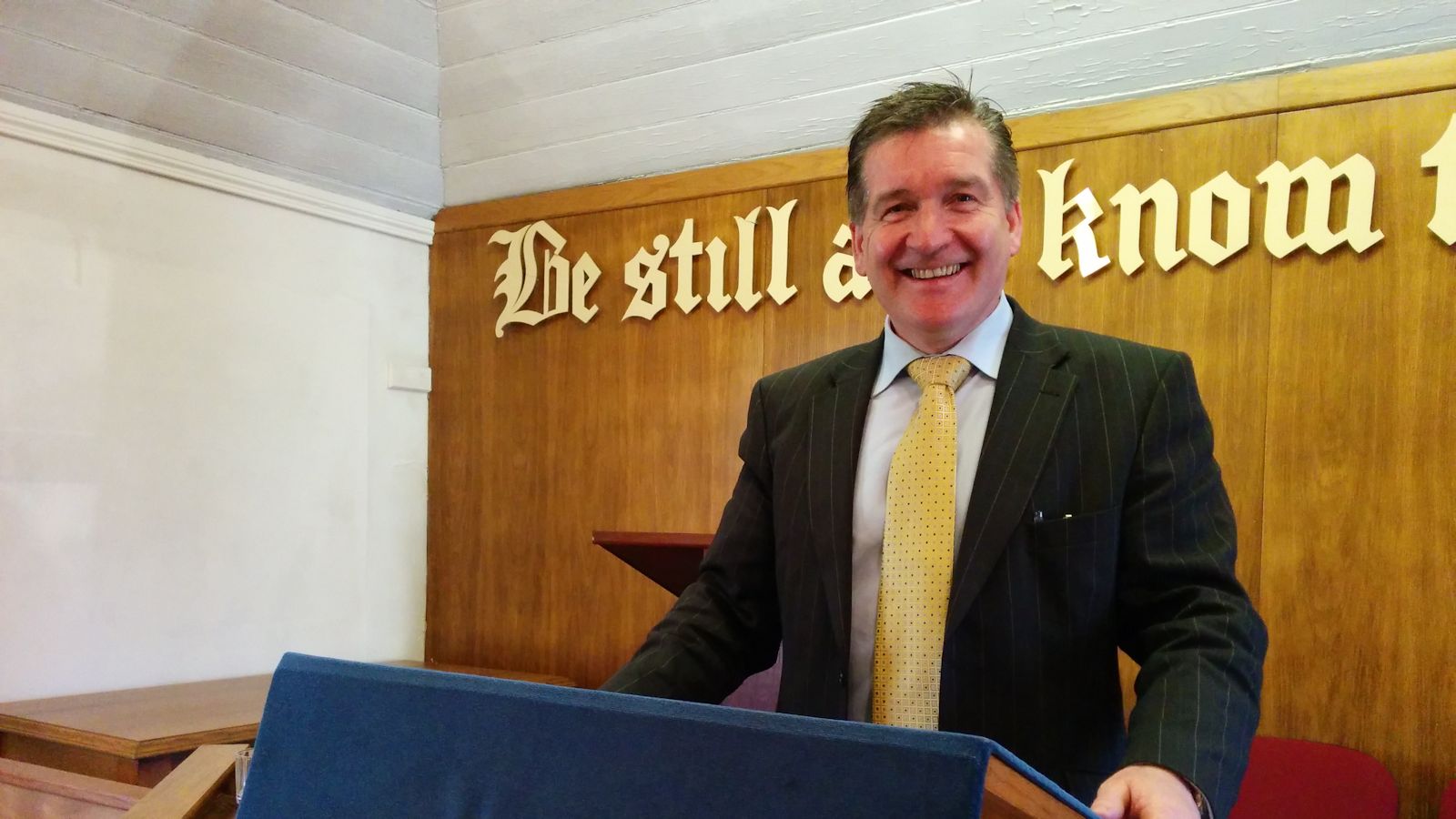
Preacher: Rev. David McLaughlin
Bible Reference: 1 Thessalonians 5:25
Podcast
Sermon Summary
The advancement of the Gospel of Jesus Christ and the ongoing life of the Church of God are not sustained by human talent, worldly personality, academic intellect, or the sophisticated organisation of man. Rather, the work of God is sustained in its entirety by the sovereign grace of God, manifested through the fervent, believing prayers of His people. In an age characterised by a frenetic pace of activity and a startling lack of spiritual depth, it is imperative that we pause to reflect upon the biblical mandate found in 1st Thessalonians 5:25: “Brethren, pray for us.”
These four simple words, penned by the great Apostle Paul as he brought his first letter to the Thessalonians to a close, open a window into the heart and mind of a man who was arguably the most significant figure in the history of the early church. Yet, this mighty preacher to the Gentiles, this tireless church planter, this sound theologian, and this faithful missionary—the man whom the Holy Spirit used to author fourteen of the twenty-seven books of our New Testament—did not view himself as a self-sufficient spiritual giant. Instead, he humbly and genuinely asked for the intercession of the ordinary believers in Thessalonica. If an inspired apostle, so richly endowed with the gifts of the Spirit and so intimately acquainted with the trials of the ministry, felt the profound necessity of the prayers of the saints, how much more must the pastors, missionaries, evangelists, and church workers of our own day depend upon the intercession of God’s people?
I. The Apostolic Example of Spiritual Realism
When we read the exhortations of Paul in the fifth chapter of 1st Thessalonians, we find a series of short, straightforward commands that govern the life of the church. Following these, Paul offers a prayer for the sanctification of the believers, asking that their “whole spirit and soul and body be preserved blameless unto the coming of our Lord Jesus Christ” (v. 23).
Immediately following this, Paul turns his focus toward himself and his fellow labourers: “Brethren, pray for us.” This is not a man speaking from a position of vanity or seeking applause for his accomplishments. It is a manifestation of spiritual realism. Paul understood that the advancement of the Gospel depends upon the mighty power of God alone. He knew that God, in His sovereign will, dispenses that power through the prayers of His people.
- The rejection of self-sufficiency: Paul, despite his immense theological attainments, recognised his absolute dependence on God.
- The reality of the ministry: The advancement of the kingdom is not a human work, but a divine work that requires divine power.
- The danger of prayerlessness: A church that does not pray for its leaders is a church that lacks purpose and spiritual vigour.
We live in a day where far too many congregations are prone to criticising their ministers more than they call upon God for them. Yet, the Scriptures command believers to uphold God’s servants before the throne of grace. If you believe that a praying church is a powerful and purposeful church, then you must accept that the opposite is also true: a prayerless church is a parlous church, a purposeless church. Will we take these four words to heart? Will we put them into practice?
II. The People Addressed: The Family of God
In considering our text, we must first look at the word “brethren.” This is not an address to a particular denomination; it is not a reference to the Presbyterian Church, the Methodist Church, or any other institution defined by bricks and mortar. The prayer life of the church is not merely the duty of a select few, such as the elders or the deacons; it is the privilege and responsibility of the whole church family—those whom God has called out to repentance and faith in Jesus Christ.
The term “brethren” indicates a family. As Paul writes in Ephesians 3:14–15, “Of whom the whole family in heaven and earth is named.” The question that must be asked of every soul this day is: “Is God your Heavenly Father?”
- The nature of the new birth: Being born again is not hereditary, nor is it of the will of man, but of God.
- The evidence of conversion: True believers, like the Apostle Paul in Acts 9:11, are marked by a life of genuine communion with God.
- The privilege of adoption: Through the blood of Christ, believers are adopted into God’s family and granted the privilege to cry, “Abba, Father.”
It is a tragedy that today, not everyone who professes the name of Christ is regenerate. There are many religious people who are not in Christ, who have never been born again, and who cannot truly address God as their Heavenly Father. This is why we must renounce the false ecumenism that seeks to unite religious bodies—whether Roman Catholicism, Islam, Buddhism, or apostate Protestantism—in joint worship. Such ecumenism is an abomination in the sight of God. As Isaiah 59:1–2 warns, if one is not in a true relationship with God, their iniquities have separated between them and their God, and He will not hear them. Real, genuine prayer is confined to the true church of born-again believers, who approach the throne of grace solely through the merits and in the name of the Lord Jesus Christ.
III. The Petition Requested: The Necessity of Intercession
Notice the second word of our text: “pray.” Paul does not ask for money, nor for admiration, nor for acceptance. He is not asking for his ego to be stroked. He is asking for prayer.
The true pastor is not a religious performer detached from his congregation. He is a brother among brethren, a member of the body of Christ. He is not superhuman. James 5:17 reminds us that even Elias was a “man subject to like passions as we are.” Ministers grow weary, both physically and mentally. They face many temptations and battles with discouragement—often from those they least expect.
- The reality of spiritual warfare: Faithful preachers are strategic targets of the devil.
- The vulnerability of the shepherd: If Satan can wound the shepherd, he can effectively destroy the sheep.
- The power of intercession: Prayer is the greatest contribution the church can make to the gospel ministry.
The plea “brethren, pray for us” is a vital call for the congregation to support their minister. You may feel that you cannot preach, that you cannot travel as a missionary, or that you cannot give large sums of money. But every born-again Christian can pray. True prayer moves the hands of God. Acts 12 provides a remarkable example: James had been beheaded, and Peter was in prison awaiting execution. Yet, “prayer was made without ceasing of the church unto God for him” (v. 5). The result was that God sent an angel to deliver Peter. The praying church can accomplish what political influence, human strength, and human ingenuity can never do, because true prayer supplies divine, spiritual power.
IV. The Principle Included: Responsibility and Holiness
The request for prayer includes not only the minister but all the faithful labourers in Christ. We are to pray for the minister’s personal holiness and his walk with God. We are to pray for his family, and for his faithful preaching of the blood, in the power of the Holy Spirit.
- The need for spiritual oil: A sermon without prayer is like a lamp with no oil; it may have the structure of beauty, but it lacks the heavenly flame.
- The necessity of protection: Ministers are open to criticism from friend and foe; they require the protection of God as they guide the flock.
- The responsibility of the congregation: Hebrews 13:17 reminds us that ministers watch for souls as they that must give account.
We must also pray for wisdom as the minister guides and guards the flock of God. We must pray for his protection. Paul prayed for deliverance from “wicked and unreasonable men” (2nd Thessalonians 3:2). A minister cannot please everyone, and if he tries, he will end up pleasing nobody. Our goal must be faithfulness to Christ. We should pray for a spirit of “stickability”—for endurance.
There is a fearful responsibility in being a minister. Every soul in the congregation is one for whom the minister must give an account. We should pray for them to be spiritually bold—that utterance might be given unto them that they might open their mouth boldly to declare the counsel of God. We must pray for holy zeal and a passion for souls, for preaching is a matter of life and death.
V. The Power Released: The Engine Room of the Church
Finally, consider the power that is released through prayer. We know that God is sovereign; we know that the God who ordains the ends also ordains the means. He ordains the salvation of His people, and He ordains the preaching of the Gospel. But He also ordains the instrument of prayer. Ezekiel 36:37 declares: “I will yet for this be enquired of by the house of Israel, to do it for them.”
- Protection of the ministry: Prayer protects the pulpit from the influence of false doctrine and satanic opposition.
- Advancement of the work: The church advances on its knees; mission work at home and abroad relies upon the “ropes” of prayer.
- Fruitfulness in the Gospel: Prayer is the mechanism by which God brings about the conversion of souls and the planting of new churches.
This is what strengthens preaching, protects the ministry, and brings about our deliverance. We are facing satanic warfare. We are in a battle with the devil, with false doctrine, with cults, and with the discouragement of the world. Satan hates the preaching of the Word of God; he hates the exaltation of Christ; he hates the exposing of sin. He tries to destroy the gospel ministry because he hates the salvation of souls. Thus, prayer not only strengthens the ministry, but it also protects it.
Furthermore, it produces fruit. When we pray, prayer moves the hand that holds the world. God works through prayer. The church’s purity is maintained, its power is bestowed, and its perseverance is explained by the goodness of God through prayer. How do we exist for decades, and how does the church continue through the centuries? We exist because God is keeping and protecting His people in response to their prayers.
In the time of Charles Spurgeon, when he ministered to 6,000 people every Sunday at the Metropolitan Tabernacle, he once brought his students to the church and asked them if they wanted to see the secret of the church’s success. They expected to see the central heating system, but he took them down to the boiler house. There, they found 400 to 600 people in the basement, pouring out their hearts to God in prayer. He told them, “This is the engine room of the church.”
The people addressed represent the family and unity of God. The petition requested is the act of intercession. The principle included is the necessity of praying for those who labour in the Word. And the power that is released is the sovereign power of the Almighty, moved by the cries of His children.
I leave this message with you today. Take it to heart. Let us look to God for help in the work of the ministry. Let us be a people who do not merely profess the name of Christ, but who walk in the reality of His power. Let us meet at the throne of grace, knowing that “faithful is he that calleth you, who also will do it” (1st Thessalonians 5:24).