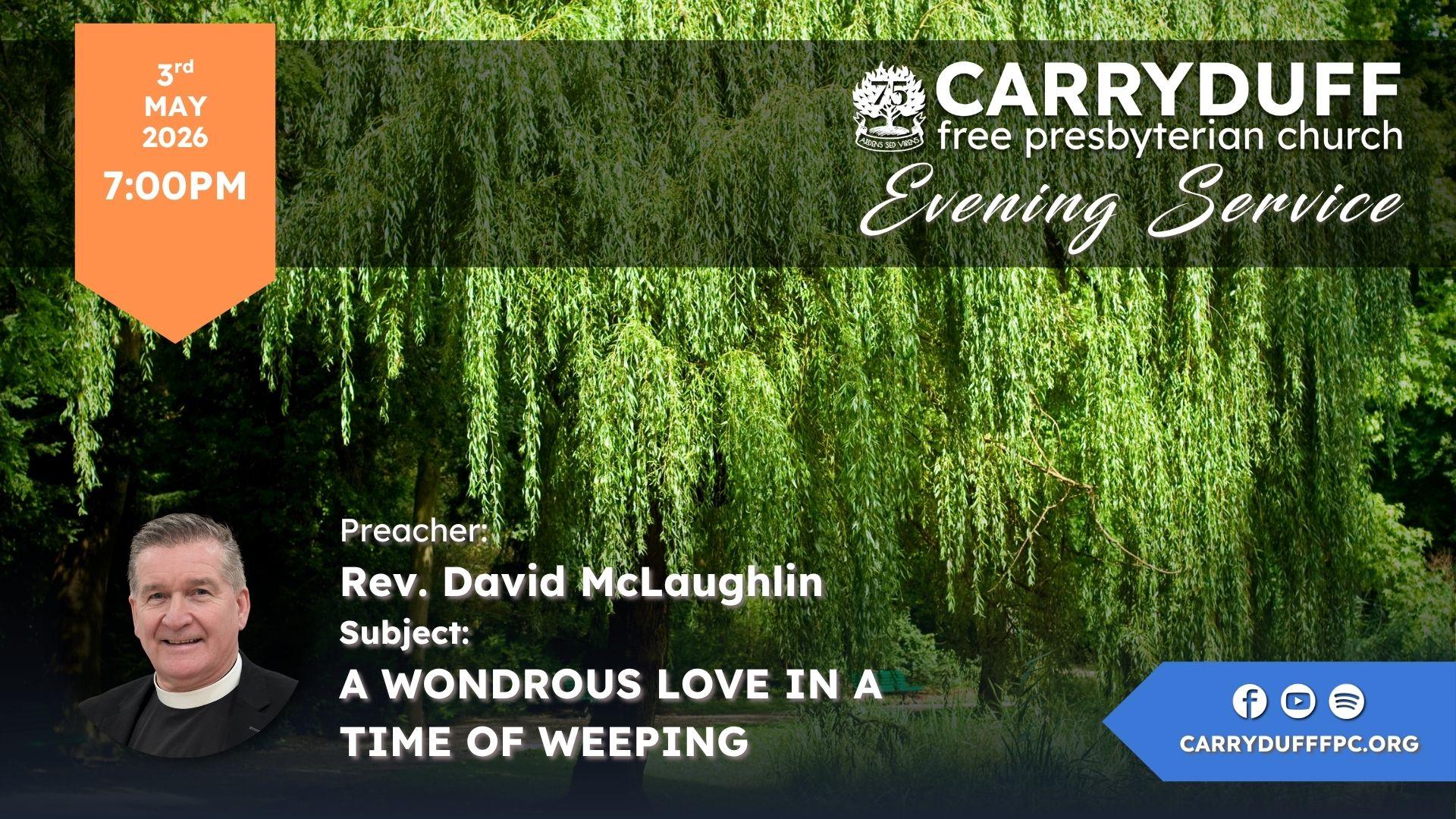

Date: SUN 7:00pm 3rd May 2026
Preacher: Rev. David McLaughlin
Bible Reference: 2 Samuel 1:26
Podcast
Sermon Summary
The sermon delivered on 2 Samuel 1:26 serves as a profound, biblically grounded meditation on the intersection of human grief, divine providence, and the covenantal love displayed through the life, death, and friendship of Jonathan and David. From a Reformed perspective, the message is not merely a eulogy for a fallen prince but a theological treatise on how God uses the bonds of human friendship to manifest His own character, to provide means of grace to His people, and to point toward the ultimate, everlasting friendship of the Lord Jesus Christ. By examining the narrative through the lens of Scripture, the preacher invites us to consider the sanctity of grief, the sovereignty of God in orchestrating relationships, and the absolute necessity of anchoring our hope in the righteousness of the Redeemer.
The Sanctification of Grief in a Fallen World
The sermon begins with an exegesis of David’s lamentation, a passage that captures the raw, unfiltered agony of a man whose heart was deeply entwined with his closest companion. The preacher rightly posits that the Bible does not demand a stoic suppression of emotion. Rather, it grants permission to grieve. In the Reformed tradition, we understand that grief is not a symptom of unbelief; it is a testament to the fact that we were created for communion and that this communion has been cruelly fractured by the fall.
Death is an intruder. It was never a part of the original, pristine creation; it entered the world as a consequence of the disobedience of the first Adam. Romans 5:12 and 6:23 remain the foundational texts for our understanding of mortality: sin is the parent of death, and death is the wages of sin. When we experience the death of a loved one, we feel the sharp, unnatural sting of this reality. The preacher argues that the believer’s grief is distinct from the sorrow of the world because it is lived out in the light of the gospel. While the world grieves with no anchor, the believer grieves with the assurance of the resurrection. Revelation 14:13 provides the ultimate comfort: “Blessed are the dead which die in the Lord from henceforth: Yea, saith the Spirit, that they may rest from their labours; and their works do follow them.”
The sermon correctly identifies that deep, godly love always results in deep grief. If we love as Christ calls us to love—with loyalty, self-sacrifice, and commitment—then the separation caused by death will necessarily bring distress. This distress is not sinful; it is a mark of the tenderness that grace produces in the heart. The closer the friendship, the more profound the loss, and the more keenly we feel the absence of the one who walked beside us.
The Providential Design of Human Relationships
Perhaps the most significant theological contribution of the sermon is its emphasis on the doctrine of providence. Within Reformed theology, we affirm that God is the architect of all things. He does not merely oversee the broad, epochal movements of history; He is intimately involved in the specific, daily encounters of His people. The friendship between David and Jonathan was not an accidental occurrence of two men meeting by chance. It was a covenantal bond ordained by God to shape David for his future kingship and to sustain him during his trials.
The preacher contends that God intentionally knits people together into our lives to serve as instruments of grace. The friends, mentors, and brothers-in-arms we encounter are gifts from the hand of God, designed to sharpen our character, correct our errors, and encourage us toward holiness. Using his own testimony of conversion, the preacher demonstrates how God used a quiet, faithful man—Andy Alexander—as a means of grace to draw an aimless, rebellious apprentice to the foot of the cross. This illustrates the Reformed view of the “means of grace.” While we typically think of the Word, the sacraments, and prayer, the preacher broadens our understanding to include those saints who, by their godly conduct and loyal friendship, act as mirrors reflecting the character of Christ to us.
True friendship, as described in Proverbs 17:17 and 18:24, is defined by constancy. A friend loves at all times, and a brother is born for adversity. In a world characterized by shifting loyalties and superficial connections, the covenantal friendship of David and Jonathan stands as a beacon. It was a relationship characterized by self-abnegation—Jonathan, the heir to the throne, willingly surrendered his own rights to support the one anointed by God to succeed his father. This is the hallmark of grace: putting the welfare of another above one’s own earthly ambition.
The Pleasantness and Wondrous Nature of Covenant Love
The sermon explores the descriptive language used by David in his lament: “very pleasant hast thou been unto me; thy love to me was wonderful.” The preacher highlights that David was not engaging in a mere sentimental recollection but was delighting in the purity, the sweetness, and the steadfastness of Jonathan’s love. This love was “wonderful” because it was sacrificial. Jonathan stood by David even when it prompted the wrath of his father, King Saul. He was a protector, a confidant, and a constant companion.
From a Christocentric perspective, the preacher masterfully argues that all such displays of earthly love are but shadows of the greater reality found in Christ. If the love of Jonathan for David was wonderful, how much more wonderful is the love of the Saviour for His people? The sermon directs the congregation to the ultimate Covenant Friend. Jesus Christ is not merely our Prophet, Priest, and King; He is our Beloved and our Friend. He is the one who ate with tax collectors and sinners, who called His disciples friends, and who demonstrated the ultimate sacrifice by laying down His life for those who were once His enemies.
The sermon draws a compelling parallel between Jonathan’s gift of his royal garments to David and Christ’s substitutionary work. Just as Jonathan clothed David with his own royal identity, Christ took upon Himself the “garments” of our sin and unrighteousness at the cross. He bore our guilt so that we might be clothed in His perfect righteousness. This is the heart of the gospel: the Great Exchange. We were not fit to enter the presence of the Father, but through the covenantal love of Jesus, we are granted pardon, protection, and provision. The friendship of David and Jonathan serves to heighten our appreciation for what Christ has done for us, for there is no love that can compare to the love of the Redeemer.
The Call to Gospel Fidelity
The concluding exhortation of the sermon is a direct challenge to the congregation’s spiritual vitality. The preacher warns against the dangers of coldness and worldliness, which are the natural consequences of a heart that has lost sight of the love of Christ. If we do not hunger for the Word, if we do not find joy in the gathering of the saints, and if we do not pursue a life of active obedience, we are providing evidence that we have become distracted by the fleeting allurements of the age.
The remedy for such spiritual malaise is a fresh sight of Christ. We need to be reminded that our lives are not random. Our spans are numbered, our paths are ordered, and our friendships are set by a Sovereign God. In the face of bereavement or any other form of adversity, the Christian is called not to a state of passive resignation, but to a state of active, resting trust. We are to say with Job, “The Lord gave, and the Lord hath taken away; blessed be the name of the Lord.” This is the response of a heart that understands the purposeful sovereignty of God—a God who is present in the hours of grief and who is the author of our legacy.
Finally, the sermon challenges every listener to examine the foundation of their hope. Have you turned from your sin? Have you believed in the Lord Jesus Christ? The call is not to perform better or to try harder, but to believe in the One who has already accomplished everything necessary for our reconciliation with the Father. To know Christ is to know the greatest Friend a sinner can have, a Friend who sticks closer than a brother and whose love passes all understanding.
Theological Reflection and Conclusion
This sermon provides a robust and necessary framework for navigating the complexities of human relationships within the context of the kingdom of God. By centering the exposition on 2 Samuel 1:26, the preacher successfully moves the conversation beyond mere sentimentality and into the realm of covenant theology. He reminds us that our relationships are not autonomous from our faith; rather, they are a primary context in which our faith is tested, refined, and expressed.
The Reformed perspective is evident throughout the message: the sovereignty of God is upheld in the ordering of friendships; the total depravity of man is acknowledged as the reason we are in such desperate need of the Saviour; the sufficiency of Christ is proclaimed as the only ground of our hope; and the sanctifying power of the Holy Spirit is emphasized as the means by which our hearts are made tender toward both God and neighbour.
In a culture that often views friendship through a utilitarian or hedonistic lens, this sermon offers a counter-cultural, biblical alternative. Friendship is not about what we can extract from others for our own benefit; it is about how we can serve as channels of divine grace to those around us. It is about the covenantal commitments we make to one another, reflecting the eternal covenant of grace that God has established with His people in Christ.
As we conclude this summary, we are left with the enduring image of David mourning his friend—not as one without hope, but as one who felt the weight of a world that was broken, while simultaneously looking forward to the rest that awaits the people of God. The sermon effectively captures the tension of the Christian life: we dwell in a fallen world where death separates, yet we are united to an eternal Friend who has conquered death and who promises that we shall be reunited with all those who have died in Him.
This message is a call to holiness, a call to intentionality in our relationships, and above all, a call to gaze upon the beauty of the Lord Jesus Christ. It serves as a reminder that every instance of earthly love is a pointer to the source of all love. When we lose a friend, we feel the ache; but in that ache, we are meant to find a deeper hunger for the One who will never leave us nor forsake us. The providence of God is seen in the people He brings into our lives, and His grace is seen in how He uses those people to prepare us for the day when we shall see Him face to face.