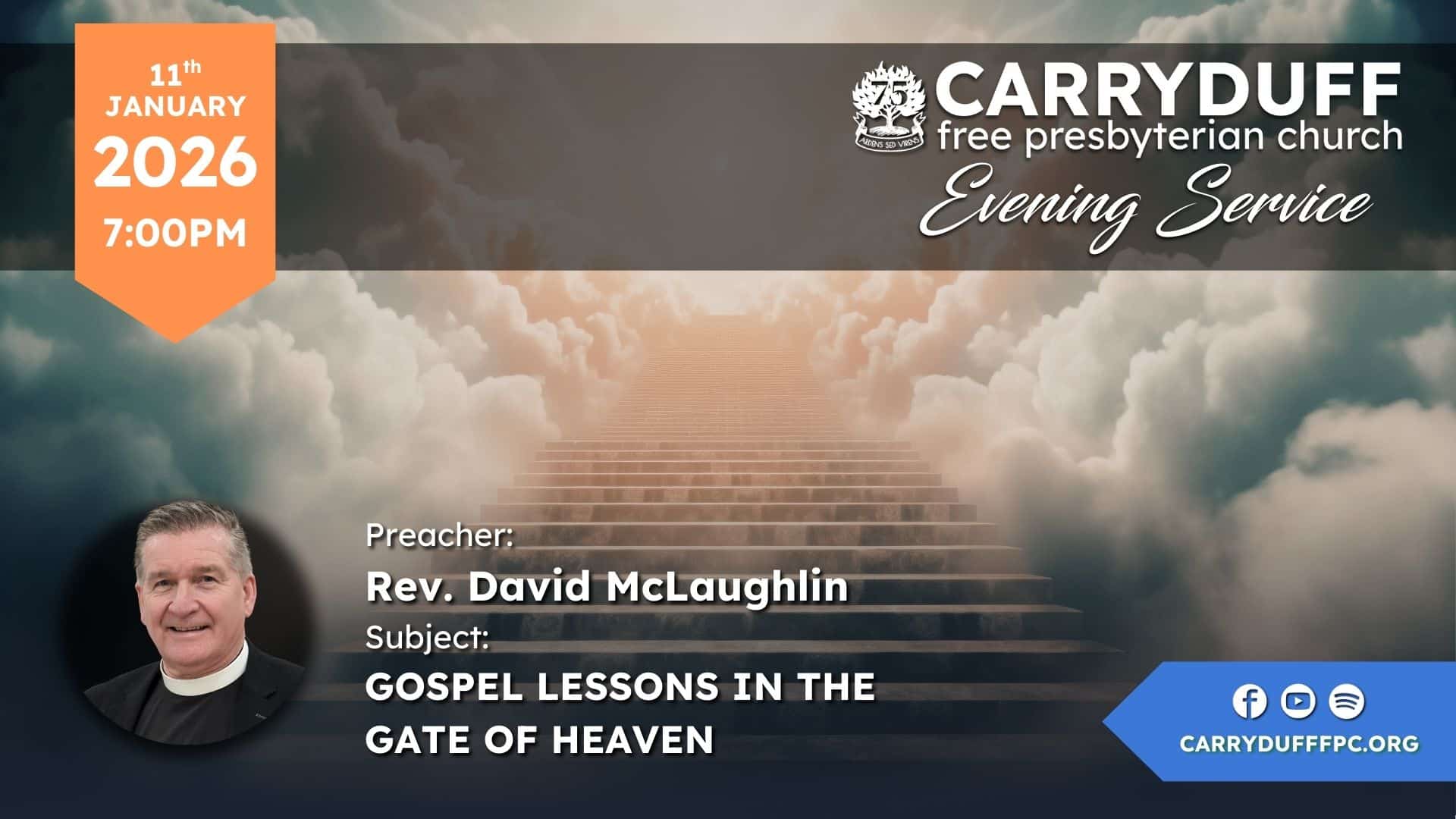

Date: SUN 7:00pm 11th January 2026
Preacher: Rev. David McLaughlin
Bible Reference: Genesis 28:17
Podcast
Sermon Summary
The preacher begins by reading the full passage, which recounts Jacob’s flight from Beersheba towards Haran. Jacob, a fugitive in his forties after deceiving his brother Esau and father Isaac to steal the birthright and blessing, is alone, empty-handed, and vulnerable. He stops for the night, using stones as a pillow, and falls asleep under the open sky.
In this desperate state, God sovereignly intervenes with a dream: Jacob sees a ladder (or stairway) set upon the earth, its top reaching heaven, with the angels of God ascending and descending upon it. At the top stands the Lord, who reaffirms the Abrahamic covenant promises to Jacob — the land, innumerable descendants spreading in all directions, blessing to all families of the earth through his seed, and God’s constant presence, protection, and guidance until the promises are fulfilled.
Jacob awakens in awe and terror, declaring the place holy: the Lord is present though he had not realised it, making it the house of God and the gate of heaven.
The preacher draws three main gospel lessons from this “gate of heaven”:
1. A vital revelation: the vast separation between earth and heaven, bridged by one way — Christ.
There is an immense gulf between earth and the third heaven (God’s dwelling place), far beyond the visible skies or galaxies. Sin has fixed an unbridgeable chasm (as in the rich man and Lazarus in Luke 16). No human effort can cross it.
The ladder represents not man’s ascent to God, but God’s initiative in coming down to man. Heaven is open and active. Jesus Himself interprets this in John 1:51, telling Nathanael that he will see angels ascending and descending upon the Son of Man — identifying Christ as the ladder/stairway.
Thus, the gate of heaven is not a physical location, church, ritual, or human merit, but a person: the Lord Jesus Christ. He is the sole mediator (1 Timothy 2:5), the only way (John 14:6), and salvation is by grace alone through faith in Him alone. Multiple “gates” or ways promoted by false religions contradict Scripture.
2. A recording that is deeply instructive: God’s grace comes to the unsaved sinner.
Notably, God identifies Himself as “the Lord God of Abraham thy father, and the God of Isaac” — but omits Jacob’s name. At this point, Jacob (aged around 40) is not saved; he is a deceiver with no fear or love for God. He had heard God’s voice before (Genesis 26:24) but it meant nothing until now.
God takes the initiative in sovereign grace, speaking directly without rebuking Jacob’s sins. Jacob realises he has been unaware of God’s presence. The preacher stresses that faith comes by hearing God’s Word (Romans 10:17), and salvation is receiving Christ as Lord and Saviour (John 1:12). He illustrates this with a story of a dying soldier in World War I who finds peace through John 3:16, and another of a man who reluctantly attends church and is converted by the invitation to “come just as you are.”
3. A realisation that is profoundly illustrative: true conversion brings change and commitment.
Jacob’s life is transformed. He rises early, sets up his stone pillow as a pillar, anoints it with oil, and names the place Bethel (“house of God”). He vows: if God keeps His promises (presence, provision, safe return), then the Lord will be his God, the pillar will be God’s house, and he will give a tenth.
This vow is not to earn favour but a response of faith to grace — immature perhaps, yet real. The rascal becomes redeemed; separation from God ends. The preacher likens this to rags made clean (as in a story of Queen Victoria), symbolising cleansing by Christ’s blood.
The sermon concludes with an urgent appeal: Do you know Jesus Christ as the only ladder to heaven? Have you received Him by faith, experienced a changed life, and committed to live for His glory — not to earn salvation, but in loving response?