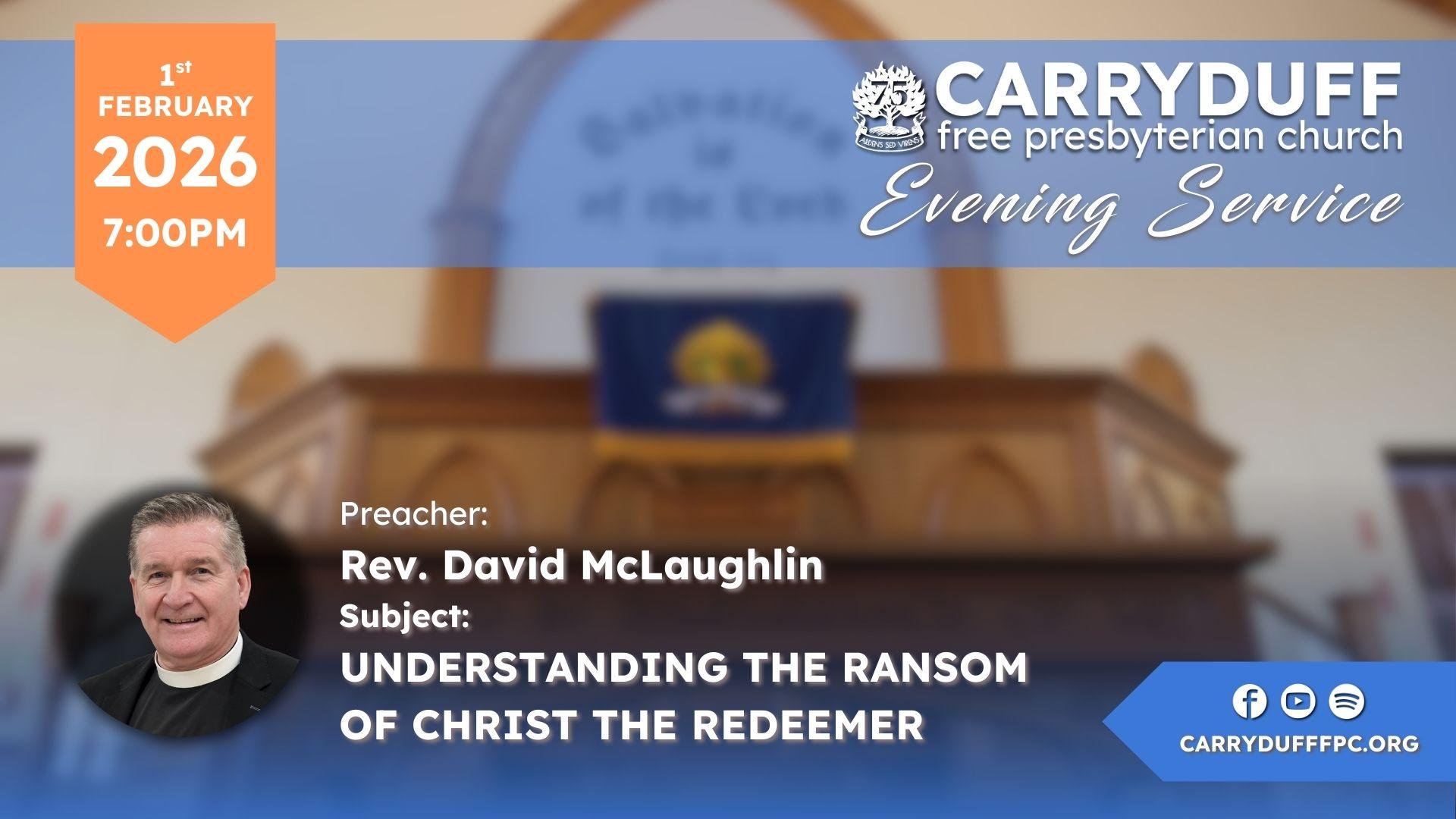


Date: SUN 7:00pm 4th January 2026
Preacher: Rev. David McLaughlin
Bible Reference: Job 14:14
Podcast
Sermon Summary
(Text: Job 14:14 – “If a man die, shall he live again? All the days of my appointed time will I wait, till my change come.”)
Delivered on the first Lord’s Day evening of 2026, this sermon draws from Job chapter 14, particularly verses 1–14, to explore the profound reality of human life as a divinely appointed, finite span marked by frailty, suffering, and ultimate purpose.
Context of Job’s Words
The preacher introduces Job as an upright, God-fearing man from the land of Uz who endured unimaginable sorrow. Job spoke these words amid deep personal grief, having lost all ten of his children in a catastrophic collapse of a house during a storm (Job 1:18–19). He also suffered severe physical affliction. In the midst of such agony, Job wrestles with the great question: “If a man die, shall he live again?” Yet, even in despair, he expresses resolute hope: throughout his “appointed time” he will wait for the “change” that God will bring.
The preacher connects this ancient grief to contemporary tragedies, urging prayer for bereaved families and referencing recent disasters (e.g., a ski-resort incident and sudden deaths of young people), reminding the congregation that suffering can tempt us to view life as random or meaningless. The Bible, however, teaches the opposite: life is neither accidental nor aimless but a sovereignly appointed period under heaven.
Main Theme: Man’s Appointed Time Under Heaven
The sermon structures its exposition around Job’s declaration in verse 14, identifying four key aspects:
- The Fact of an Appointed Time
Every human life has a fixed, God-determined duration. Drawing on Job 7:1, Acts 17:26, Psalm 90:12, James 4:14, and Hebrews 9:27, the preacher emphasises that our days are numbered like those of a hireling whose hours are set by his employer. Birth, death, and every intervening moment – joy, sorrow, health, sickness, labour, and rest – fall within God’s appointment. Nothing lies outside His sovereign decree. This “dash” between date of birth and date of death on a gravestone represents the entirety of one’s allotted span. - The Focus of an Appointed Time
God alone is the Appointor. He fixes lifespans not in cruelty but in wisdom and purpose. Life is brief – likened to a vapour (James 4:14) or a flower cut down (Job 14:2) – and fragile. Death is certain and appointed (Hebrews 9:27), often sudden and unpredictable, as illustrated by tragic accidents and untimely deaths. Yet this appointed time is preparatory: its chief purpose is to prepare us to meet God (Amos 4:12). We exist to glorify God, to be reconciled to Him through repentance and faith in Christ, and to be born again by His Spirit. - The Fruit of an Appointed Time
How one responds to this appointed span reveals the state of the heart:- The ungodly waste it, living selfishly and neglecting God and salvation.
- The unregenerate often resent it, murmuring against their circumstances and questioning God’s wisdom.
- The regenerate, like Job, wait for it in faithful submission, trusting that death is not the end but a “change” leading to resurrection and eternal life.
- The Finality of an Appointed Time
Every life has a beginning, a course, and an inescapable end followed by judgement (Hebrews 9:27). Time moves relentlessly onward, whether we acknowledge it or not. The urgent question is not how long we shall live, nor how successful or wealthy we become, but: Are you prepared to meet God? Have you repented of sin and trusted in Christ alone for salvation?
Gospel Hope and Conclusion
The preacher closes with the hope of the resurrection grounded in Jesus Christ, who entered our world with His own appointed time – to be born, to live, to die on the cross for sins, and to rise bodily from the dead. Christ’s resurrection guarantees that believers who die in Him shall live again. Death for the Christian is not final separation but a glorious “change” – reunion with loved ones and eternal joy in God’s presence.
The sermon ends with a solemn appeal: time is ticking silently and steadily. Do not waste, resent, or ignore your appointed time. Behold, now is the accepted time; now is the day of salvation. The preacher invites any seeking help to speak with him, offering pastoral care in the Lord’s name.