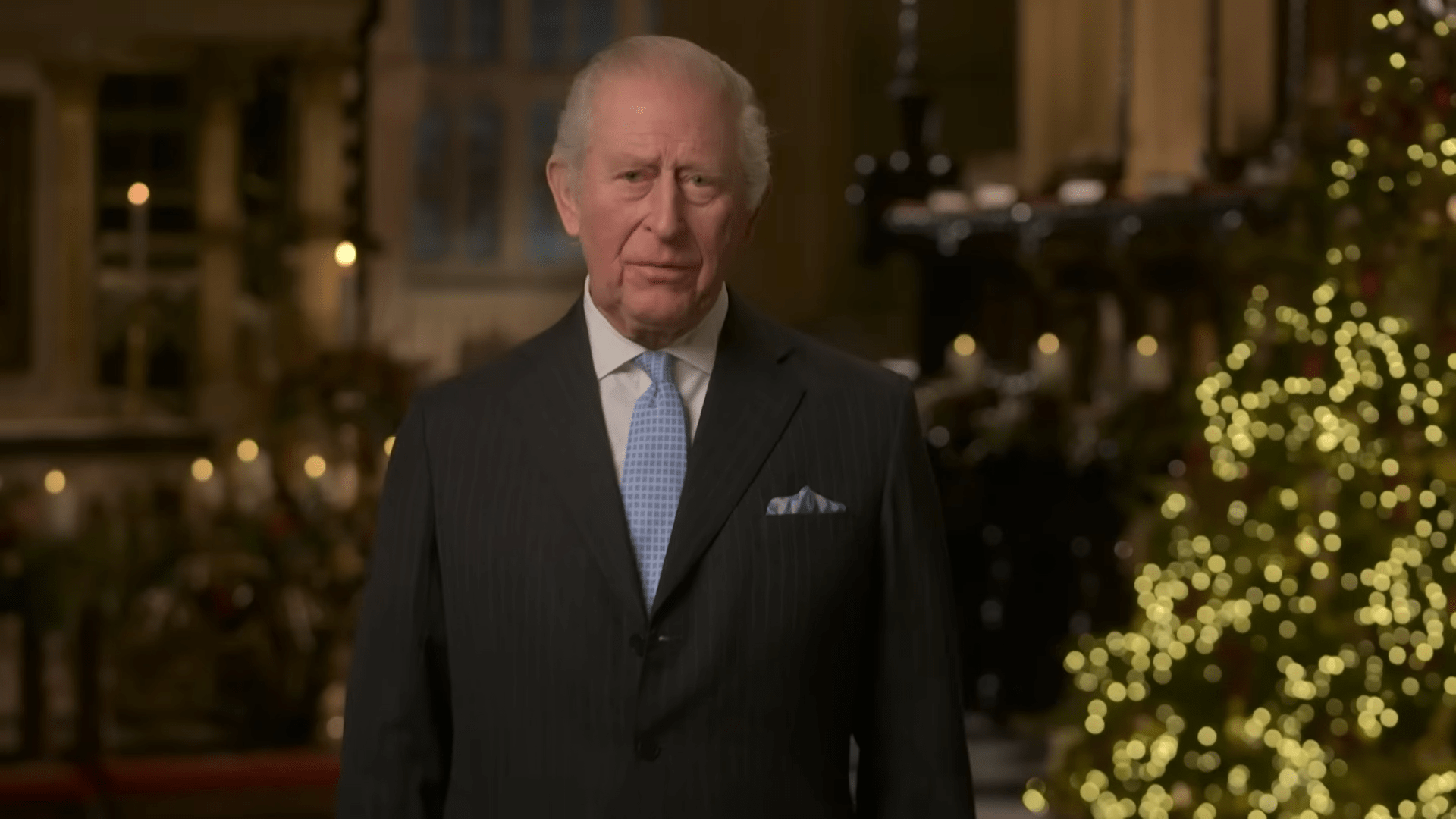

Each year, the Christmas address from the monarch serves as a mirror of the moral and spiritual state of our nation. There was a time when this address resounded with clear affirmation of the faith “once delivered unto the saints.” Today, however, it has become a polished meditation on human virtue and common goodwill—a doctrinally neutral message designed to offend no one, and therefore to instruct no one.
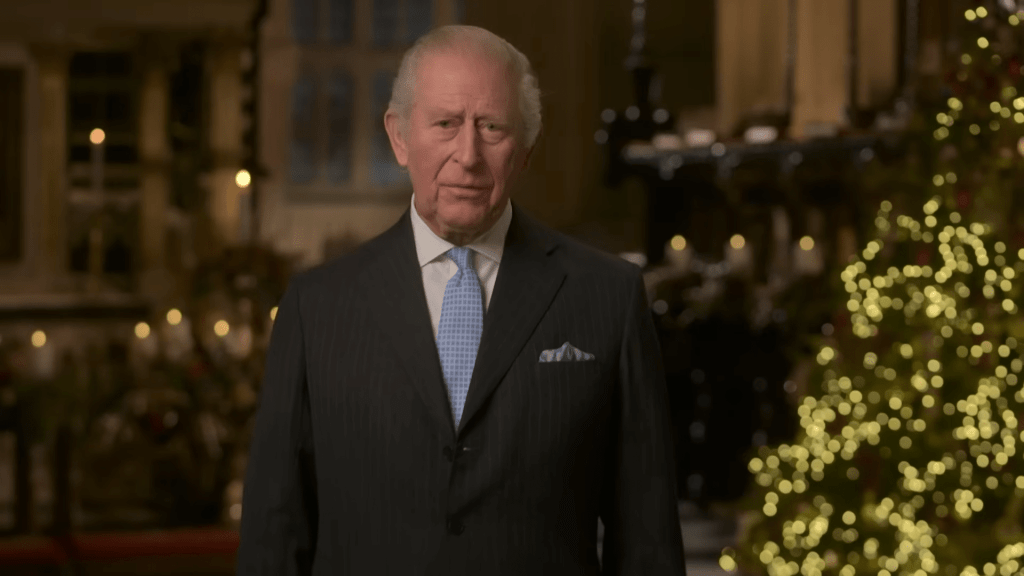
His Majesty’s recent Christmas message exemplified this tragic drift. Though filled with grace of diction and noble moral sentiment, it carried the unmistakable tones of an ecumenism divorced from truth. The King spoke tenderly of the “pilgrims of hope,” of unity among “all the great faiths,” of “shared values,” and of “respect for all life.” These phrases, elegant though they be, reduce the Gospel of Christ to moral poetry—to the “form of godliness” that denies the power thereof (2 Timothy 3:5).
The So‑Called “Spiritual Unity”
Early in his speech, the King recalled with pleasure his “historic moment of spiritual unity” with Pope Leo at the Vatican. Yet one must ask: unity upon what foundation? Modern ecumenism prefers sentiment over substance, speaks of unity devoid of repentance, and replaces doctrine with diplomacy.
Such a concept was alien to the Reformers, and contrary to both Scripture and our Confession. The Westminster Confession of Faith, Chapter 25, Section 2, declares:
“The visible Church… is the Kingdom of the Lord Jesus Christ, the house and family of God, out of which there is no ordinary possibility of salvation.”
This is not mere sectarianism. It is the recognition that truth cannot be shared where falsehood is maintained. Rome and Geneva cannot join hands while holding opposite gospels. As long as the Papal Church denies justification by faith alone, exalts human merit, and enthrones another mediator beside Christ, true spiritual unity remains impossible without betrayal of the Gospel.
The Holy Scripture confirms it with force:
“Neither is there salvation in any other: for there is none other name under heaven given among men, whereby we must be saved.” (Acts 4:12)
Unity without truth is not peace but surrender.
Pilgrimage Reinterpreted
His Majesty built his message around the word “pilgrimage.” Yet he spoke not of a journey toward celestial glory, but of mankind’s collective advance toward mutual understanding and shared virtue—a moral pilgrimage, not a spiritual one.
The Bible speaks otherwise. The believer’s pilgrimage is not toward enlightenment through human cooperation but toward the holy city of God, attainable only by faith in Christ. “For here have we no continuing city,” wrote the Apostle, “but we seek one to come.” (Hebrews 13:14) And again, “These all died in faith… and confessed that they were strangers and pilgrims on the earth.” (Hebrews 11:13)
The WCF, Chapter 14, Section 2, explains the nature of such faith:
“By this faith, a Christian believeth to be true whatsoever is revealed in the Word, for the authority of God Himself speaking therein… yielding obedience to the commands, trembling at the threatenings, and embracing the promises of God.”
There is no hint here of spiritual pluralism. The Christian pilgrim marches not “with all the faiths,” but follows one Shepherd by one road.
“Enter ye in at the strait gate,” said our Lord, “for wide is the gate, and broad is the way, that leadeth to destruction… Because strait is the gate, and narrow is the way, which leadeth unto life, and few there be that find it.” (Matthew 7:13‑14)
The Shadow of Modern Religion
The King’s reference to “deep wells of hope treasured by all the great faiths” illustrates the heart of the present decay. The modern pulpit seldom denies Christianity outright—it simply makes it unnecessary. Faith becomes a virtue irrespective of its object; piety, a sentiment divorced from truth. But the object of faith is everything. The WCF, Chapter 1, Section 6, states:
“The whole counsel of God concerning all things necessary for His own glory, man’s salvation, faith, and life is either expressly set down in Scripture, or by good and necessary consequence may be deduced from Scripture.”
No creed outside of Scripture can provide “wells of hope.” Every man‑made religion, however cultured, is a broken cistern that can hold no water.
“For other foundation can no man lay than that is laid, which is Jesus Christ.” (1 Corinthians 3:11)
Yet this is the crisis of our civilisation: we have retained religion’s vocabulary while exiling its truth.
Queen Elizabeth II and the Faith Once Proclaimed
At this point one cannot help recalling with melancholy gratitude the Christmas messages of the late Queen Elizabeth II. Though restrained by constitutional formality, she spoke often with quiet clarity of her personal faith in the Lord Jesus Christ. Her messages did not merely commend courtesy; they bore witness to conversion.
In 2000 Her Majesty proclaimed: “For me, the teachings of Christ and my personal accountability before God provide a framework in which I try to lead my life.” In 2011, she said, “God sent into the world a unique person – neither a philosopher nor a general… but a Saviour, with the power to forgive.” In 2016 she affirmed: “Billions of people now follow Christ’s teaching and find in him the guiding light for their lives. I am one of them…” , and in 2020 she comforted the nation, “The teachings of Christ have served as my inner light, as I hope they have guided you.”
Such words anchored her hearers in the Gospel, not in moral abstraction. However ceremonial her position, she used it to confess the Name above every name. Her speeches were not theological treatises, yet their centre was unmistakably Christ the Saviour of sinners.
How different the tone now. Where Queen Elizabeth II spoke of a Redeemer, King Charles III speaks of a role model. Where she proclaimed divine grace, he extols human kindness. Her faith was particular; his is plural. Her Christ ruled the nations; his joins the pantheon.
We may recall the warning of the aged prophet: “If the foundations be destroyed, what can the righteous do?” (Psalm 11:3)
The Still Point and the Cross
His Majesty drew upon the verse of T. S. Eliot—“At the still point of the turning world”—to counsel calmness amid haste. Yet there is no still point for the soul apart from Christ. Stillness without forgiveness is stagnation, not peace. The one “still point” in human history is the Cross itself, where divine wrath and divine mercy met, and the world was redeemed.
“For Christ also hath once suffered for sins, the just for the unjust, that He might bring us to God.” (1 Peter 3:18)
Apart from that event, all speeches on peace are little more than poetry. The King’s exhortations to “get to know our neighbours” and “show respect” are noble civic virtues, but they are not the Gospel. They can restrain hatred but cannot reconcile man to God. True peace is vertical before it can ever be horizontal: “Therefore being justified by faith, we have peace with God through our Lord Jesus Christ.” (Romans 5:1)
The Incarnation With and Without the Cross
In his closing paragraphs, His Majesty spoke tenderly of “the one who came down to earth from heaven,” yet he portrayed that coming chiefly as moral inspiration—“the way our Lord lived and died”—without mention of why He died. The modern mind welcomes Christ’s birth and admires His compassion but refuses His atonement. Yet Christmas without Calvary is sentiment without salvation.
“For unto you is born this day in the city of David a Saviour, which is Christ the Lord.” (Luke 2:11)
The WCF, Chapter 8, Section 1, proclaims:
“It pleased God, in His eternal purpose, to choose and ordain the Lord Jesus, His only begotten Son, to be the Mediator between God and man; the Prophet, Priest, and King… the Judge of the world.”
If Christ is merely exemplar, then Christianity is moral philosophy; if He is Saviour, then all the world must bow before Him. “That at the name of Jesus every knee should bow… and every tongue should confess that Jesus Christ is Lord.” (Philippians 2:10‑11)
A Prayer for the King
O Lord, righteous and merciful,
We lift before Thee our sovereign, King Charles III. Grant him the illumination of Thy Spirit, that he may know Thee not as distant Deity but as his own Redeemer. Remind him of the oath he swore at his Coronation—to maintain the Laws of God and the true profession of the Gospel—and strengthen him to fulfil it with holy fear.
Bestow upon him courage to honour Christ above human favour; wisdom to discern truth from error; and humility to confess the Name that is above every name. And upon us as a people, pour out repentance and faith, that we may once more be known as a nation under God.
We ask these things in the precious name of Jesus Christ our Saviour and Lord.
Amen.
The Nature of the Oath and the Breach
The Coronation Oath is not a decorative remnant of medieval liturgy; it is the legal and theological centrepiece of Britain’s constitutional theology. It binds the Sovereign before God and the people to uphold the Protestant settlement grounded in the Reformation and embodied in the Articles of Religion and the Westminster standards that shaped our national conscience.
According to the traditional wording (as affirmed in 1953 and again verbally in 2023):
“Will you to the utmost of your power maintain the Laws of God and the true profession of the Gospel? Will you to the utmost of your power maintain in the United Kingdom the Protestant Reformed Religion established by law?”
That oath is a sacred covenant. To visit the Vatican in “spiritual unity,” to promote multi-faith parity in the public proclamation of Christmas, and to reduce Christ’s Lordship to moral example constitutes a practical renunciation of that covenant. It is not a matter of politics but of fidelity to God.
The Duty of a Godly, Reformed Privy Council
A Privy Council shaped by Reformed theology would act as guardians of the national covenant rather than as mere bureaucrats. Its response to such a breach should be sober, constitutional, and scriptural.
A faithful council would be expected to:
- Admonish the Sovereign Privately: Following the pattern of Nathan before David (2 Samuel 12:1–13), a delegation of senior counselors or bishops should seek audience with His Majesty to reprove the specific acts inconsistent with his oath. The tone should be loyal yet unsparing: correction, not defiance.
- Issue a Public Affirmation of Faith: The Council could reaffirm the Protestant Reformed Faith as established by law. This would not depose the King but remind both Crown and people that constitutional monarchy in Britain is inseparable from the Reformed confession.
- Seek Parliamentary Recognition: In times past, both Lords and Commons publicly reaffirmed the Protestant nature of the Crown (e.g., the Settlement of 1701). A godly Council could petition Parliament to re‑declare this foundation, without necessarily invoking punitive power, but as a national repentance and clarification.
- Call the Churches to Prayer and Fasting: In Scripture, breaches of covenant are not handled by rebellion but by humble national repentance (see Nehemiah 9). The Council would direct the realm to seek God’s mercy upon the Sovereign and nation alike.
- Advise Limitation of Religious Syncretism in Royal Functions: State occasions should return to explicitly Christian form, conducted under the authority of the Protestant Established Church. Multi‑faith ceremonies should be replaced by occasions of thanksgiving grounded in the Gospel.
Scriptural Grounds for Such Action
The Word of God forbids rulers to despise their vows:
“When thou shalt vow a vow unto the Lord thy God, thou shalt not slack to pay it: for the Lord thy God will surely require it of thee.” (Deuteronomy 23:21)
And again:
“It is better that thou shouldest not vow, than that thou shouldest vow and not pay.” (Ecclesiastes 5:5)
The monarch is not exempt from divine jurisdiction. The covenant made in the Coronation Oath is witnessed publicly before the nation and under the blessing invoked by the Archbishop. To break it is not a mere political faux pas; it is perjury before the Almighty.
The Role of the Local Church
In an era when civil corrections are timid, the Church of Christ must take up the moral standard as a spiritual duty. The local congregation cannot replace the State Church in constitutional terms, but it can awaken conscience.
A. Teach and Inform
- Preach expository sermons on covenant faithfulness, the duty of magistrates, and the example of biblical kings who fell under judgment for compromise (Solomon, Rehoboam, Ahaz).
- Hold public lectures or study series on the Coronation Oath, the Protestant settlement, and the duties of Christian rulers.
- Distribute printed literature explaining why the monarchy’s legitimacy rests on obedience to divine law, not on popularity or modern pluralism.
B. Pray Corporately
- Dedicate the Lord’s Day nearest the anniversary of the Coronation to intercession for the King—praying not flippantly for his success, but earnestly for his repentance and spiritual renewal.
- Encourage fasting and solemn assemblies in accordance with Joel 2:15–17: “Blow the trumpet in Zion… let the priests, the ministers of the Lord, weep.”
C. Peaceful Public Witness
- Organize respectful petitions calling for reaffirmation of the Protestant character of the Crown. These should be rooted in Scripture and history, not party politics.
- Arrange peaceful vigils at cathedrals or civic squares where the Christmas message is played, handing out leaflets that highlight the biblical Gospel as distinct from the pluralistic civil religion.
- Encourage Christian citizens to write to their MPs and peers urging them to defend the Protestant establishment in law and custom.
D. Form Alliances of Witness
- Unite with like‑minded churches across denominations on the single issue of fidelity to the Gospel within the institutions of the Realm.
- Support Reformed societies that preserve historic confessions and seek to educate young people about Britain’s covenantal heritage.
The Spirit of the Campaign
The church’s goal must never be rebellion or insolence. True reformation proceeds from humility, not hostility. The tone is to be that of Elijah before Ahab or John Knox before Mary—a mixture of respect and holy fear.
The motto should be “Loyal but not silent.”
We honour the King’s office because Scripture commands it; but loyalty to the office includes reminding the monarch that he serves under a higher Crown.
“And now, O ye kings, be wise: be instructed, ye judges of the earth. Serve the Lord with fear, and rejoice with trembling. Kiss the Son, lest he be angry, and ye perish from the way.” (Psalm 2:10–12)
The Desired End
If the nation were blessed with a Privy Council faithful to God’s Word and a Church courageous enough to speak, the consequences of royal error would not be partisan chaos but reconciliation under truth. This is what a Reformed polity exists to achieve: not dethronement, but repentance; not innovation, but restoration.
Perhaps this present controversy can become the very occasion for national awakening. For the Lord is merciful, and the same Hand that chastens can yet heal:
“If my people, which are called by my name, shall humble themselves, and pray, and seek my face, and turn from their wicked ways; then will I hear from heaven, and will forgive their sin, and will heal their land.” (2 Chronicles 7:14)
A monarch may sit upon the throne by human succession, but he reigns in righteousness only by divine appointment. Should he betray the trust of his oath, it is the duty of godly counsellors to reprove, the duty of Churchmen to pray, and the duty of the people to testify.
It was once said of faithful rulers that they were “Defenders of the Faith.” May our nation learn once more that faith defended only by silence is faith already surrendered.
“Righteousness exalteth a nation: but sin is a reproach to any people.” (Proverbs 14:34)
Expanded from thoughts by “Gospel Goal”.