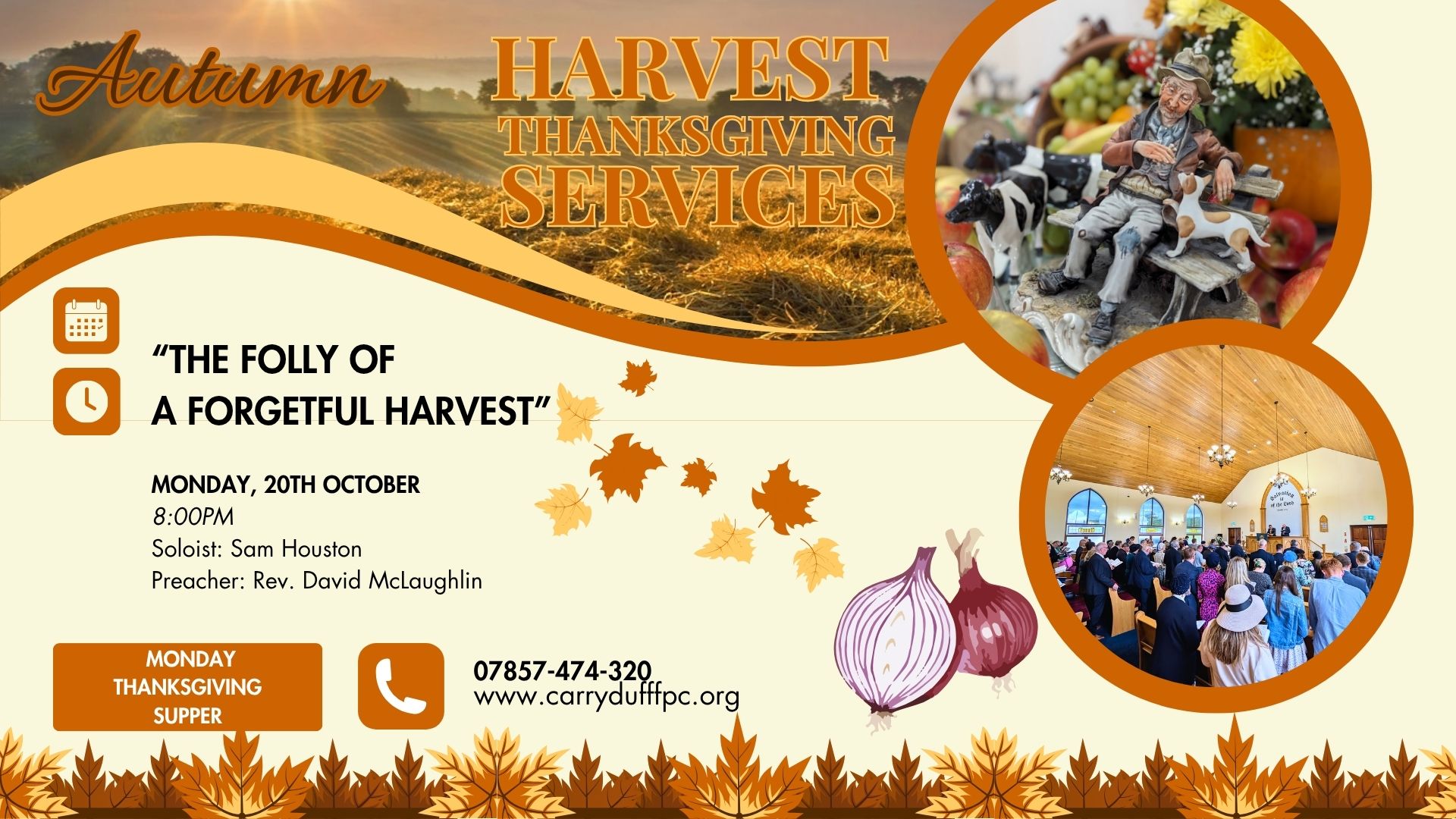

Date: MON 8:00pm 20th October 2025
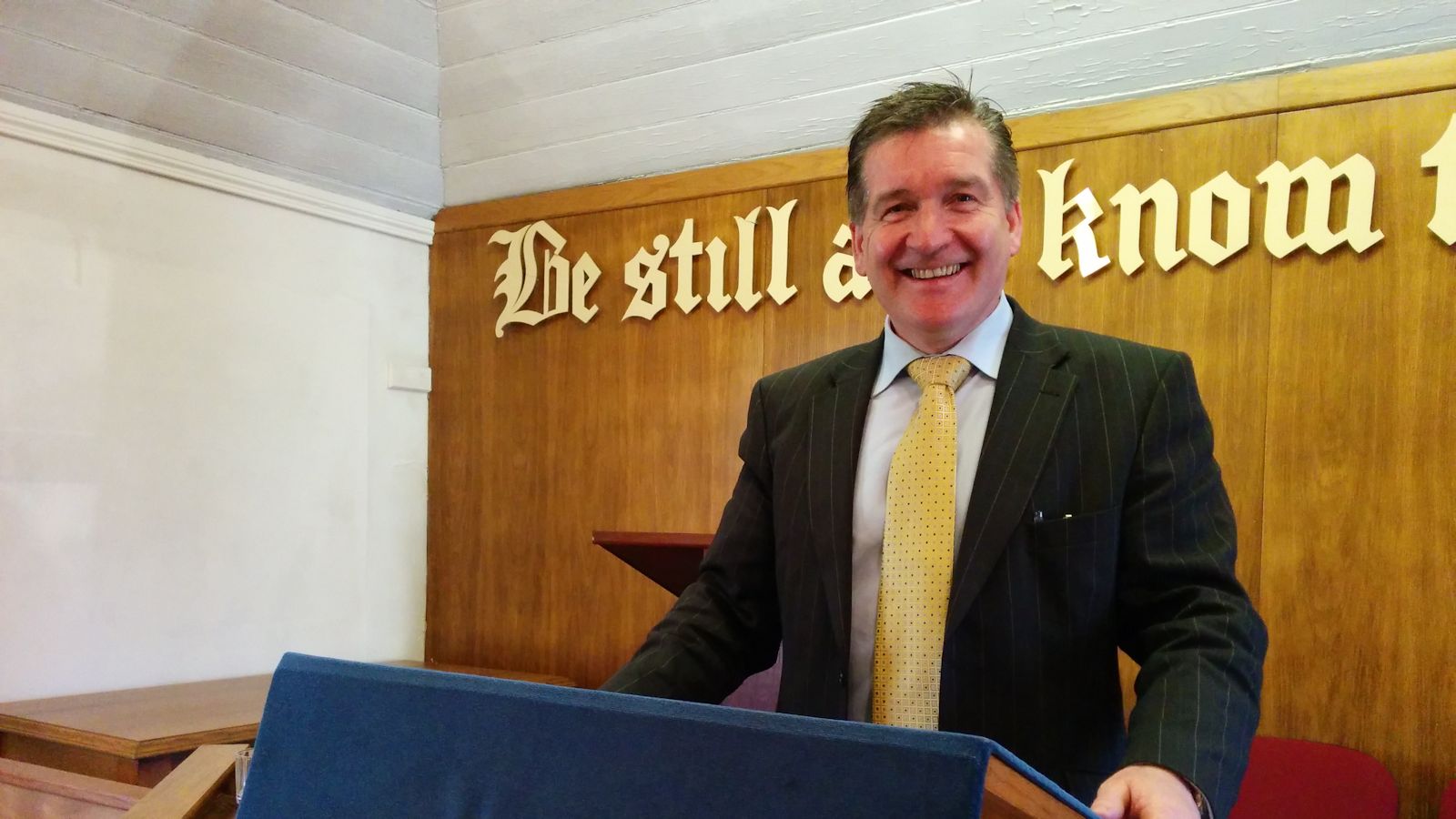
Preacher: Rev. David McLaughlin
Bible Reference: Isaiah 17:10-11
Because thou hast forgotten the God of thy salvation,
and hast not been mindful of the rock of thy strength,
therefore shalt thou plant pleasant plants,
and shalt set it with strange slips:
In the day shalt thou make thy plant to grow,
and in the morning shalt thou make thy seed to flourish:
but the harvest shall be a heap in the day of grief and of desperate sorrow.
Subscribe to the podcast here:
Spotify Podcasts | Apple Podcasts | Pocket Casts
Email | RSS | more information here

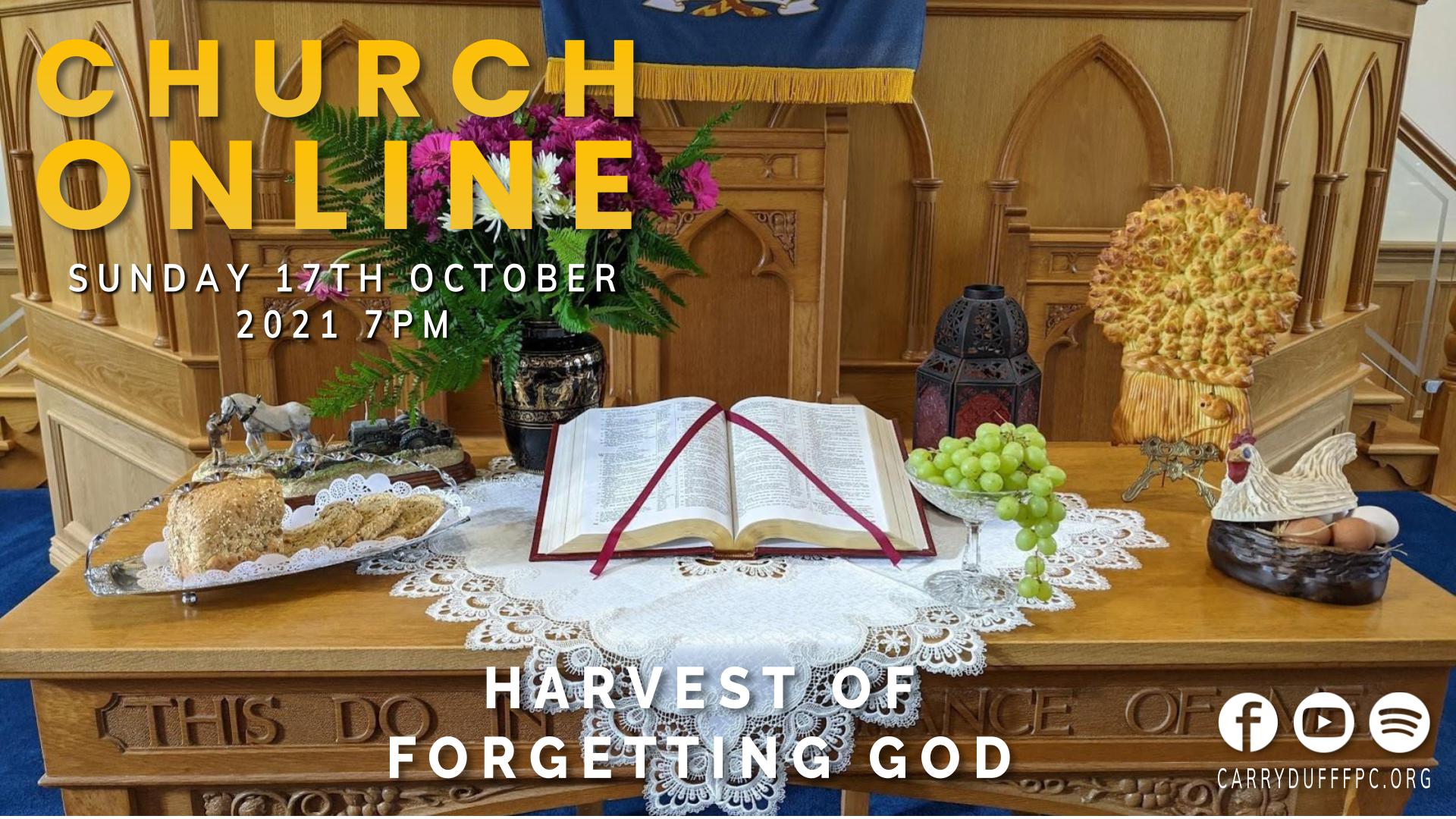
Harvest 2025 Photos
Sermon Summary: The Folly of a Forgetful Harvest (Isaiah 17:1-11)
Text Focus: Isaiah 17:10-11 – “Because thou hast forgotten the God of thy salvation, and hast not been mindful of the rock of thy strength, therefore shalt thou plant pleasant plants, and shalt set it with strange slips: In the day shalt thou make thy plant to grow, and in the morning shalt thou make thy seed to flourish, but the harvest shall be a heap in the day of grief and of desperate sorrow.”
Sermon Title: The Folly of a Forgetful Harvest
Occasion: Harvest Thanksgiving Service, 2025
Context: Delivered during a Harvest Thanksgiving Service, the sermon is based on Isaiah 17:1-11, a prophecy concerning the judgment on Damascus and its implications for Judah due to an unholy alliance. The preacher uses this passage to warn against the spiritual peril of forgetting God, applying the message to both the historical context of Judah and the contemporary audience in 2025. The sermon emphasizes the consequences of neglecting God, the deceptive allure of worldly pursuits, and the urgent need for repentance and faith in Christ.
Detailed Summary:
Introduction
The sermon begins with the reading of Isaiah 17:1-11, a prophecy titled “The Burden of Damascus,” which foretells the destruction of Damascus and the consequences for Judah due to their alliance with this pagan city. The preacher highlights the focus text (verses 10-11) and titles the sermon “The Folly of a Forgetful Harvest,” connecting it to the Harvest Thanksgiving theme. The word “harvest” appears 53 times in the Bible, from Genesis 8:22 (promising seedtime and harvest) to Revelation 14:15 (the final harvest). The preacher notes that despite claims of having “no harvest sermons,” the Bible provides ample material on this theme. The sermon’s central message is the folly of forgetting God, which leads to a disastrous harvest of sorrow.
Historical Context: Judah’s Unholy Alliance
- Isaiah’s Warning: The prophet Isaiah warns Judah and its king against forming an alliance with Damascus, a pagan city. This alliance is against God’s will and will trigger disastrous consequences, including invasion and desolation.
- The Law of the Harvest: Isaiah’s warning is grounded in the principle, “What you sow, you reap.” Sowing sin (e.g., aligning with ungodly nations) results in reaping far more trouble than anticipated, costing more and lasting longer than intended.
- Judah’s Sin: Judah’s desire to emulate surrounding pagan nations reflects a deliberate turning away from God. This choice will lead to distress, sorrow, and a downward spiral, ultimately bringing disaster to Jerusalem and the land.
Key Points of the Sermon
- The Charge Pronounced: Forgetting God (v. 10)
- The Indictment: The core charge against Judah is, “Thou hast forgotten the God of thy salvation, and hast not been mindful of the rock of thy strength.” The word “forgotten” (used 46 times in the King James Bible) means to “let slip away,” illustrated by a boat drifting from the harbour due to neglect in tying it up.
- Wilful Neglect: This forgetfulness is not accidental but deliberate and wilful, akin to a drunken ship captain ignoring warnings of danger or a banker stealing despite knowing it is wrong. Such choices bring self-inflicted consequences.
- Modern Application: The preacher applies this to contemporary society, noting that forgetting God is a grievous sin today. Many live as if God does not exist, ignoring His person, provision, and power. The preacher cites Jeremiah 2:13, where God laments that His people have forsaken Him, the fountain of living waters, for broken cisterns that hold no water.
- Examples of Forgetfulness: The preacher humorously recounts personal experiences of forgetting mundane things (e.g., car keys, phone, PIN numbers) to illustrate that while such forgetfulness is annoying, forgetting God is far more serious. He warns that society’s rejection of God is not mere oversight but a rebellious choice, akin to saying, “No God” (Psalm 14:1), reflecting a wilful, wicked mindset.
- The Consequence Pictured: A False Harvest (v. 11a)
- Horticultural Imagery: The text uses the metaphor of planting “pleasant plants” with “strange slips” (foreign influences, i.e., Damascus and Assyria). Initially, Judah’s alliance seems promising, with plants growing and seeds flourishing, symbolizing temporary success and pleasure.
- Deceptive Allure: The preacher warns that without God at the centre, human efforts are deceptive. The enemy (Satan) lures people with temporary pleasures, but these lead to pain and spiritual poverty. Other objects take God’s place when He is not on the throne of one’s life.
- Personal Anecdote: The preacher shares a story of knocking on a door in Donegal and encountering a man who boasted of his wealth (boat, cars, house) and rejected the need for God. The preacher responded, “You might be rich in this world’s goods, but you’re not rich toward God,” emphasizing that worldly success is fleeting without spiritual grounding.
- Broader Application: This consequence applies to individuals, churches, and nations. Forgetting God leads to chasing temporary pleasures that ultimately fail to satisfy.
- The Crops Perished: A Harvest of Sorrow (v. 11b)
- The Outcome: The harvest becomes “a heap in the day of grief and of desperate sorrow,” meaning it is completely lost or removed (Hebrew: “removed in the day of inheritance”). Instead of a bountiful harvest, Judah faces despair, decay, and destruction.
- Historical Fulfillment: This prophecy was fulfilled when Judah was taken into Babylonian captivity (609, 597, 586 BC), with Jerusalem destroyed and the land under Gentile occupation until the Balfour Declaration in 1948, when Israel was reborn as a nation.
- Eternal Perspective: The preacher cites Psalm 9:17, “The wicked shall be turned into hell, and all nations that forget God,” emphasizing that Judah’s temporal judgment pales in comparison to the eternal judgment awaiting those who reject God. The final harvest (Revelation 14:15) will bring ultimate accountability.
- God’s Word and Salvation
- Relevance of Scripture: Despite being 2,600 years old, Isaiah’s prophecy is relevant today. God’s Word is a living guide, a “lamp unto our feet” (Psalm 119:105), and not boring or erroneous but vital for all ages.
- God’s Salvation: The preacher emphasizes that God is the planner, executor, revealer, and maintainer of salvation through Jesus Christ, the “rock of thy strength.” Christ is the stable, secure foundation (Matthew 16:18), and salvation is through faith in Him alone (John 3:16, John 14:6).
- Call to Repentance: Citing Isaiah 55:7-8, the preacher urges the congregation to forsake sinful ways, return to God, and receive His mercy. Salvation is by faith, a truth rediscovered during the Reformation and preached by Paul (Ephesians 2:8-9).
- Urgency of Choice: The preacher calls for a personal response: to trust in Christ, adhere to Him, and rely on Him. He warns against relying on good works, church attendance, or worldly achievements, as these cannot save (Isaiah 17:7-8).
- Final Warning and Encouragement
- Count Your Blessings: The preacher encourages the congregation to reflect on God’s physical, material, spiritual, and national blessings, such as times of revival and deliverance. Yet, many reject God despite these gifts.
- Eternal Consequences: Forgetting God leads to eternal separation (Matthew 7:23). The preacher pleads with the audience not to be guilty of this “gross treachery” but to look to Christ, the Lamb of God who takes away the sin of the world (John 1:29).
- Hope in Christ: The greatest knowledge is knowing God, which leads to true self-knowledge (as noted by John Calvin). The preacher closes with a call to repentance and faith, urging the congregation to be reconciled to God through Christ.
Key Themes:
- Forgetting God: Wilful neglect of God’s person, provision, and power is a serious sin with devastating consequences, both temporally and eternally.
- The Law of the Harvest: Sowing sin reaps sorrow, while sowing faith in God yields eternal life. Judah’s alliance with Damascus illustrates this principle.
- God’s Salvation: Jesus Christ, the rock of ages, is the only source of salvation, available through repentance and faith.
- Urgency of Decision: Each person must choose to trust in Christ to avoid the folly of a “forgetful harvest” and the judgment to come.
- Relevance of Scripture: God’s Word is timeless, offering guidance and warning for all generations.
Conclusion:
The sermon uses Isaiah 17:10-11 to deliver a powerful warning about the consequences of forgetting God, drawing parallels between Judah’s unholy alliance with Damascus and modern society’s rejection of God. The preacher emphasizes the deceptive allure of worldly pursuits, the certainty of God’s judgment, and the hope of salvation through faith in Christ. The message is a heartfelt call to repentance, urging the congregation to count their blessings, turn to Christ, and avoid a harvest of grief and sorrow. The sermon concludes with a reminder of the eternal stakes: knowing God through Christ is the greatest need, and neglecting Him leads to eternal loss.