
Held at Martyrs Memorial Free Presbyterian Church, Belfast
Monday, 17th March 2026
Theme: Separated unto the Gospel of God (Romans 1:1)
Introduction
The 75th Anniversary Thanksgiving Service of the Free Presbyterian Church of Ulster was a moving and historic occasion, held precisely seventy-five years to the day after the denomination’s founding in the little County Down village of Crossgar on 17th March 1951. The event took place in Martyrs Memorial Free Presbyterian Church, Belfast — the very congregation so long associated with Dr. Ian R. K. Paisley, the denomination’s founder.
The evening not only commemorated the past but sought to rekindle the spiritual fervour and gospel zeal that characterised the early days of the movement. The service was chaired by Rev. Ian Brown, minister of the Martyrs Memorial, and featured a panel discussion with Rev. Trevor Baxter, Rev. Alan Smylie, and Mr. Tommy Gilmore, followed by a sermon entitled “Separated unto the Gospel” from Philippians 1:27.
Opening of the Service
The 75th Anniversary Thanksgiving Service commenced with a rousing congregational singing of Psalm 100 from the Scottish Psalter, sung to the tune commonly associated with the doxological majesty of the psalm:
“All people that on earth do dwell,
Sing to the LORD with cheerful voice;
Him serve with mirth, His praise forth tell,
Come ye before Him and rejoice.”
The congregational singing filled the historic walls of Martyrs Memorial Free Presbyterian Church with the praise of Jehovah — a fitting prelude to a service of gratitude, reflection, and rededication. The psalm, so long loved in Reformed worship, reminded all present that “It is He that hath made us, and not we ourselves; we are His people, and the sheep of His pasture” (Psalm 100:3, KJV).
Following the psalm, Rev. David McLaughlin, Minister of Carryduff Free Presbyterian Church, opened the service in prayer. His public intercession was reverent, solemn, and thoroughly scriptural — a model of classic Reformed devotion.
Opening Prayer
Rev. David McLaughlin offered a reverent and Scripture-soaked prayer that set a deeply spiritual tone for the 75th Anniversary Service. He began by addressing Almighty God and loving Heavenly Father, giving thanks for access to His throne through “the one Mediator between God and men, the man Christ Jesus” (1 Timothy 2:5).
He praised God for the faithful founding fathers of the Free Presbyterian Church — Dr. Ian Paisley, Dr. John Douglas, Dr. S. B. Cooke, Dr. Alan Cairns, and others — acknowledging their courage, gospel conviction, and tireless labours. Giving thanks for the mighty works of God over 75 years, he echoed the psalmist’s words: “The LORD hath done great things for us; whereof we are glad” (Psalm 126:3).
The prayer was both thankful and forward-looking: McLaughlin asked that the remembrance of past blessings might stir present hearts to renewed zeal for the Gospel. He prayed that the Holy Spirit would visit the church in reviving power, granting a true experience of divine presence, faithfulness “to the blood and to the Book,” and boldness to continue the labours of earlier generations.
Interceding for Northern Ireland and the wider nation, he lamented moral and spiritual decline and pleaded for a revival of true Bible-believing faith across Belfast, the Province, the Republic, and beyond. Concluding, he invoked Christ’s promise — “Whatsoever ye shall ask the Father in My name, that will I do” (John 14:13) — committing the entire meeting and denomination afresh to God’s blessing, for His glory alone.
Welcome
With that heartfelt invocation, the congregation entered into the spirit of solemn thanksgiving. The evening marked three-quarters of a century since the Lord, in His sovereign providence, raised up what became the Free Presbyterian Church of Ulster — a denomination born amid controversy, sustained by conviction, and distinguished by its uncompromising fidelity to the Word of God and the Gospel of Christ.
Rev. Brown welcomed the congregation, visitors, and ministers from across the Presbytery, remarking upon the grace of God that had preserved the witness for seventy-five years. He observed that while many church bodies had drifted into worldliness, ecumenism, or outright apostasy, the Free Church still stood upon the same biblical foundation, holding to the same faith, preaching the same Christ, and contending for the same cause.
The Panel Discussion
Following introductory remarks from Rev. Brown, a trio of long-serving servants of the denomination took part in a nostalgic and spiritually enriching panel discussion.
Reverend Trevor Baxter
Rev. Baxter reflected on his introduction to the Free Presbyterian Church in the mid-1960s through Dr. Ian Paisley’s ministry on the Ravenhill Road. His testimony recalled early days of open-air evangelism, controversy around the display of a flag on Divis Street, and his first encounter with Paisley’s fiery preaching — a kind of gospel preaching he had never heard before, even after years of involvement in the Boys’ Brigade and other church work.
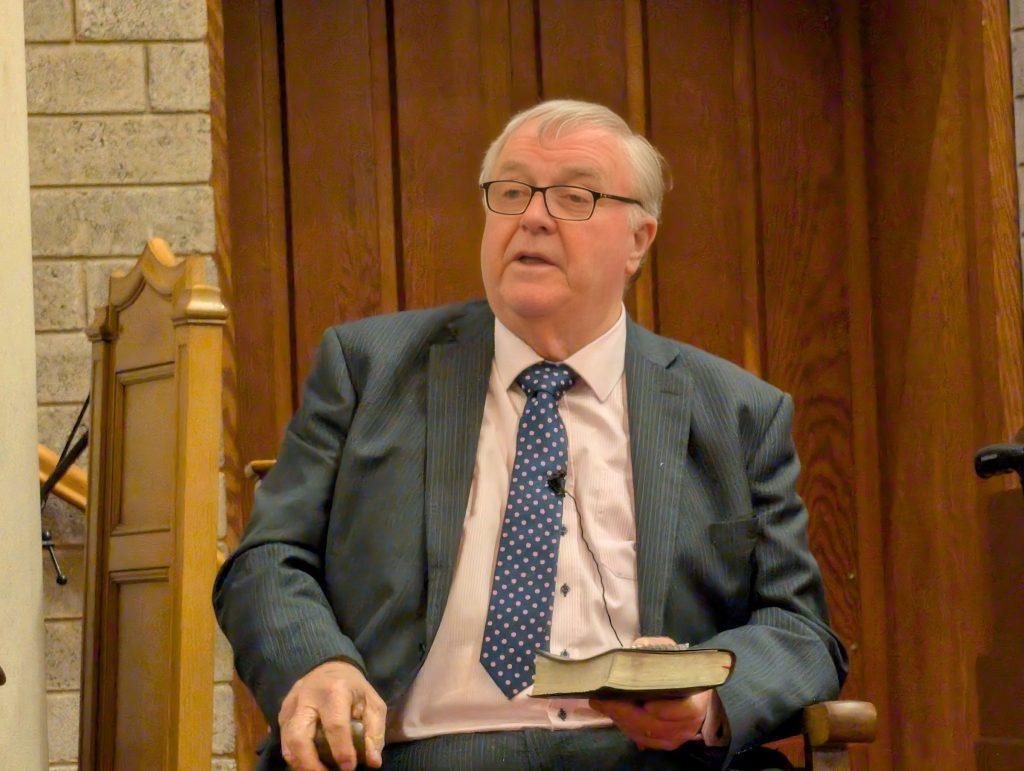
He described the early meetings as electric with the power of the Spirit, pointing especially to the passionate prayers of Billy Hamilton, whose sincerity and unction deeply moved him. Rev. Baxter recalled the vibrant fellowship of those days — meetings where, before any official hymn began, someone in the congregation would spontaneously start singing, ushering in a palpable sense of divine presence.
He also reminisced about the Cromac Street March, his first exposure to physical persecution for the gospel’s sake, and expressed heartfelt gratitude for the privilege of being part of a movement that had stood fast for six decades. “I love the Free Church,” he said, “and I love the memory of the early men.”
Mr. Tommy Gilmore
Mr. Gilmore spoke warmly of his years travelling with Dr. Paisley — at times as bodyguard, chauffeur, and companion in gospel campaigns. He recalled journeys by car at breakneck speed while reading the Scriptures aloud to Paisley as he prepared his sermons “at one hundred miles an hour up the motorway.” He shared anecdotes of divine providence and humour, particularly one mission in Dublin where chaos was turned to blessing when two Roman Catholics were gloriously saved under Paisley’s preaching on “Out of Christ, In Christ, and With Christ.”
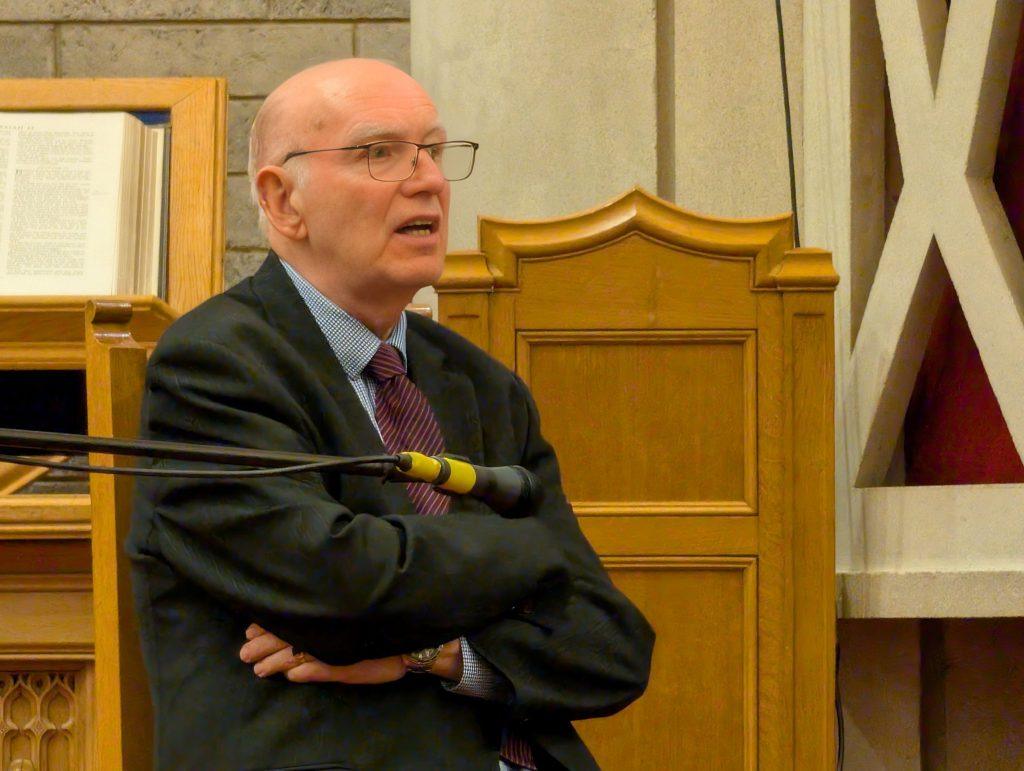
Mr. Gilmore’s stories painted a vivid picture of Paisley’s prayerful nature, noting how even police escorts and security officers refused to move a mile until prayer had first been offered. His accounts — ranging from encounters with danger to moments of revival power — underscored the vitality and divine sanction that clearly accompanied the early Free Presbyterian witness.
Reverend Alan Smylie
Rev. Smylie, who grew up attending Martyrs from boyhood, described his conversion in 1969 and his deep formative years under the ministry of Dr. Paisley. He recalled attending early meetings where the church was filled to overflowing, with crowds queuing down the Ravenhill Road as early as 5:30pm.
He spoke of Dr. Paisley’s powerful pulpit ministry — “a mighty preacher of the Word of God” — and the unforgettable movement of the Holy Spirit that swept through those days. “Every Sunday night,” he said, “souls were saved. The atmosphere was electric. Heaven came down, and glory filled our souls.”
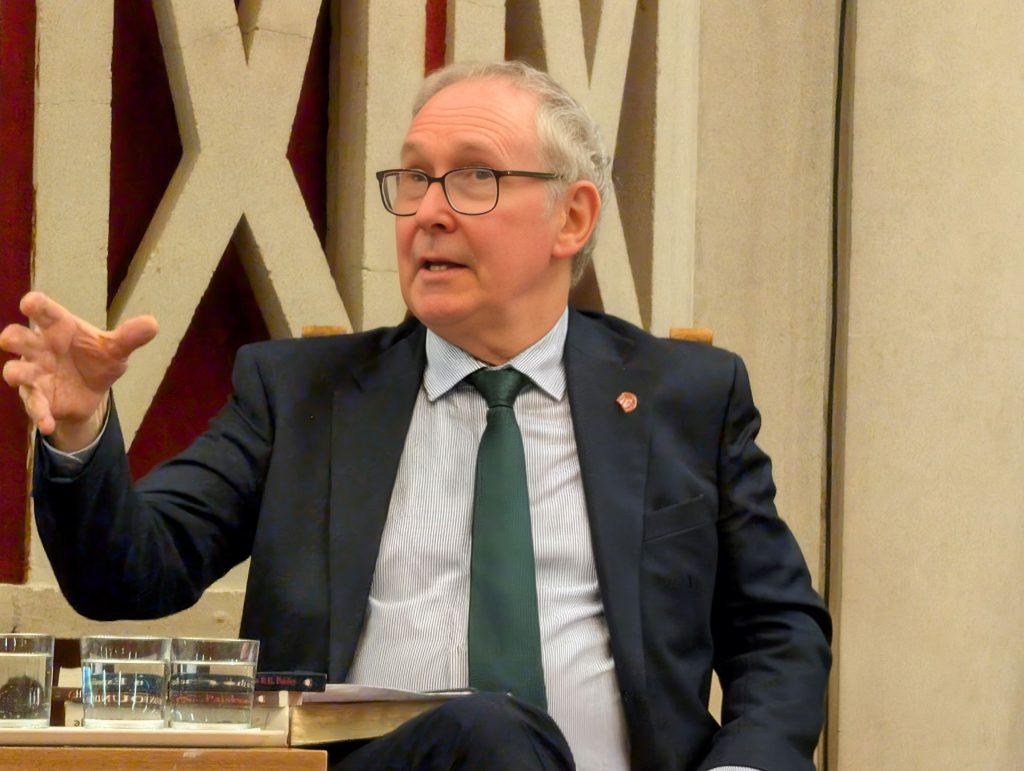
Rev. Smylie highlighted the role of men of prayer such as Bob Nevin, James Nicholl, and Stanley Cook — men who spent half-nights before God and refused to “rush the Holy Spirit.” He urged that the same spirit of earnest prayer must once again characterise the eldership and congregations if revival is to visit Ulster again.
Books by Paisley such as The Man and His Message, Romans from a Prison Cell, and Christian Foundations were commended for their enduring theological and devotional value, reminding all present of the abiding influence of the Free Presbyterian founder’s written ministry.
“The Tide Going Out” – The Question of Decline and Revival
Rev. Brown then put to the panel one of the evening’s most solemn questions: why have the great movements of God that marked the 1960s and 1970s waned, and can Northern Ireland ever see revival again?
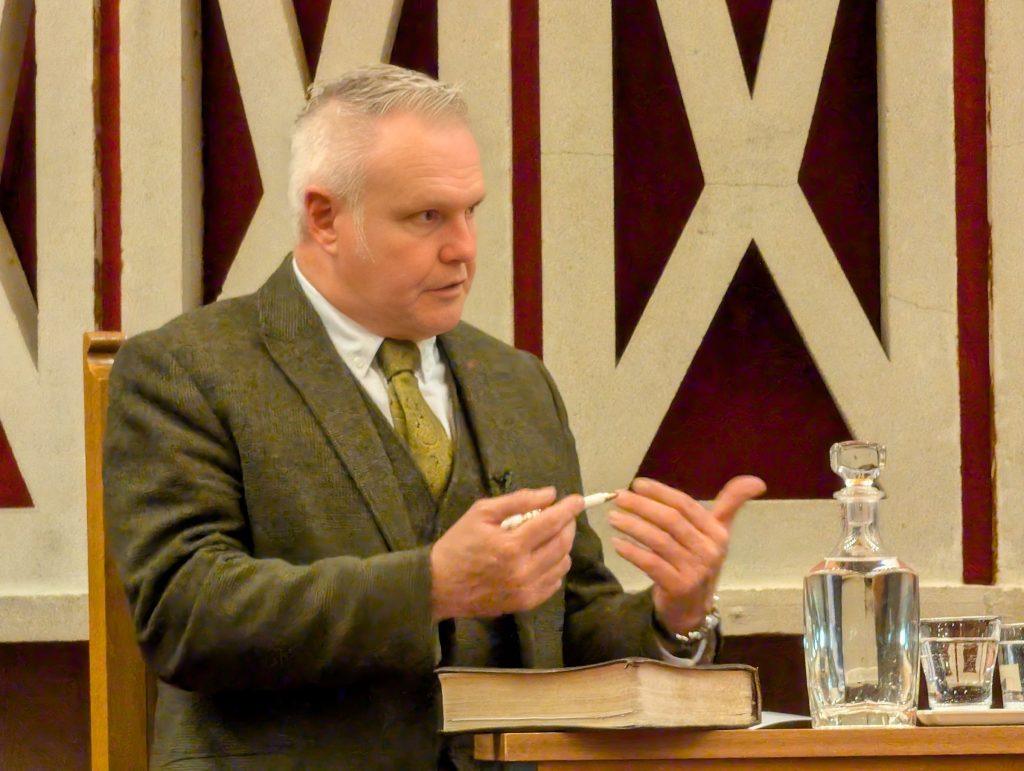
Rev. Smylie’s answer was uncompromising yet hopeful: “Our God has not changed.” Drawing parallels with the days of Whitefield, Wesley, and the 1859 Ulster Revival, he affirmed that God is still able to move in a decadent age. Quoting the late Dr. Paisley, he said, “Brethren and sisters, the tide has gone out. But when the tide comes in again, all the rubbish on the beach is swept away.” The challenge was therefore to remain faithful, prayerful, and united — waiting upon God to send another mighty visitation.
Missions and the Global Field
Mr. Gilmore, speaking next, turned the audience’s eyes beyond Ulster to the worldwide spread of the Free Presbyterian witness — Nepal, Uganda, Australia, and new works in the Philippines. He gave heartfelt praise for those serving abroad and lamented the shortage of labourers at home: “Every month we get the call, ‘Come and help us,’ but there’s nobody to go.”
He appealed for young men and women to seek God’s call into the Whitefield College of the Bible, that the mission and ministry might continue. His memories of the Men’s Prayer Meeting in Ravenhill, from ten at night until half seven in the morning, served as a stirring reminder that the movement was born in prayer — and will only continue through prayer.
The Future Generation
In closing, Rev. Brown asked the panel to address the young people of the Free Presbyterian Church — the fourth generation — who never personally knew the founders. Rev. Baxter responded with great wisdom. He warned against romanticising the past while ignoring the call of God in the present, reminding the youth that the same Holy Spirit and same Gospel are available today.
He shared his respect and affection for former lecturers such as Dr. Alan Cairns, Rev. S.B. Cooke, and Dr. John Douglas, urging those training for the ministry to respect and honour today’s leaders just as former generations did theirs. His wise counsel to any young man considering ministry was vintage realism:
“If you can do anything else, do it. But if you are convinced that God has called you to preach, then go with the call of God.”
His appeal closed with a call to wholehearted commitment: “Go through with God, thy vows to pay.”
📖 The Preaching of the Word
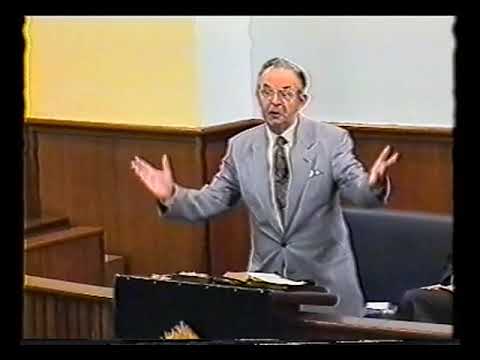
Rev. Ian Brown – “Separated unto the Gospel” (Philippians 1:27)
Rev. Brown’s anniversary sermon served as both a historical reflection and a spiritual charge. Taking Philippians 1:27 — “Only let your conversation be as it becometh the gospel of Christ…” — he wove together history, doctrine, and application under the great Pauline theme: The Faith, Fellowship, Fight, Furtherance, and Future of the Gospel.
1️⃣ The Faith of the Gospel
Reminding the congregation of the Free Presbyterian Church’s origins in Crossgar, Rev. Brown recounted how the Down Presbytery’s suppression of gospel zeal led a group of faithful elders to take their stand — not in rebellion, but for Christ. They refused to close their church hall to the preaching of a young Rev. Ian Paisley, even under threat of suspension. Ninety-four souls were saved in that mission, and the Free Presbyterian Church of Ulster was born.
Rev. Brown read from the minutes of the third Presbytery meeting of 1951, which praised the triune God for His saving grace and pledged to lift “the blue banner of historic Presbyterianism in these days of apostasy and modernism.” This, he said, was “Separation unto the Gospel”— a positive stand for truth, not a negative schism.
Citing Galatians 1:8–9, he declared:
“Though we, or an angel from heaven, preach any other gospel unto you than that which we have preached unto you, let him be accursed.”
2️⃣ The Fellowship of the Gospel
True fellowship, Rev. Brown explained, is not mere socialisation over tea, but a spiritual communion rooted in common participation in the Gospel (Philippians 1:5). He reminded believers of their duty to love one another yet draw clear lines of doctrinal separation.
“We can share friendship with unbelievers,” he said, “but not fellowship with those who deny the authority of Scripture, the deity of Christ, or the blood atonement.”
Quoting Ephesians 5:11 — “Have no fellowship with the unfruitful works of darkness, but rather reprove them” — he reaffirmed the Free Presbyterian stance on ecclesiastical separation as both biblical and loving.
3️⃣ The Fight for the Gospel
Rev. Brown turned next to verse 7, warning that there has never been a generation of Christians without controversy. He recalled historic liberal apostasies in Irish Presbyterianism, especially the 1927 acquittal of Professor J. Ernest Davey, despite his denial of the Bible’s verbal inspiration and the infallibility of Christ.
The failure of institutional Presbyterianism to defend gospel truth, he explained, necessitated the rise of the Free Presbyterian movement. As Paul was “set for the defence of the gospel” (Philippians 1:17), so too must today’s believers be ready to take their stand.
He referenced the denomination’s confrontations with modernism, Romanism, and ecumenism — and the imprisonments of ministers in 1966 for protesting the Pope’s visit. Drawing from those events, he declared:
“The things which happened unto us have fallen out rather unto the furtherance of the gospel.”
(Philippians 1:12)
4️⃣ The Furtherance of the Gospel
The Free Presbyterian witness, said Rev. Brown, spread not through comfort but through conflict and consecration. From four congregations in 1951 to more than seventy-five works today across four continents, the God who “causeth all things to work together for good” has prospered His word.
The imprisonment of ministers — once intended to silence them — in fact ignited revival. “Thirty churches in five years,” he said. “What the enemy meant for evil, God meant unto good.” (Genesis 50:20)
5️⃣ The Future of the Gospel
Finally, Rev. Brown called the church to renewed dedication. The survival and strength of the Free Presbyterian Church, he warned, depend not on past victories but on present faithfulness:
“Whether I come and see you, or else be absent,” wrote Paul, “that ye stand fast in one spirit, with one mind, striving together for the faith of the gospel.”
He concluded by challenging believers to emulate the men of David’s day who said, ‘Thine we are, David, and on thy side’ (1 Chronicles 12:18) and the exiles of Nehemiah’s time who covenanted to stand “for the house of the Lord.” The anniversary, he said, must be a moment of personal and corporate rededication to the Saviour’s cause.
“If we will but give ourselves again to the Lord, to prayer, and to the faithful preaching of the Word, the latter end shall greatly increase.” (Job 8:7)
Music & Worship
The congregation sang with robust voice two of the great hymns of evangelical Christianity:
- “I’m Not Ashamed to Own My Lord”, recalling the words sung when Free Presbyterian ministers were jailed in 1966.
- “To God Be the Glory”, the doxology of the denomination’s seventy-fifth year — fittingly closing with “Great things He hath done!”
A vocal solo, “His Robes for Mine”, beautifully rendered by Abigail, directed hearts heavenward, with its profound doctrine of substitution:
“I cling to Christ and marvel at the cost;
Jesus forsaken, God estranged from God;
But by such love, my life is not my own —
My praise, my all, shall be for Christ alone.”
Closing Prayer
The meeting concluded with prayer from Rev. Jonathan Storey of Mount Merrion FPC, who gave thanks to the Lord for His faithfulness through seventy-five years of gospel witness, and prayed for revival, unity, and future blessing upon the denomination:
“Lord, as we have contemplated seventy-five years of the Free Presbyterian Church, we thank Thee for Thy faithfulness. Where would we be without a faithful God in heaven? … May the gospel be resounded in an emphatic way this year. Give us breath from heaven. Revive Thy church again.”
Fellowship
Following the benediction, attendees were invited upstairs for “light refreshments,” symbolising the close fellowship of believers, as the strains of conversation mingled with gratitude and renewed vision for the future.
Conclusion
The 75th Anniversary of the Free Presbyterian Church of Ulster at Martyrs Memorial was far more than a commemoration — it was a reaffirmation of biblical conviction. From Crossgar in 1951 to Belfast in 2026, the same Gospel has been preached, the same Christ exalted, and the same Scriptures honoured.
As Rev. Brown declared:
“The church has been enabled to stand these seventy-five years for the crown rights of our Lord Jesus Christ. And by His grace, it shall stand yet.”
“To God be the glory, great things He hath done.”
(Psalm 126:3)