Table of Contents

Subscribe to the podcast here:
Spotify Podcasts | Apple Podcasts | Pocket Casts
Email | RSS | more information here
🌿 Introduction
Every year on the 31st of October, countless Christians across the world pause to remember one of the most momentous events in human history — the beginning of the Protestant Reformation. This anniversary is far more than a historical commemoration. It marks the rediscovery of the true Gospel of our Lord Jesus Christ — a truth long obscured by man-made traditions, yet preserved by the Word of God.
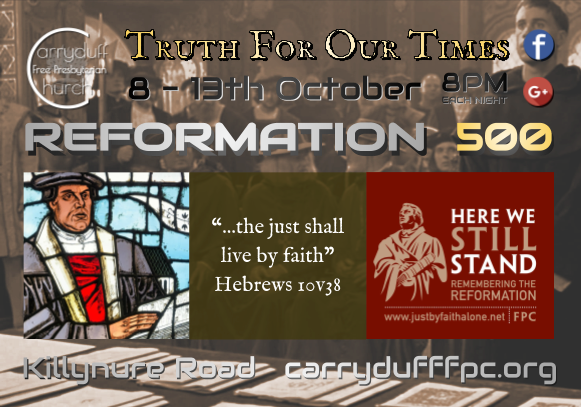
The Reformation was not a rebellion against the Church; it was a return to the message that has been true from the beginning — that the just shall live by faith. It was God’s gracious act of reawakening His people to the authority of Scripture and the sufficiency of Christ’s finished work on the cross.
📜 The Story of Martin Luther
On the 31st of October 1517, a German monk named Dr Martin Luther nailed his Ninety-Five Theses to the door of the Castle Church in Wittenberg, Saxony. This act sparked a movement that shook Europe and changed the course of world history. His Theses were a series of statements challenging the corruption of the Roman Church, especially the sale of indulgences and the false doctrine of purgatory.
Early Life and Education
Martin Luther was born on 10 November 1483 in Eisleben, Germany, to Hans and Margaret Luther. His father was a miner who owned an iron ore business and hoped his son would become a lawyer. Martin was well-educated, studying grammar, rhetoric, and logic at Mansfeld, Magdeburg, and later at the University of Erfurt, where he earned his degree in law.
But in 1505, tragedy struck — his close friend died suddenly, and Luther himself endured a serious illness. Later that same year, on his way home, he was caught in a violent thunderstorm. Fearing death, he cried out to Saint Anne, promising that if his life were spared, he would become a monk. True to his vow, he entered the Augustinian monastery at Erfurt that very year.
📖 A Discovery That Changed the World
At the monastery, Luther devoted himself to the Scriptures. As a professor of Biblical Studies at the University of Wittenberg, he began to pour over the Book of Romans. Between 1510 and 1517, he became convinced of a truth that would change not only his own life but the entire course of Christian history — justification by faith alone.
Luther came to see that righteousness before God is not obtained through works, penance, or religious rituals, but received through faith in Christ alone. He discovered that “the righteousness of God” in Romans 1:16–17 refers not to God’s holy wrath but to a righteousness graciously given to us through the Gospel — a righteousness earned by Christ’s sinless life and atoning death.
In 1510, while visiting Rome on pilgrimage, Luther ascended the Scala Sancta (Holy Stairs) in the belief that climbing them on his knees would reduce his time in purgatory. Yet, as he climbed, the words of Scripture thundered in his mind:
“The just shall live by faith.” — Romans 1:17
In that moment, his heart was illuminated. He realised that salvation is not achieved by climbing to God through human merit, but received by faith in the One who descended to us — the Word made flesh.
🔨 The Hammer Blow That Echoed Through History
With this conviction burning within him, on 31 October 1517, Luther nailed his Ninety-Five Theses to the church door in Wittenberg — the traditional place for academic debate. His goal was reform, not rebellion. But God had other plans.
Unknown to Luther, the Theses were quickly translated from Latin into German, printed on the newly invented Gutenberg press, and spread throughout Germany and beyond. The sound of that hammer against the wooden door reverberated far beyond Wittenberg — even to the halls of Rome.
At the heart of Luther’s protest was a cry against the false promises of indulgence-sellers such as Johann Tetzel, who infamously declared:
“As soon as the coin in the coffer rings, the soul from purgatory springs.”
To Luther, this was an intolerable distortion of the Gospel. Grace could not be sold, and forgiveness could not be purchased — for Christ Himself had paid it all.
✝️ The Message of the Reformation
The rediscovery of the Gospel brought light where there had been darkness. The Reformation reminded the world that:
- Salvation is by grace alone (Sola Gratia)
- Through faith alone (Sola Fide)
- In Christ alone (Solus Christus)
- As revealed in Scripture alone (Sola Scriptura)
- To the glory of God alone (Soli Deo Gloria)
These five great truths continue to form the foundation of true, biblical Christianity.
A Message for Today
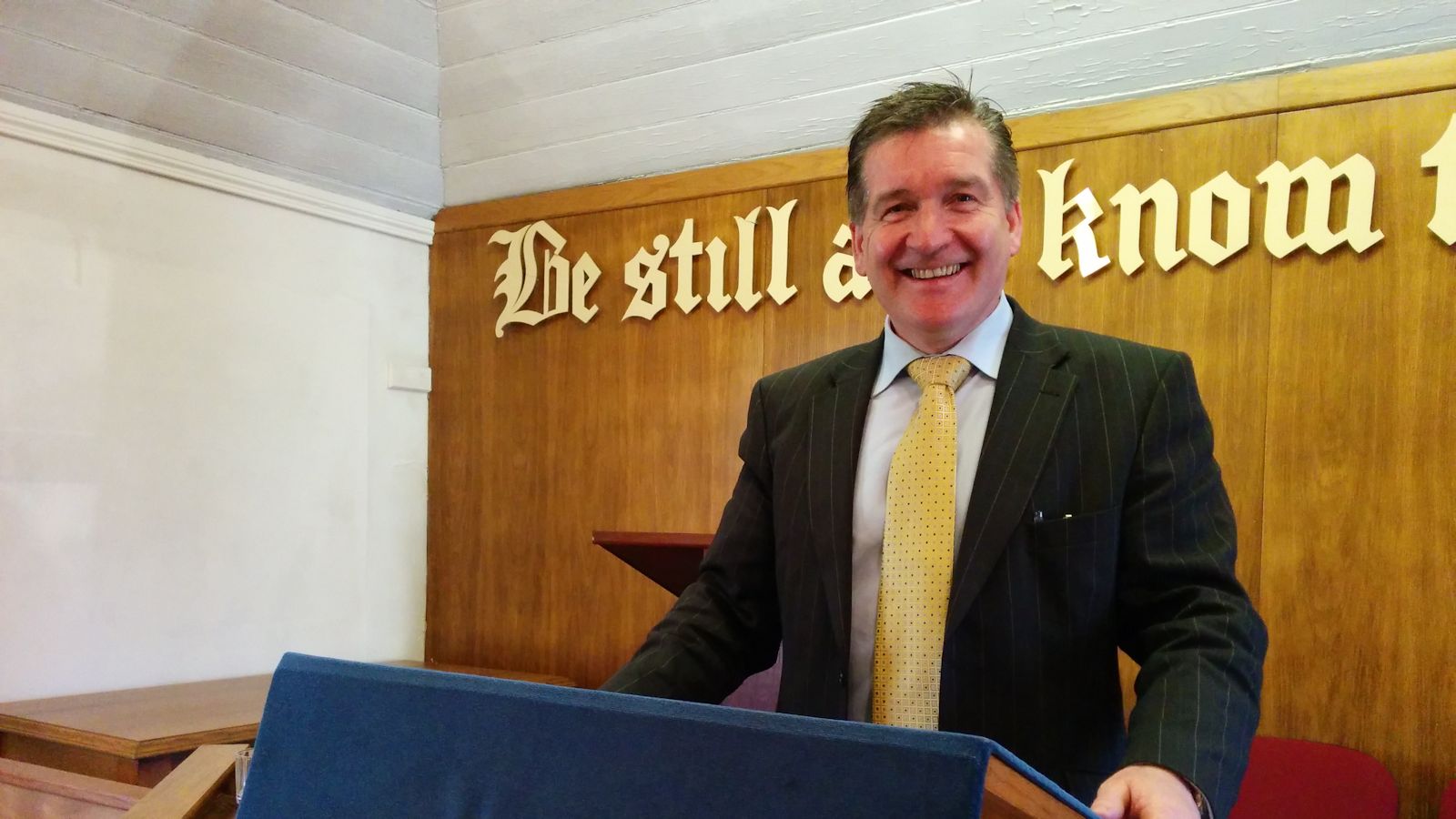
On this Reformation Day, we echo Luther’s words and faith. Today, I had the privilege of preaching this same message before Belfast City Hall, under the text “The just shall live by faith.” I thank Brian and Simon, who stood faithfully alongside me as we lifted up the Gospel in the open air.
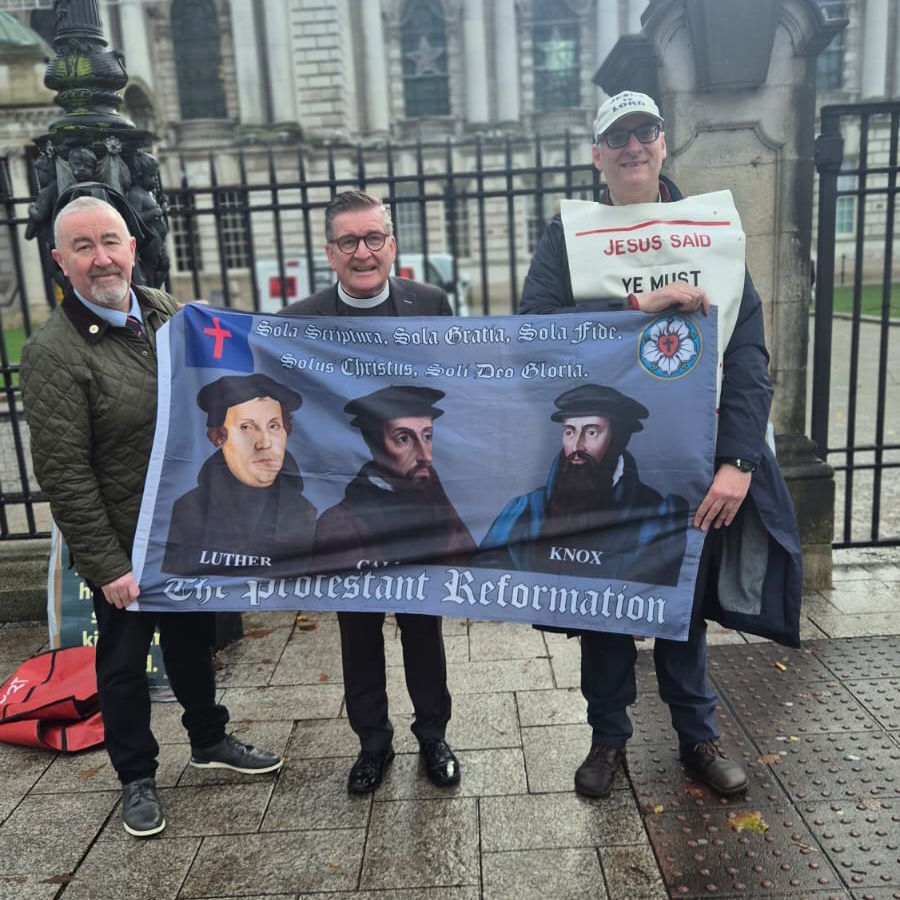
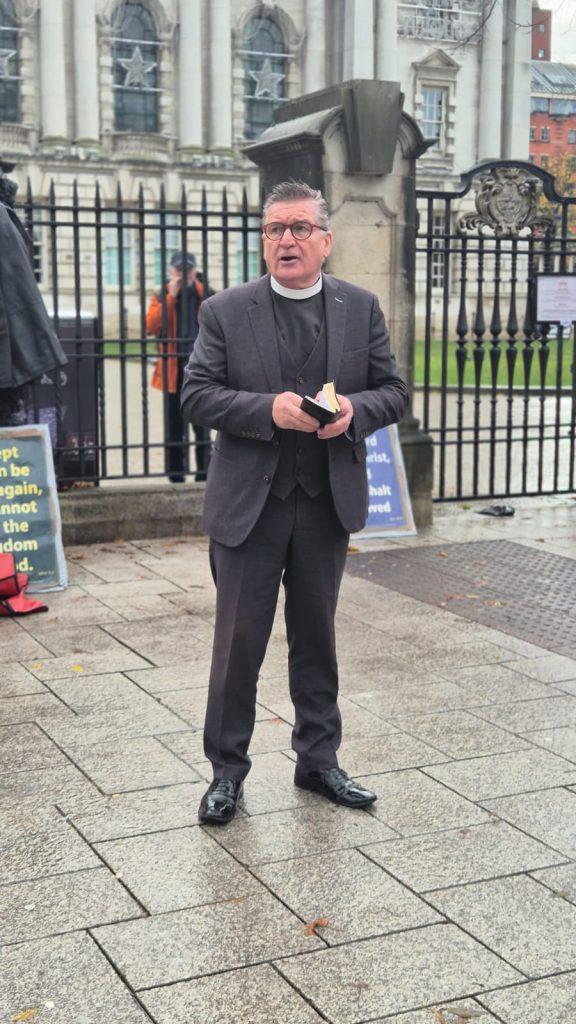
We spoke of how this message leads to peace with God, how it reveals the way to heaven, and how it brings true life — abundant and eternal — through faith in Jesus Christ.
It was a joy to stand in our city, proclaiming that timeless message once again:
The just shall live by faith.
May the Lord bless His Word to all who hear, and may light and truth fill the hearts of not hundreds, but thousands — that men and women with no thought or fear of God might yet come to a saving knowledge of Jesus Christ as Lord and Saviour.
Amen.