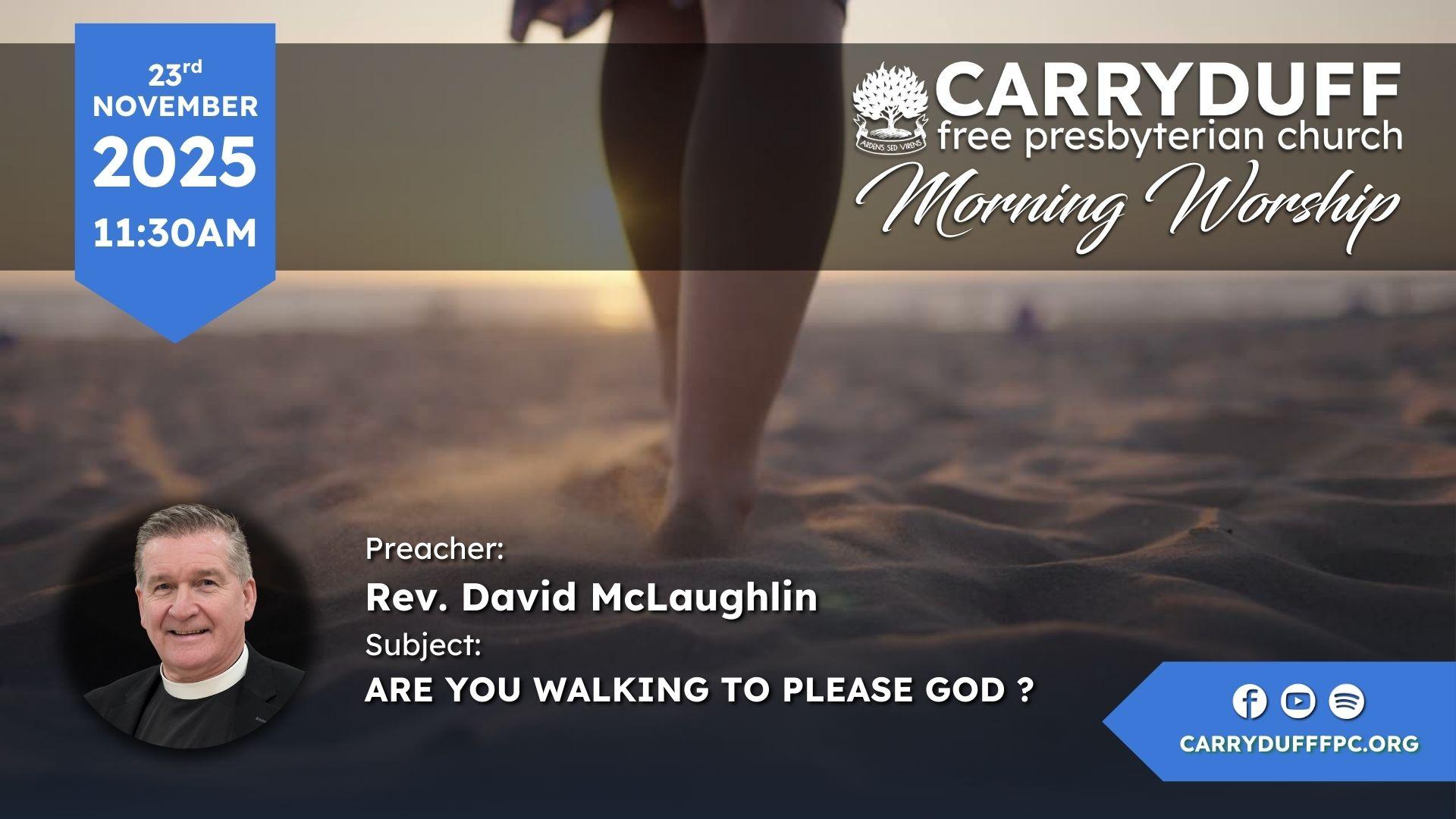

Date: SUN 11:30pm 7th December 2025
Preacher: Rev. David McLaughlin
Bible Reference: 1 Thessalonians 4:9-12
But as touching brotherly love ye need not that I write unto you: for ye yourselves are taught of God to love one another. And indeed ye do it toward all the brethren which are in all Macedonia: but we beseech you, brethren, that ye increase more and more; And that ye study to be quiet, and to do your own business, and to work with your own hands, as we commanded you; That ye may walk honestly toward them that are without, and that ye may have lack of nothing.
Podcast
Sermon Summary
(1 Thessalonians 4:9–12, preached from the Authorised (King James) Version)
The preacher continued an expository series on 1 Thessalonians, focusing on verses 9–12 under the title The Church of Brotherly Love. He noted that even a first-century pagan observer (Lucian) was struck by the extraordinary, self-sacrificial love displayed among persecuted Christians amidst a culture steeped in idolatry and immorality. This love is not an optional extra but an essential facet of biblical sanctification (already introduced in 4:3), like one glittering face of a diamond that reflects true holiness.
The passage was expounded under three main headings:
- The Instruction in Brotherly Love (v. 9)
Paul tells the Thessalonians, “as touching brotherly love ye need not that I write unto you.” This does not mean the subject is closed or that they have already mastered it perfectly. Rather, Paul does not need to argue the case at length because the Thessalonians are already “taught of God to love one another.”- They are taught in the new birth and ongoing sanctification: divine grace implants a holy love that is foreign to fallen human nature.
- They are taught by Scripture (the repeated command to “love one another”).
- They are taught by Christ Himself (John 13:34–35 – “By this shall all men know that ye are my disciples…”).
- Natural humanity is marked by self-love, not Philadelphia (brotherly love). Even genuine believers can struggle with selfishness, bitterness, or resentment (illustrated by the story of a Christian nurse persecuted by an antagonistic boss, and Amy Carmichael’s response of using hurt as “an opportunity to die to self”). True brotherly love is supernatural, a gift of grace, and one of the clearest evidences that a church is authentic (1 John 3:10–14; 4:7–21). It stands in stark contrast to the selfish lust that dominated Greco-Roman culture and still confuses the world today.
- The Instinct of Brotherly Love (v. 10a)
“And indeed ye do it toward all the brethren which are in all Macedonia.”
When someone is truly born again, the life of God in the soul instinctively produces love for the brethren, just as a newborn baby cries, a bird flies, or a dog barks. This is not forced or artificial; it flows from the new nature (2 Peter 1:4).- God is love (1 John 4:8, 16); therefore His children partake of that loving nature.
- Love for the brethren is inseparable from love for God (1 John 4:20–21). Claiming to love God while hating a brother makes one a liar.
- The preacher frankly acknowledged that believers still sin, still have personalities that clash, and can be difficult to live with (including himself!). Yet the indwelling Holy Spirit sheds abroad God’s love in our hearts (Romans 5:5) and enables us, despite provocation, to display sanctifying, sacrificial love.
- The Increase of Brotherly Love (vv. 10b–12)
Although the Thessalonians’ love had reached all the churches in Macedonia (a commendation), Paul still “beseeches” them to “increase more and more.” Complacency is dangerous; love must grow.
Here Paul moves from Philadelphia (family affection for believers) to agape – the self-sacrificing divine love that seeks the highest good of the other, even at personal cost (cf. John 3:16; Ephesians 5:2).
Growth in love is worked out practically in three areas (v. 11):- Study to be quiet – Make it your ambition not to disturb the peace of the congregation. Avoid tale-bearing, harsh criticism, or stirring strife. Christ Himself was gentle and did not “cry…in the street” (Isaiah 42:2). Turn criticism into prayer.
- Mind your own business – Do not be a busybody meddling in others’ affairs (a problem later explicitly addressed in 2 Thessalonians 3:11).
- Work with your own hands – Earn your living honestly, refusing to become a burden on the church. Some in Thessalonica had apparently stopped working (perhaps expecting Christ’s immediate return) and were living off others – an abuse Paul firmly corrects.
Conclusion