
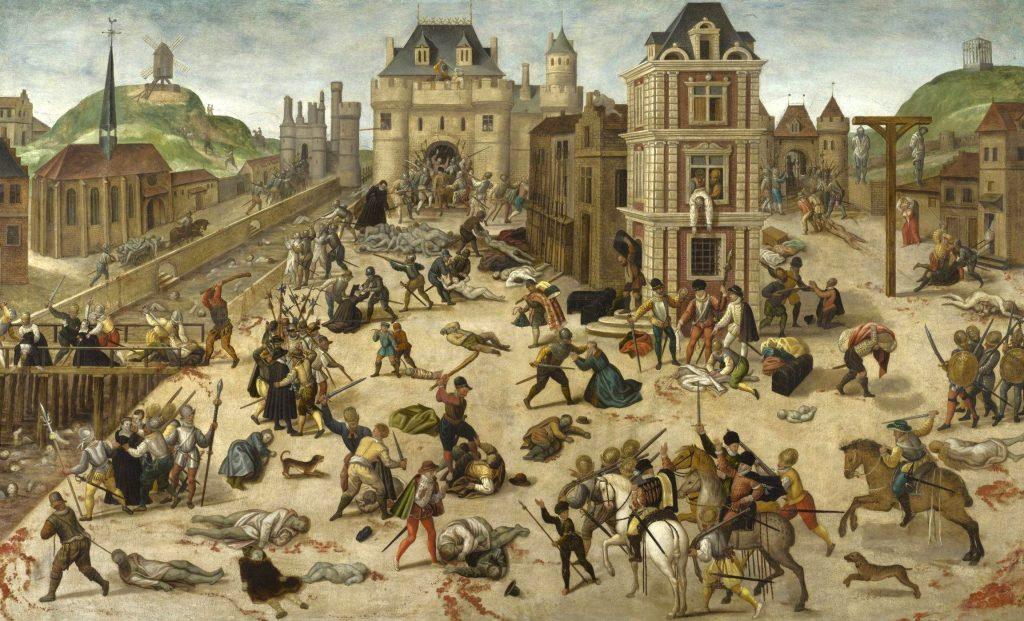
A research paper, published in 2006, Estimates of the Number Killed by the Papacy in the Middle Ages and Later, written by Dr. David Plaisted (Ph.D. 1976, Stanford) a Research Professor from The University of North Carolina at Chapel Hill, attempts to arrive at an estimate, including figures, for deaths resulting from forms of torture and killing that did not involve a formal trial, religious wars, and other forms of Catholic violence enacted against Protestants and other non-Catholics.
On this webpage, we summarise the findings of the paper for ease of understanding.
Estimates of the Number Killed by
the Papacy in the Middle Ages and Later
by David A. Plaisted (2006)
You can read the research paper below.
Forward
“For two or three centuries, many Protestants have given figures concerning the total number of people killed directly or indirectly by the Papacy during the Middle Ages.
The numbers given include 50 million, 68 million, 100 million, 120 million, and 150 million. Roman Catholics typically give much smaller numbers. Frequently the figures are stated without any information about where they came from or how they were computed.
The purpose of this note is to describe where some of these figures come from and to comment on their reliability. Surely nearly all Roman Catholics as well as Protestants disapprove of past religious persecutions, so this discussion should not reflect negatively on current members of the Roman Catholic Church. However, events in Nazi Germany show how easily persecution can revive, so it is necessary to be on guard against it and maintain an awareness of its history. Of course, many other groups besides the Papacy, have persecuted. And all of us, without Christ, have the roots of sin in ourselves.
The reason the Papacy stands out is that it has ruled for such a long period of time over such a large area, exercised so much power, and claimed divine prerogatives for its persecutions.
The magnitude of the persecutions is important for the following reason: One can excuse a few thousand cases as exceptional, but millions and millions of victims can only be the result of a systematic policy, thereby showing the harmful results of church-state unions.”
- Overview
The work examines how historical Protestant writers estimated the number of people — especially Protestants — killed by the Roman Catholic Church during the Middle Ages and later. It traces the origins, methods, and sources behind widely quoted figures like “50 million Protestants killed” or “68 million total killed”, exploring the plausibility of such large numbers and providing historical examples.
The author compiles data from older church histories, martyrologies, and writings, noting that while exact verification is impossible, these figures were seriously put forward by respected Protestant historians of their time.
2. The Post-Reformation “50 Million” Estimate
2.1 Key Sources
- John Dowling, History of Romanism (1847) — cites “more than fifty millions” slain from the birth of Popery (A.D. 606) to his own day.¹
- W.C. Brownlee, Popery an Enemy to Civil Liberty (1836) and The Roman Catholic Religion Viewed in the Light of Prophecy and History (1843) — consistently uses the 50 million figure for Christians in Europe, excluding non-Christians.²
- Charles Buck, A Theological Dictionary (1838) — states “fifty millions of Protestants” have been victims of Papal persecution.³
- Albert Barnes, Commentary on Revelation 11:14 — cites “several million” in France and supports large aggregate estimates.⁴
2.2 Reconstruction of the Calculation
| Event / Period | Dates | Estimated Deaths | Sources |
| Early Reformation persecutions | 1518–1548 | 15M | Wesley⁵ |
| Thirty Years’ War | 1618–1648 | 18M | Halley⁶; Hassell⁷ |
| Bohemian Persecutions | Early 1600s | 3M | Clarke⁸ |
| French Huguenot Wars | mid-1500s–1600s | 4M | Mariejol⁹; Barnes⁴ |
| Poland, Hungary, Lithuania | 1500s–1600s | 4M | Bennet¹⁰ |
| Irish Rebellion & Later Killings | 1641 onward | 1M | Davis¹¹ |
| Other Protestant Persecutions | various | 5M | Brownlee²; Halley¹² |
| Total | 1518–1700s | 50M | Consolidated |
- Expansion to “68 Million+” with Pre-Reformation Events
3.1 Key Pre-Reformation Sources
- Reconquista of Spain: Brownlee cites 3 million Moors and 2 million Jews killed; other sources give higher figures.¹³ Joseph McCabe estimates the Christian reconquest cost over 20 million lives.¹⁴
- Hundred Years’ War: Some Protestant sources, such as Philip Pregill and Frederic J. Baumgartner (cited in later compilations), attribute up to 10 million deaths partly to Papal influence.¹⁵
- Investiture Controversy: Joseph Berg cites 2 million killed in related conflicts.¹⁶
- Albigensian Crusade (1209–1229): Estimated 1–2 million killed.¹⁷
- Waldensian Persecutions: Brownlee refers to “millions” over several centuries.¹⁸
- Hussite Wars & Suppression: Several hundred thousand to over a million killed.¹⁹
- Cathar Suppression: Dominican inquisitor Rainerius claimed 4 million Cathari existed; most were killed.²⁰
3.2 Reconstruction of the Expanded Total
| Event / Period | Dates | Estimated Deaths | Sources |
| Post-Reformation subtotal | 1518–1700s | 50M | See above |
| Reconquista of Spain | c. 700s–1492+ | 3–20M | Brownlee¹³; McCabe¹⁴ |
| Hundred Years’ War | 1337–1453 | ~10M | Pregill¹⁵ |
| Investiture Controversy Wars | 1000s–1100s | 2M | Berg¹⁶ |
| Albigensian Crusade | 1209–1229 | 1–2M | Newman¹⁷ |
| Waldensian Persecutions | 1100s–1400s | Millions | Brownlee¹⁸ |
| Hussite Wars & Suppression | 1420–1431 | 0.5–1M+ | Wylie¹⁹ |
| Cathar Suppression | 1100s–1300s | Up to 4M | Schaff²⁰ |
| Total with pre-Reformation | c. 1000 years | ~68M+ | Consolidated |
- Methodological Notes
- Figures are maximum historical estimates as presented in Protestant polemical works; modern scholarship typically assigns lower numbers.
- Many events combined religious and political motives; Protestant authors tended to attribute nearly all deaths in such conflicts to Papal policy.
- Martyrologies frequently included war-related famine, disease, and displacement in death tolls.
- Conclusion
- The 50 million Protestant deaths figure was not randomly invented but built from a series of high but plausible (for the time) estimates of specific conflicts and persecutions.
- Expanding the scope to all victims of Papal religious wars and persecutions, including pre-Reformation events, leads to totals around 68 million or more.
- Even if modern historians might debate the exact numbers, the scale and severity of religious violence under Papal influence were immense.
Footnotes
- John Dowling, The History of Romanism (New York: Edward Walker, 1847), 541–542.
- W.C. Brownlee, Popery an Enemy to Civil Liberty (New York: J.S. Taylor, 1836), 104–105; W.C. Brownlee, The Roman Catholic Religion Viewed in the Light of Prophecy and History (New York: Charles K. Moore, 1843), 60, 97.
- Charles Buck, A Theological Dictionary (Philadelphia: Thomas Cowperthwait & Co., 1838), s.v. “Persecution.”
- Albert Barnes, Notes on the Book of Revelation, Vol. 2 (New York: Harper & Brothers, 1853), on Rev. 11:14.
- John Wesley, “Doctrine of Original Sin,” in The Works of John Wesley, ed. Thomas Jackson, vol. 9 (London: Wesleyan Conference Office, 1872), 217–19.
- Henry H. Halley, Pocket Bible Handbook, 13th ed. (Chicago: Henry H. Halley, 1939), 418.
- Cushing B. Hassell, History of the Church of God (Middletown, NY: Gilbert Beebe’s Sons, 1886), ch. XVII.
- Samuel Clarke, A Looking-Glass for Persecutors (London: W. Miller, 1674), 52.
- Pierre Mariejol, Les guerres de religion (Paris: Fayard, 1980), 396.
- Benjamin Bennet, Several Discourses Against Popery (London: Lawrence and Midwinter, 1714), 457.
- Sir John Davis, Historical Relations Concerning Ireland (London: 1612), quoted in Wesley, “Doctrine of Original Sin.”
- Henry H. Halley, Bible Handbook (Grand Rapids: Zondervan, 1965), 726.
- Brownlee, Popery an Enemy to Civil Liberty, 88.
- Joseph McCabe, The Story of Religious Controversy (Girard, KS: Haldeman-Julius, 1929), ch. XXV.
- Philip Pregill, Landscapes in History, 2nd ed. (New York: Wiley, 1999); Frederic J. Baumgartner, France in the Sixteenth Century (New York: St. Martin’s Press, 1995).
- Joseph Berg, Lectures on Romanism (Philadelphia: D. Weidner, 1840), 260.
- Albert Henry Newman, A Manual of Church History (Philadelphia: American Baptist Publication Society, 1902), 461.
- Brownlee, Popery an Enemy to Civil Liberty, 104–105.
- James A. Wylie, The History of Protestantism, Vol. 2 (London: Cassell, 1878), bk. 17, ch. 19.
- Philip Schaff, History of the Christian Church, Vol. 5 (Grand Rapids: Eerdmans, 1910), ch. 10.
Bibliography
Barnes, Albert. Notes on the Book of Revelation. Vol. 2. New York: Harper & Brothers, 1853.
Baumgartner, Frederic J. France in the Sixteenth Century. New York: St. Martin’s Press, 1995.
Bennet, Benjamin. Several Discourses Against Popery. London: Lawrence and Midwinter, 1714.
Berg, Joseph. Lectures on Romanism. Philadelphia: D. Weidner, 1840.
Brownlee, W.C. Popery an Enemy to Civil Liberty. New York: J.S. Taylor, 1836.
———. The Roman Catholic Religion Viewed in the Light of Prophecy and History. New York: Charles K. Moore, 1843.
Buck, Charles. A Theological Dictionary. Philadelphia: Thomas Cowperthwait & Co., 1838.
Clarke, Samuel. A Looking-Glass for Persecutors. London: W. Miller, 1674.
Dowling, John. The History of Romanism. New York: Edward Walker, 1847.
Halley, Henry H. Bible Handbook. Grand Rapids: Zondervan, 1965.
———. Pocket Bible Handbook. 13th ed. Chicago: Henry H. Halley, 1939.
Hassell, Cushing B. History of the Church of God. Middletown, NY: Gilbert Beebe’s Sons, 1886.
Mariejol, Pierre. Les guerres de religion. Paris: Fayard, 1980.
McCabe, Joseph. The Story of Religious Controversy. Girard, KS: Haldeman-Julius, 1929.
Newman, Albert Henry. A Manual of Church History. Philadelphia: American Baptist Publication Society, 1902.
Pregill, Philip. Landscapes in History. 2nd ed. New York: Wiley, 1999.
Schaff, Philip. History of the Christian Church. Vol. 5. Grand Rapids: Eerdmans, 1910.
Wesley, John. “Doctrine of Original Sin.” In The Works of John Wesley. Edited by Thomas Jackson. Vol. 9. London: Wesleyan Conference Office, 1872.
Wylie, James A. The History of Protestantism. Vol. 2. London: Cassell, 1878.
Charts
Here’s the timeline infographic showing the estimated death tolls for each major event (per historical Protestant sources) and how they build toward the 50M and 68M+ totals.

Here’s the cumulative chart showing how the estimated deaths (per historical Protestant sources) build over time, eventually reaching the widely cited 50M post-Reformation total and exceeding 68M when pre-Reformation events are included.