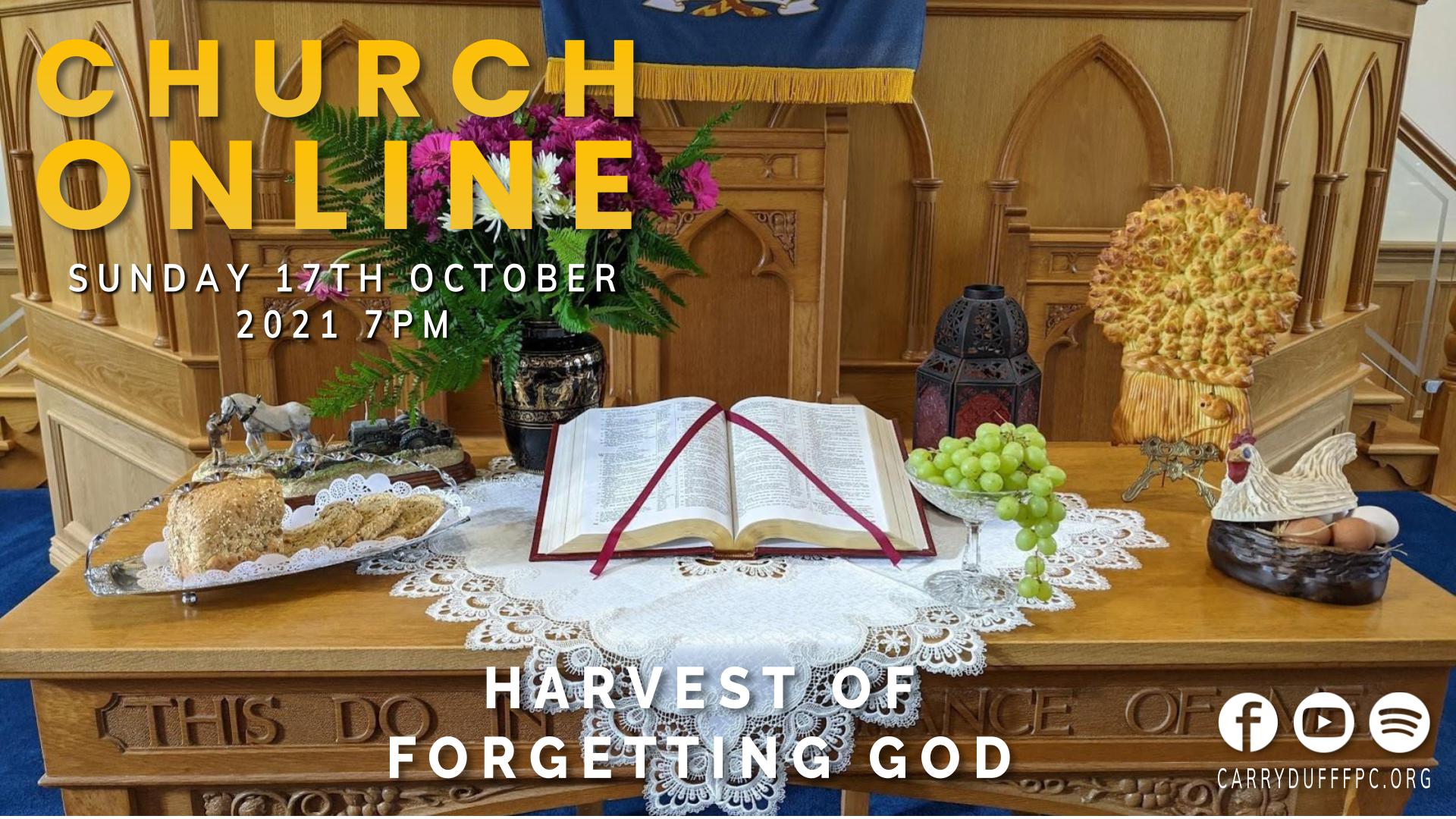

Date: SUN 7:00pm 19th October 2025
Preacher: Rev. Gary Goodes
Bible Reference: Genesis 2:17
But of the tree of the knowledge of good and evil, thou shalt not eat of it: for in the day that thou eatest thereof thou shalt surely die.
Subscribe to the podcast here:
Spotify Podcasts | Apple Podcasts | Pocket Casts
Email | RSS | more information here

Harvest 2025 Photos
Sermon Summary: Genesis 2:15-17
This sermon, delivered on the evening of 19th October, 2025, focuses on Genesis 2:15-17, where God places Adam in the Garden of Eden, instructs him to tend it, and permits him to eat from every tree except the tree of the knowledge of good and evil, with the warning that eating from it will lead to death. The preacher uses these verses to draw a parallel between two trees: the tree of the knowledge of good and evil in Eden, termed the “tree of death,” and the cross of Calvary, referred to as the “tree of life.” The sermon explores their similarities, contrasts, and spiritual significance, urging the congregation to choose faith in Christ.
Key Points:
- Context in Genesis:
- God places Adam in the idyllic Garden of Eden, providing everything for his happiness and fulfilment. However, to exercise free will, God gives Adam a choice: he may eat from any tree except the tree of the knowledge of good and evil, with death as the consequence of disobedience (Genesis 2:16-17).
- This tree, called the “tree of death,” represents the potential for sin and its consequences.
- The Two Trees Compared:
- Location in a Garden: Both the tree of the knowledge of good and evil and the cross of Calvary are situated in gardens. The sermon references John 19, noting that Jesus was crucified in a garden near a new sepulchre, linking the first Adam’s sin in Eden to the last Adam (Christ) redeeming humanity in another garden.
- Knowledge of Good and Evil: Both trees provide knowledge of good and evil, but in different ways:
- The Edenic tree leads to knowledge through disobedience and personal experimentation, resulting in sin’s destructive consequences (e.g., the first murder between Adam’s sons).
- The cross reveals the nature of sin (evil) through Christ’s suffering for humanity’s sins and demonstrates God’s goodness, love, and grace.
- Consequences: The Edenic tree brings death and banishment from paradise, while the cross offers life and access to paradise through faith.
- Human Nature and Sin:
- The sermon challenges the notion that human problems stem solely from environment or upbringing. It asserts that humanity’s issue is sin, inherited from Adam (Romans 5:12), and that no amount of external improvement (education, wealth, etc.) can resolve this spiritual problem—only Christ can transform the heart.
- The preacher illustrates humanity’s rebellious nature, likening it to ignoring a “wet paint” sign or a poison warning, as seen in Adam and Eve’s choice to disobey God after the serpent’s deception (Genesis 3).
- The Deception of the Serpent:
- The devil, described as subtle, twists God’s word to tempt Eve, questioning whether God truly forbade eating from the tree (Genesis 3:1). Eve’s response adds to God’s command (mentioning not touching the tree), showing early distortion of truth.
- The serpent’s lie—that eating the fruit would make them like gods without consequence—leads to their fall, teaching them good and evil through the painful absence of good and the presence of evil.
- Calvary’s Redemption:
- The cross, unlike the Edenic tree, reveals sin’s true cost through Christ’s suffering (2 Corinthians 5:21). It shows God’s love, as Christ died for sinners while they were still in sin (Romans 5:8).
- The sermon highlights the thief on the cross (Luke 23:39-43), contrasting Adam’s banishment from paradise for stealing forbidden fruit with the thief’s acceptance into paradise through faith in Christ. This underscores salvation by faith alone, not works.
- Call to Action:
- The preacher, sharing his own conversion from atheism at age 23, urges the congregation to respond to Christ’s invitation to salvation. He warns against living for oneself, which he equates to stealing the life God gave for His glory.
- Emphasising God’s love and knowledge of every individual’s sins, the sermon invites all to come to Christ in repentance and faith, assuring that Jesus will not cast out those who come to Him (John 6:37).
- The devil, who tempted Adam and Eve to eat from the first tree, now seeks to deter people from accepting Christ at the second tree. The congregation is encouraged to act immediately, trusting in Christ’s sacrifice for eternal life.
Theological Themes:
- Sin and Redemption: The sermon contrasts the fall through Adam’s disobedience with redemption through Christ’s obedience on the cross.
- Free Will and Choice: Adam’s choice to disobey and the thief’s choice to believe highlight the human responsibility to choose between God’s word and the devil’s deception.
- God’s Love and Grace: The cross demonstrates God’s love for sinners, offering salvation despite humanity’s unworthiness.
- Urgency of Salvation: The preacher stresses the immediacy of deciding for Christ, warning of eternal consequences for rejecting Him.
Conclusion:
The sermon weaves together the narratives of the two trees to illustrate humanity’s fall and God’s redemptive plan. It calls listeners to reject the temptation to learn good and evil through personal experimentation with sin and instead embrace the revelation of God’s love and grace at the cross. By placing faith in Christ, individuals can move from death to life, from banishment to paradise, as exemplified by the thief on the cross. The invitation is urgent and personal, extended to all with the promise of acceptance and eternal life.
Prayer Focus: The sermon begins and ends with prayers for the congregation’s spiritual awakening, asking God to draw those outside His family to faith through the “cords of Calvary love” and to empower the preaching with the Holy Spirit.
This summary captures the sermon’s core message, structure, and call to faith, presented in clear UK English while preserving the preacher’s evangelistic tone and biblical focus.