
Christ’s Affirmation of the Sabbath and the Perpetual Moral Law
“Jesus said unto him, Thou shalt love the Lord thy God with all thy heart, and with all thy soul, and with all thy mind.
This is the first and great commandment.
And the second is like unto it, Thou shalt love thy neighbour as thyself.
On these two commandments hang all the law and the prophets.”
— Matthew 22:37–40 (Authorised Version)
Introduction
In a sermon preached on Sunday evening, 22nd March, the Revd David McLaughlin expounded upon the words of our Lord in Matthew 22, addressing the profound truth that Christ’s summary of the moral law—love to God and love to neighbour—reflects the two tables of the Decalogue. Revd McLaughlin reminded his hearers that the first table (Commandments 1–4) defines our duty toward God, while the second table (Commandments 5–10) concerns our duty toward others.
He also referred to a matter often overlooked or misrepresented in modern religious discourse: that our Lord did indeed speak to the sanctifying of the Sabbath day, and that He reaffirmed rather than abolished the moral order summarised in the Ten Commandments. This article will explore that vital truth from a Reformed and Scriptural perspective, demonstrating that the Fourth Commandment—the keeping holy of one day in seven—is as binding under the Gospel as under the Law, though now observed on the first day of the week in commemoration of the resurrection of Christ.
The Two Tables of the Law: Love to God and Love to Neighbour
The moral law given at Sinai, written by the finger of God on two tables of stone (Exodus 31:18; Deuteronomy 9:10), is often divided thus:
- First Table: Commandments 1–4, governing our reverence and love toward God.
- Second Table: Commandments 5–10, governing our conduct toward our fellow men.
Christ’s answer to the lawyer in Matthew 22:37–39 perfectly reflects this order. The first and great commandment—“Thou shalt love the Lord thy God”—comprises all duties belonging to the divine relationship: worship, reverence, truth, and sanctified time. The second—“Thou shalt love thy neighbour as thyself”—summarises the ethics of human fellowship, justice, and mercy.
Far from suggesting that love replaces law, Christ teaches that love fulfils law (Romans 13:8–10). The commandments remain the structured expression of how love behaves in relation to both God and man. “On these two hang all the law and the prophets”—not as redundant relics, but as commandments now written on the believer’s heart under the New Covenant (Jeremiah 31:33).
Christ and the Perpetuity of the Moral Law
Our Lord Jesus Christ declared unambiguously:
“Think not that I am come to destroy the law, or the prophets: I am not come to destroy, but to fulfil.”
— Matthew 5:17
To “fulfil” here is to bring to its full measure—not to repeal, but to realise its perfect intent. Christ, as both Lawgiver and Redeemer, satisfied every moral demand, embodying obedience on behalf of His people. Yet in doing so He never released mankind from moral obligation. As the heavens endure, so does the law’s binding authority upon all men as the rule of righteousness:
“Till heaven and earth pass, one jot or one tittle shall in no wise pass from the law.” — Matthew 5:18
The law remains the rule of life, not the means of justification. This distinction—central to Reformed theology—ensures that grace does not foster lawlessness, but rather gratitude born of redemption.
The Fourth Commandment and the Two Tables of the Law
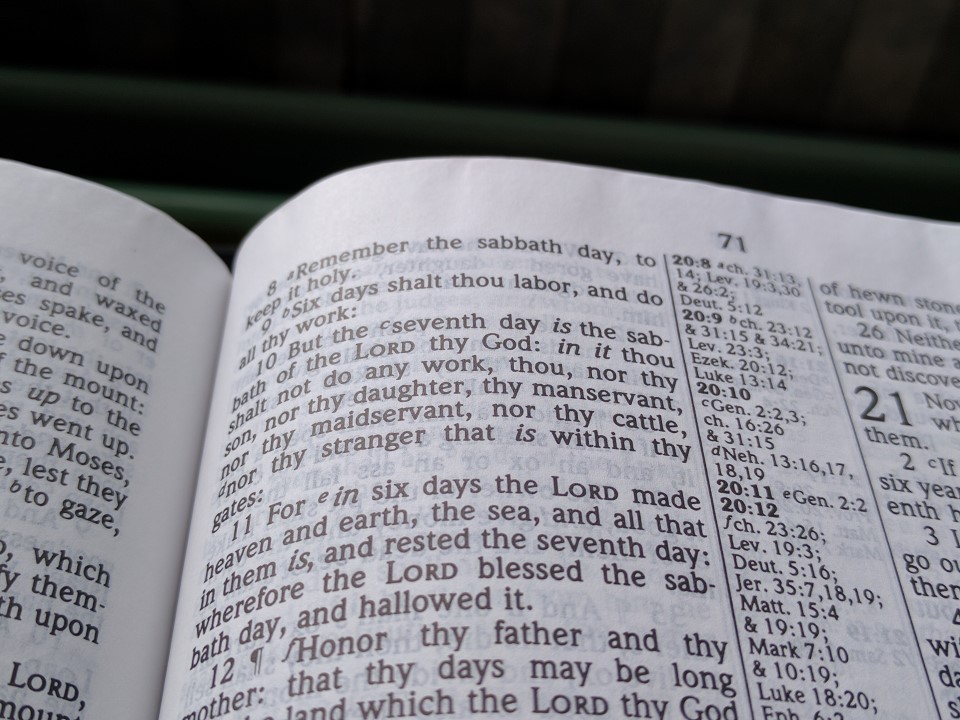
The Fourth Commandment, to remember the Sabbath day and keep it holy, stands uniquely as the bridge between the two tables. It demands devotion to God in holy worship and also extends mercy to man in physical rest. It is rooted not in Sinai alone, but in creation itself:
“And on the seventh day God ended his work which he had made; and he rested on the seventh day… And God blessed the seventh day, and sanctified it.”
— Genesis 2:2–3
Being a creation ordinance, the Sabbath cannot be limited to Israel nor classed merely as ceremonial. It is fundamental to the order of human life—universal, moral, and perpetual. The Sabbath testifies that man is more than a labouring creature; he is a worshipping soul who needs sacred time set apart for God.
Christ’s Affirmation of the Sabbath
It is inaccurate to suggest that the Lord Jesus ignored or contradicted the command to keep the Sabbath. The Gospels reveal His deep engagement with the Sabbath and His correction of the Pharisees’ distortions of its observance.
1. Christ’s Personal Example
“And he came to Nazareth, where he had been brought up: and, as his custom was, he went into the synagogue on the sabbath day.” — Luke 4:16
The Saviour’s routine synagogue attendance demonstrates habitual Sabbath sanctification. He utilised the day for reading the Word, proclaiming truth, and acts of mercy.
2. Christ’s Defence of True Sabbath-Keeping
In Matthew 12, when the Pharisees accused Christ’s disciples of Sabbath violation, He replied that works of mercy and necessity are not breaches of the commandment. His words, “It is lawful to do well on the sabbath days” (v.12), restore the law’s intended purpose: not bondage, but blessing. The Sabbath was designed for man’s spiritual and physical good (Mark 2:27).
3. Christ’s Declaration of Sovereignty
“The Son of man is Lord even of the sabbath day.” — Matthew 12:8
This pronouncement neither annuls nor reduces the Sabbath’s authority; rather it establishes Christ as its rightful Lawgiver. To be “Lord of the Sabbath” is to possess the prerogative to regulate its observance, not abolish its sanctity.
4. Continuance After the Resurrection
In Matthew 24:20, Jesus instructs His disciples concerning events decades hence:
“Pray ye that your flight be not in the winter, neither on the sabbath day.”
Such a command would be meaningless if the Sabbath were to disappear with the resurrection. Instead, by divine appointment, the day of sacred rest was transferred from the seventh to the first day of the week—“the Lord’s Day” (Revelation 1:10)—commemorating Christ’s triumph over death.
The Christian Sabbath: The Lord’s Day
The change of the day’s observance finds apostolic precedent in:
- John 20:19 — Christ appearing to His disciples on “the first day of the week”.
- Acts 20:7 — The early Church gathering “upon the first day of the week” to worship and break bread.
- 1 Corinthians 16:2 — Believers setting aside offerings on “the first day of the week”.
These texts establish the rhythm of Christian worship on the same weekly principle, yet upon the day sanctified by the resurrection. The day changed; the moral principle remained intact.
The Confessional Witness
The Westminster Confession of Faith (1646) declares in Chapter 21, paragraph 7:
“As it is the law of nature, that, in general, a due proportion of time be set apart for the worship of God; so, in His Word, by a positive, moral, and perpetual commandment binding all men in all ages, He hath particularly appointed one day in seven for a Sabbath…”
The Second London Baptist Confession of Faith (1689)—adopted by the Particular Baptists and nearly identical in theology—echoes this doctrine:
“From the beginning of the world to the resurrection of Christ, the last day of the week was the Sabbath; and from the resurrection of Christ was changed into the first day of the week, which is called the Lord’s Day, and is to be continued to the end of the world as the Christian Sabbath.”
(Chapter 22, Paragraph 7)
Thus, both historic Reformed and Baptist confessions affirm the continuity of the Fourth Commandment and its Christian transformation under the New Covenant.
The Sabbath’s Place in the Twofold Love Commandment
When Christ summarised the law, the Sabbath found its rightful place under the first great commandment—love to God. To love God wholly is to delight in His worship and to dedicate time to His honour. To neglect the Sabbath is, in effect, to deny that love which renders obedience joyful. Equally, the Sabbath’s provision of rest for servants, strangers, and livestock reveals love to neighbour, fulfilling the second great commandment in compassion and justice.
Therefore, the Sabbath rests upon the twin pillars of divine and human love. It embodies both piety and charity—worship and welfare. That is why the commandment stands precisely where it does, linking heaven and earth, God and man.
Conclusion
Our Lord’s teaching in Matthew 22 was not a simplification of moral duty but a sublime summation of it. In those two commandments of love, He reaffirmed the entire Decalogue. Revd David McLaughlin’s reminder from 22nd March rightly draws our attention to the enduring relevance of those two tables—their unity under the banner of love, and the Saviour’s lordship over each.
Christ did not repudiate the Sabbath; He purified it from corruption, sanctified it by His own observance, and exalted it in His resurrection as the Christian Sabbath—the Lord’s Day. The love of God and the love of neighbour together uphold the same eternal moral law, and the Sabbath commandment sits at their junction, as both a token of grace and a test of obedience.
“If ye love me, keep my commandments.” — John 14:15
Such love will not chafe at God’s law but will delight in it. The believer resting in Christ’s finished work also delights to rest one day in seven unto the Lord, acknowledging with gratitude the God who created, redeemed, and sanctifies His people.
Soli Deo Gloria.