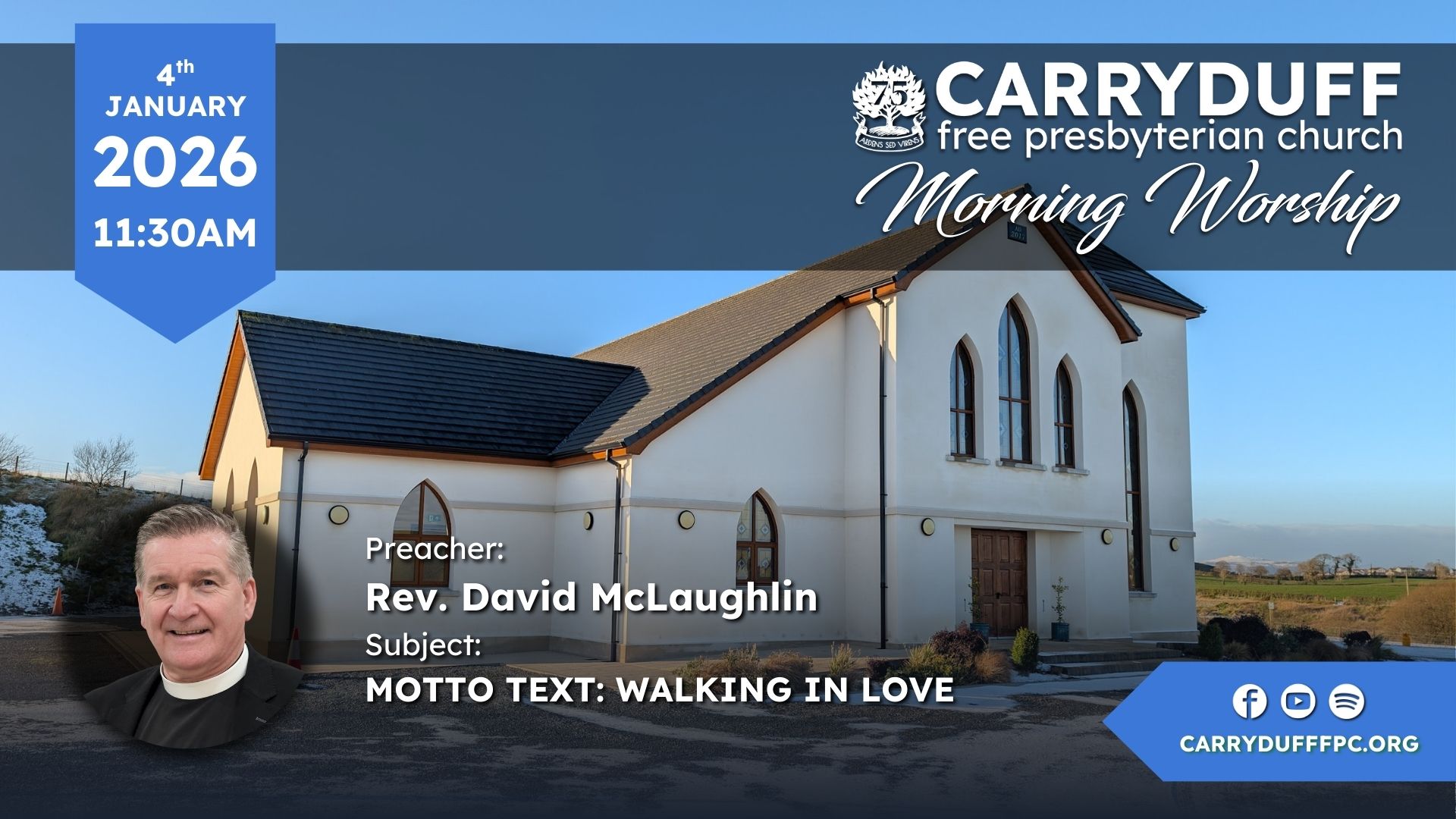

Rev. David McLaughlin would like to thank all those young people who attended the youth rally at Portadown (1st March 2026). Below, is a summary of what the Lord laid on his heart for you all that evening.
Introduction
The subject of Christian obedience—its nature, origin, and evidence—stands at the heart of any true understanding of salvation. This sermon was directed chiefly at young people, yet its principles reach far beyond age or circumstance. The preacher’s central theme, taken from John 14:15, is simple yet profound:
“If ye love me, keep my commandments.”
From these words of Christ flows a powerful truth: obedience does not earn salvation, but rather manifests it. The sermon draws heavily from Scripture, and through a deeply pastoral lens, distinguishes true grace from legalism, profession from possession, and rules-based religion from a living relationship with Christ.
This article aims to expand upon those truths clearly and systematically—remaining faithful to the spirit of reformed orthodoxy and to the King James Bible which formed the basis of the original sermon.
The Foundation of Salvation
Salvation by Grace Alone
One of the strongest themes in the sermon is the assertion that salvation is entirely of God. Quoting Ephesians 2:8–9, the preacher reminds his audience that:
“For by grace are ye saved through faith; and that not of yourselves: it is the gift of God:
Not of works, lest any man should boast.”
Grace, then, is undeserved favour. It is not merely an abstract principle, but the condescending mercy of a holy God toward sinful humanity. It cannot be earned by obedience, nor maintained by merit.
To rest one’s hope upon moral conduct, ecclesiastical membership, or any outward conformity is to construct faith upon sand. As the Lord says in Matthew 7, the house built upon the rock stands firm in the storm, but the one founded upon sand—mere profession without transformation—collapses under judgement.
The Work of Christ as the Sole Ground
Salvation has a definite ground—not human piety, but the finished work of Jesus Christ. He lived perfectly, died sacrificially, and rose victoriously. Romans 5:6–8 establishes this point with unrivalled clarity:
“For when we were yet without strength, in due time Christ died for the ungodly… But God commendeth his love toward us, in that, while we were yet sinners, Christ died for us.”
If salvation could be achieved through law-keeping, as legalism claims, then “Christ is dead in vain” (Galatians 2:21). Thus, obedience cannot form the basis of justification. It is the fruit, never the root.
The Nature of True Conversion
Change as the Mark of Grace
The essence of regeneration lies in transformation. The preacher quotes 2 Corinthians 5:17:
“Therefore if any man be in Christ, he is a new creature: old things are passed away; behold, all things are become new.”
Salvation cannot exist without a change in heart, desire, and conduct. Merely attending church, reciting a prayer, or making a profession is insufficient. The gospel produces in the soul both a hatred of sin and a love for righteousness.
From Legalism to Love
Legalism is described in the sermon as “behaviour modification without heart modification.” It substitutes external compliance for spiritual life. Yet true obedience, the preacher insists, is born from a heart renewed by the Spirit—obedience that flows from love, not compulsion.
The difference between the two lies here:
- Legalism says, “I must obey in order for God to love me.”
- Grace says, “Because God loves me, I delight to obey.”
This aligns perfectly with Romans 8:1:
“There is therefore now no condemnation to them which are in Christ Jesus, who walk not after the flesh, but after the Spirit.”
The regenerate believer is free from the bondage of performance-based religion. His obedience springs from gratitude, not guilt.
The Evidence of Salvation
Obedience as Proof of Relationship
Obedience functions as evidence—not for God, who knows the heart—but for ourselves and for the watching world. 1 John 2:4 makes this distinction stark:
“He that saith, I know him, and keepeth not his commandments, is a liar, and the truth is not in him.”
Thus, a professing believer devoid of obedience deceives himself. The test of spiritual authenticity is not public zeal, emotional fervour, or membership credentials, but the quiet continuity of obedience motivated by love.
A Personal Question
The sermon presses the listener to self-examination: “Has your life changed since professing faith in Christ?”
- Do you possess greater love for righteousness and deeper hatred for sin?
- Has your appetite for God’s Word increased?
- Do you sense a growing submission to the lordship of Christ?
Such marks are not perfection, but direction. The Christian life is not the achievement of flawless morality, but the pursuit of holiness born from a new heart.
The Glory of God’s Salvation
Created in Christ Unto Good Works
The preacher references Ephesians 2:10 as a natural continuation of the salvation paradox—saved not by works, but unto them:
“For we are his workmanship, created in Christ Jesus unto good works, which God hath before ordained that we should walk in them.”
This defines the true glory of salvation: God not only redeems from sin but refashions the human soul to reflect His own holiness. The believer, as a new creation, walks in liberty, not in the bondage of fear.
Liberty from Legalism
In Galatians 5:1, the Apostle Paul implores:
“Stand fast therefore in the liberty wherewith Christ hath made us free, and be not entangled again with the yoke of bondage.”
Legalism is that very yoke. It engenders pride, hypocrisy, comparison, and ultimately despair. Grace, by contrast, produces joy, humility, and sanctified obedience. One strives to appease; the other delights to please.
Illustration: The Thief on the Cross
Among the sermon’s most striking moments is the retelling of the dying thief beside Christ (Luke 23:39–43). Without opportunity for good works or religious rituals, the thief simply cried, “Lord, remember me when thou comest into thy kingdom.” Christ’s reply was immediate: “Today shalt thou be with me in paradise.”
This account demonstrates that salvation is not about ticking moral boxes or accruing merit—it rests upon grace received through faith. Yet even in those final breaths, the thief exhibited obedience—the obedience of faith, the submission of repentance, and the confession of Christ as Lord.
Christian Obedience in Practice
True obedience manifests in the daily walk—through prayer, repentance, love, humility, and service. It is lived out not to secure divine favour but because the believer has already received it.
The preacher’s personal testimony, concluding the sermon, illustrates this transformation vividly:
- The abandonment of sinful habits not by coercion but by conviction.
- The awakening of spiritual thirst so intense he sought Scripture immediately.
- The desire to share the gospel that once he had ignored.
Such outcomes display not moral effort but the regenerating power of the Holy Spirit.
The Contrast Between Legalism and Holiness
Legalism says, “Do more to be accepted.”
Holiness says, “You are accepted, therefore do more.”
One seeks salvation by performance; the other demonstrates salvation by transformation. One boasts in self; the other glorifies Christ.
Legalism creates a culture of comparison and pride within the church. Holiness, grounded in grace, produces gratitude and humility.
Conclusion: Grace that Produces Obedience
The preacher’s sermon ends with an appeal: “Choose a relationship with Christ over rules.” This is not an invitation to antinomianism (lawlessness), but to genuine discipleship—a life guided by the Spirit and shaped by love for the Saviour.
Salvation is indeed by grace alone, through faith alone, in Christ alone, to the glory of God alone, as revealed in Scripture alone. Yet that very grace demands response—it produces obedience as naturally as fruit grows from a living tree.
To quote the text again:
“If ye love me, keep my commandments.”
This simple conditional is not coercive but relational. The Christian keeps Christ’s commandments because he cannot help but love Him who first loved him.
Final Exhortation
Dear reader, the question remains personal and urgent:
Are you resting upon your works, or upon the finished work of Christ?
Do you obey out of fear, or out of love?
Only one of these bears the mark of true salvation. The other is mere religion without redemption.
Let every heart examine itself before God, seeking not to perform for approval, but to love because we are already loved.
“We love him, because he first loved us.”
(1 John 4:19)
 What Do You Believe — and Why Do You Believe It?
 What Do You Believe — and Why Do You Believe It?
That’s a question every Christian must answer. In a world of endless opinions, shifting morals, and pressure to compromise, many young believers know where they go to church but not why they stand where they stand.
The Stand Fast in the Faith Conference has been designed to help you think, understand, and take your stand upon the timeless truth of God’s Word. I invite you to come, dedicate the time, fellowship with believers, and feast on the Word of God on Saturday 21st March.