
Based on the First Epistle to Timothy 2:1–3 (KJB)
“I exhort therefore, that, first of all, supplications, prayers, intercessions, and giving of thanks, be made for all men;
For kings, and for all that are in authority; that we may lead a quiet and peaceable life in all godliness and honesty.
For this is good and acceptable in the sight of God our Saviour.”
—1 Timothy 2:1–3 (KJB)
A Biblical Mandate to Pray for Nations
The Apostle Paul instructs believers to pray for rulers and all who hold authority. This command applies even when those rulers are unjust or hostile to the gospel. Christians are not first called to political activism but to faithful intercession before the throne of God.
Today this call is especially urgent for the nation of Iran—known historically as Persia. Iran stands at a moment of deep tension and uncertainty, in the eye of a storm: internal unrest, regional conflict, economic hardship, and the ever-present shadow of war.
For believers around the world, this moment should stir earnest prayer.
The Historical Land of Persia
Iran occupies a region of immense historical and biblical significance. In ancient times, the Persian Empire stretched across vast territories and played a major role in the history of God’s people.
Notable rulers include:
- Cyrus the Great, who permitted the Jewish exiles to return and rebuild Jerusalem.
- Darius I, who continued policies favorable to the Jews.
These events are recorded in the books of Ezra, Nehemiah, and Esther.
The Bible also refers to regions within or near modern Iran such as:
- Elam
- Media
- Parthia
In Acts 2:9, people from these lands were present in Jerusalem at Pentecost, hearing the gospel proclaimed.
This reminds us that the peoples of this region have been within the redemptive purposes of God from ancient times.
The Modern Political Reality
Modern Iran emerged from the upheaval of the Iranian Revolution, which overthrew Mohammad Reza Shah Pahlavi and established an Islamic Republic under Ruhollah Khomeini.
Since then, the nation has experienced:
- Heavy government control and surveillance
- Strict censorship and limits on speech
- Suppression of dissent
- Periodic violent repression of protests
Many citizens have grown weary of corruption, hypocrisy, and economic hardship. For decades, Iranians have lived under a system where religious authority and political power are tightly intertwined.
Fear and mistrust are common realities in daily life.
Persecution of Christians and Dissidents
Christians—especially converts from Islam—often face significant pressure, including:
- Harassment by security forces
- Imprisonment
- Restrictions on church gatherings
- Confiscation of Bibles
- Social ostracism
Many believers therefore meet in secret house churches. The underground Christian movement has grown in recent decades, yet it remains fragile and often fragmented.
There is also a severe shortage of trained pastors and sound Bible teachers. False teachings can easily spread when theological resources are scarce.
The Need for Scripture and Faithful Teaching
Faithful translation and distribution of Scripture remain crucial.
Organizations such as the Trinitarian Bible Society have worked to provide Persian-language Bibles, including editions of the Henry Martyn Persian New Testament—a translation associated with the missionary Henry Martyn.
But the need is still great:
- More accurate translations
- More pastors trained in sound doctrine
- More resources rooted in historic, biblical Christianity
The Iranian church needs solid, Christ-centered teaching grounded in Scripture—not religious speculation or political ideology.
Salvation Is Not Political
The gospel message must remain clear:
Salvation does not come through revolutions, political movements, or national reform. It comes through the finished work of Jesus Christ alone.
As Scripture teaches, redemption is accomplished not by human effort but by the grace of God through faith.
Political change may alter circumstances, but only the gospel can transform hearts.
Biblical Prophecy and Iran
Some Bible readers wonder whether modern Iran corresponds to ancient peoples mentioned in prophecy.
The Bible references regions like:
- Elam (see Jeremiah 49:34–39)
- Persia (see Daniel)
However, it is difficult to make precise one-to-one identifications between modern nations and ancient prophetic references. What Scripture clearly teaches is not the exact geopolitical alignment of future nations but the sovereignty of God over all history.
God raises up kings and removes them according to His purposes.
God’s Sovereignty Over Nations
Scripture repeatedly affirms that God rules over the affairs of the world.
No ruler escapes His authority.
One day every leader—including every ruler of Iran—will stand before God to give an account.
As written in Romans 14:12:
“So then every one of us shall give account of himself to God.”
No regime, however powerful, will escape divine judgment.
A Nation in the Eye of the Storm
Iran today stands under dark clouds:
- Geopolitical tension
- Internal unrest
- Economic strain
- The threat of wider conflict
The population—young, educated, and increasingly disillusioned—longs for justice and honesty in public life.
This moment of crisis may also be a moment of gospel opportunity.
Historically, times of upheaval often prepare hearts to seek truth.
How Christians Should Pray
In obedience to 1 Timothy 2, believers should pray:
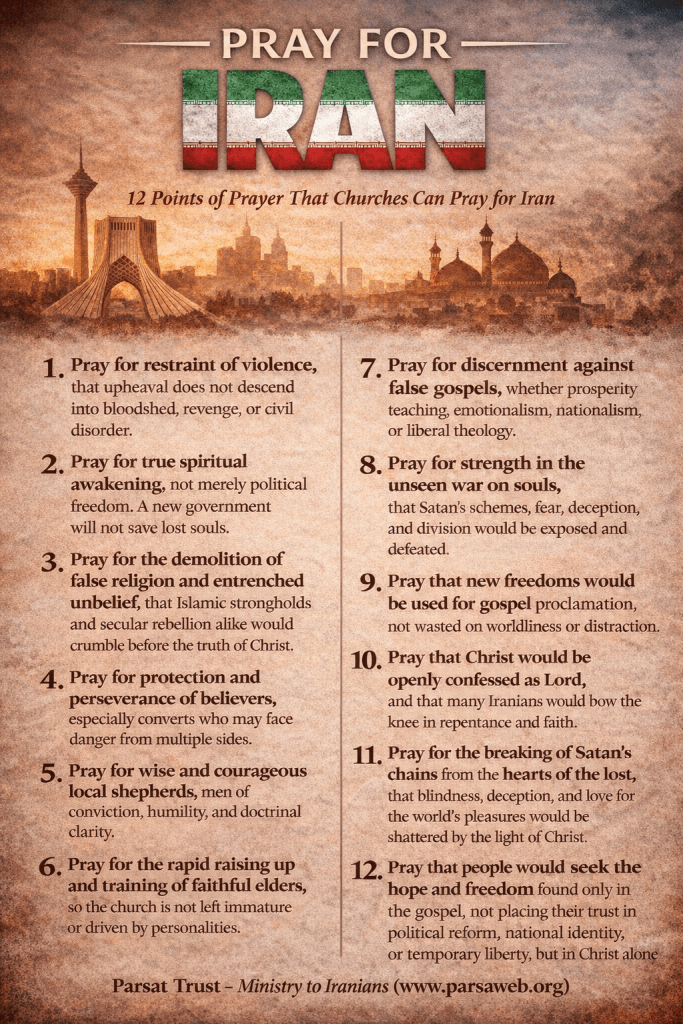
- For true peace and justice in Iran — that violence, repression, and fear would give way to stability and righteousness.
- For the downfall of false religion — that systems which obscure the gospel would lose their hold on the nation.
- For the spread of the gospel — that Christ would be openly proclaimed throughout Iran.
- For the underground church — that believers would be protected, strengthened, and unified.
- For pastors and teachers — that God would raise up faithful leaders grounded in Scripture.
- For Bible translation and distribution — that the Persian Scriptures would reach every household.
- For national leaders — that they might act with justice—or be removed according to God’s will.
Hope for a New Dawn
Though the situation appears dark, the gospel reminds us that no nation lies beyond God’s reach.
The land once known as Persia has witnessed God’s providence before. It could again see a remarkable spiritual awakening.
The future of Iran does not ultimately rest in the hands of political leaders, military powers, or international alliances. It rests in the hands of the sovereign Lord of history.
And so the church must pray:
That God would bring light into darkness.
That Christ would build His church.
That one day the people of Iran would experience a new dawn—one marked not by fear or repression, but by the freedom found in the gospel of Jesus Christ. ✝️🙏
A Nation in Crisis: War and the Death of a Leader
In recent days, the situation in Iran has taken a dramatic and historic turn. The country’s long-time Supreme Leader, Ali Khamenei, who ruled the Islamic Republic since 1989, was killed in February 2026 during a series of joint military strikes carried out by Israel and the United States targeting senior Iranian leadership and military infrastructure.
Iranian state media later confirmed his death and announced a national period of mourning.
This assassination has created the most serious political crisis in the Islamic Republic since the Iranian Revolution.
At the same time, a wider regional war has erupted. Military strikes by Israel and the United States have targeted Iranian missile bases and nuclear-related facilities—part of a broader effort to weaken Iran’s military capabilities and limit its nuclear program.
The conflict has already caused heavy casualties and widespread destruction, with hospitals and civilian infrastructure reportedly damaged during the fighting.
These developments have left the Iranian population in a state of deep uncertainty. Leadership succession is unresolved, the country faces internal instability, and the threat of further escalation across the Middle East remains high.
The Shadow of the Nuclear Question
For decades, Iran’s nuclear program has been a central source of international tension. Western governments and Israel have feared that uranium enrichment and related activities could eventually enable the development of nuclear weapons.
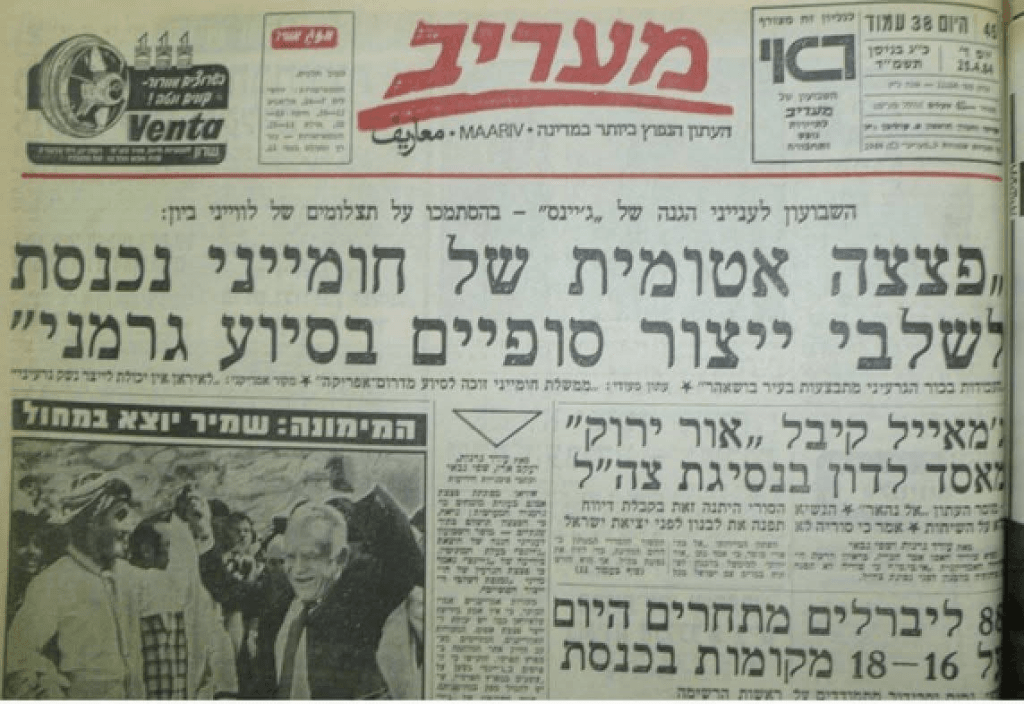
Iran has repeatedly claimed its program is for civilian energy purposes, while critics argue it could enable rapid weaponization if the political decision were made.
The recent strikes by Israel and the United States were justified, by those governments, as attempts to halt or delay Iran’s nuclear capabilities and prevent the emergence of a nuclear weapon in the region.
This dispute over nuclear technology has been one of the main factors pushing the Middle East toward the current conflict.
A Moment of Tremendous Uncertainty
The death of Ali Khamenei has opened a profound leadership vacuum. For decades, he held ultimate authority over Iran’s military, judiciary, and political system.
Now the future direction of the Islamic Republic is unclear.
Will the regime tighten its grip on power?
Will internal divisions deepen?
Or could the nation move toward a new political future?
No one yet knows.
What is certain is that millions of ordinary Iranians—many weary of corruption, repression, and religious hypocrisy—are caught in the middle of a dangerous storm.
A Time for Earnest Prayer
For Christians, moments like this should not produce political triumphalism or indifference. Instead, they should drive us to prayer.
Scripture reminds us that God is sovereign over the rise and fall of rulers.
Kings and presidents may believe they control history, but ultimately they answer to God.
As written in Romans 14:12:
“So then every one of us shall give account of himself to God.”
This includes every ruler—whether in Iran, Israel, or any other nation.
The church should therefore pray:
- For peace amid war
- For the protection of civilians
- For justice and truth to prevail
- For the opening of Iran to the gospel of Jesus Christ
The present crisis may yet become an unexpected door for the spread of the gospel in the land once known as Persia.
God often works through upheaval in ways human eyes cannot yet see.
A Biblical Theology of Persia and Elam in Prophecy
When considering the modern nation of Iran, it is helpful to reflect on the biblical lands that historically occupied the same region. In Scripture, this area is often associated with Persia and Elam. These peoples and territories appear in several prophetic passages, reminding us that the lands of modern Iran have long been within the unfolding purposes of God.
The Bible does not present modern geopolitical maps, nor does it allow us to make simplistic identifications between present-day nations and prophetic symbols. Yet it clearly shows that God has always been sovereign over the region historically connected with Persia.
From the earliest centuries of biblical history to the prophetic writings and even into the New Testament era, these lands appear repeatedly in the narrative of redemption.
Elam in the Prophets
One of the most direct prophetic references is found in the ministry of Jeremiah. In Jeremiah 49:34–39, God pronounces judgment upon Elam:
“I will break the bow of Elam, the chief of their might.”
This prophecy speaks of divine judgment against the power and pride of Elam. Yet the prophecy does not end with destruction alone. In verse 39, the Lord declares:
“But it shall come to pass in the latter days, that I will bring again the captivity of Elam, saith the LORD.”
This remarkable promise shows both judgment and restoration. Even in pronouncing judgment upon nations, God leaves open the door of mercy and future redemption.
Some theologians see here a hint that the peoples of this region would one day again be touched by God’s saving purposes.
Persia in the Book of Daniel
The most detailed biblical treatment of Persia appears in the visions given to the prophet Daniel. In Daniel 8, the prophet sees a ram with two horns representing the Medo-Persian Empire. This empire would succeed Babylon and dominate the ancient Near East.
These events were historically fulfilled in the rise of the Persian Empire under rulers such as Cyrus the Great.
Significantly, Cyrus became an instrument in God’s providence by allowing the Jewish exiles to return to Jerusalem and rebuild the temple. Though he did not personally know the God of Israel, he nevertheless served God’s sovereign purposes.
This reminds us that God often uses rulers—even those outside His covenant people—to accomplish His will in history.
Daniel also contains a mysterious reference to spiritual warfare in Daniel 10, where a heavenly messenger speaks of the “prince of Persia.” Many interpreters understand this as a spiritual power influencing earthly kingdoms, reminding us that political events often have unseen spiritual dimensions.
Persia in the Prophecies of Ezekiel
The prophet Ezekiel also refers to Persia in his visions.
In Ezekiel 38:5, Persia is listed among the nations allied with Gog in a future conflict:
“Persia, Ethiopia, and Libya with them; all of them with shield and helmet.”
Interpretations of this passage vary widely among scholars. Some see it as referring to ancient conflicts, while others believe it describes a future coalition of nations opposing God’s people.
What is certain is that Persia is presented as a significant nation in the broader drama of God’s dealings with the world.
Again, the key theological point is not the exact political alignment of modern nations but the certainty that God governs the rise and fall of kingdoms.
Persia in the New Testament
Even in the New Testament, the peoples of this region appear in the story of the early church.
At Pentecost, when the Holy Spirit was poured out, visitors from several regions associated with modern Iran were present.
Acts 2:9 mentions:
- Parthians
- Medes
- Elamites
These people heard the gospel proclaimed in their own languages.
This moment demonstrates that the gospel was reaching the Persian world from the very beginning of the church age.
God’s Sovereignty Over Nations
The consistent biblical message is clear: God rules over all nations.
Empires rise and fall. Rulers gain power and lose it. Political systems appear permanent but eventually pass away.
Yet the kingdom of God endures.
The Scriptures repeatedly remind us that leaders are accountable to God. One day every ruler will stand before the divine Judge.
As written in Romans 14:12:
“So then every one of us shall give account of himself to God.”
This truth applies to every government—past, present, and future.
A Pastoral Call to Prayer
In light of these biblical truths, how should Christians respond to the present crisis in Iran?
First, we must remember that our ultimate hope does not rest in political systems or military outcomes. Nations may rise or collapse, but the gospel of Jesus Christ remains the only true hope for humanity.
Second, we must obey the apostolic command found in 1 Timothy 2:1–3—to pray for rulers and those in authority.
Therefore, believers should pray:
- That God would restrain violence and bloodshed
- That justice and truth would prevail
- That the people of Iran would be delivered from oppression and fear
- That the underground church would be strengthened and protected
- That faithful pastors and Bible teachers would be raised up
- That the Scriptures would spread throughout the land
- And, above all, that many would come to saving faith in Jesus Christ
The land once known as Persia has seen the mighty works of God before. It witnessed the return of the Jewish exiles, the rise and fall of empires, and the early spread of the gospel.
It may yet witness another great work of God.
So let the church pray earnestly:
Pray that the Lord would bring light into darkness.
Pray that the gospel would advance despite persecution.
Pray that Christ would build His church even in the midst of war and uncertainty.
For the Lord who rules the nations is still gathering His people from every tribe, tongue, and nation—including the people of Iran.
We will be sharing more information by Pastor Pooyan Mehrshahi, chairman of the Parsa Trust and pastor at Providence Baptist Chapel Church, Cheltenham, click on the red bell at the bottom left to be notified of new posts.