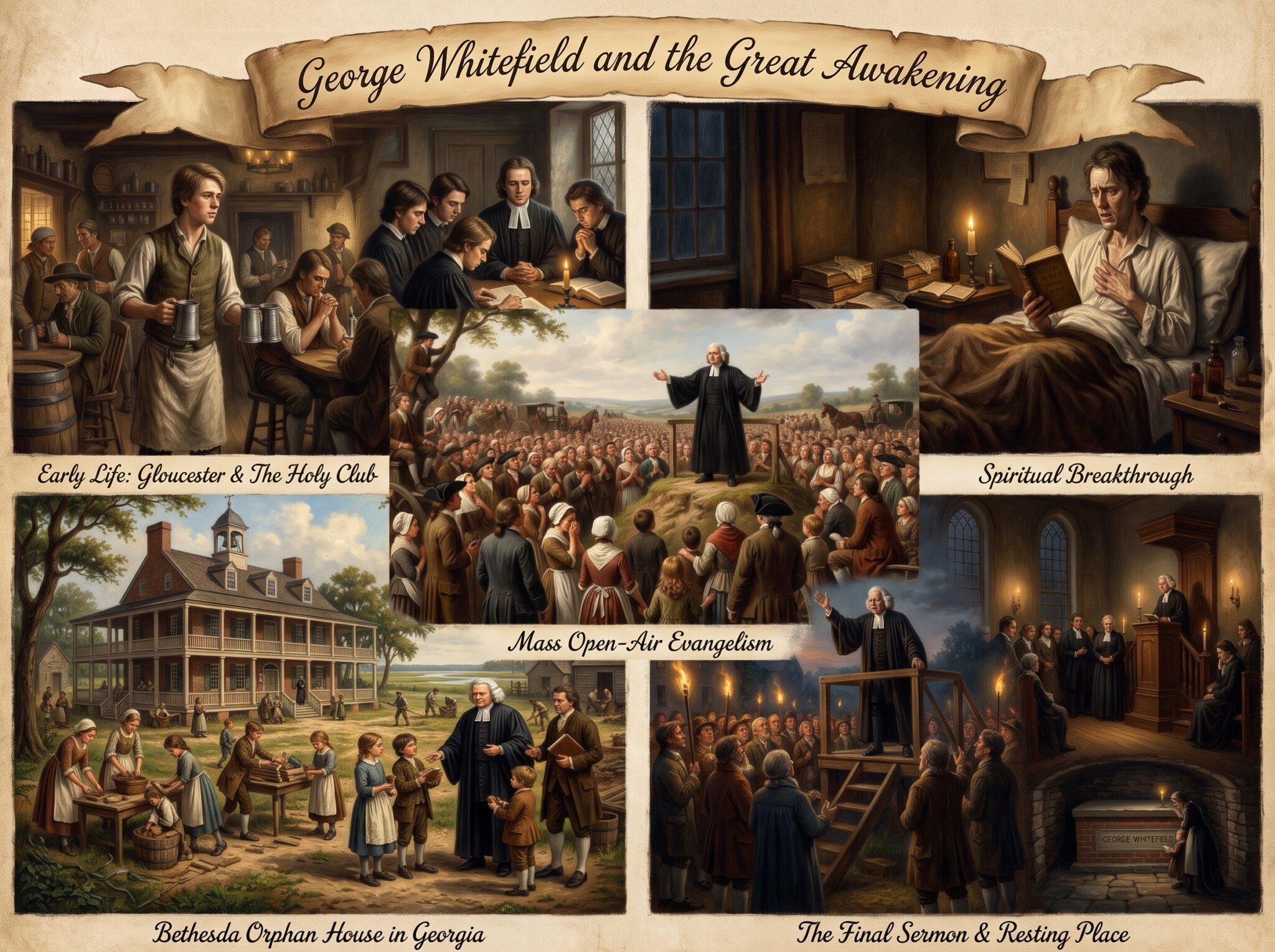

Introduction: The Man Who Shook the English-Speaking World
George Whitefield (16 December 1714 – 30 September 1770) stands among the most consequential figures in the history of Protestant Christianity, yet his name is often overshadowed by his contemporaries John and Charles Wesley. By any measurable standard, Whitefield was the greater preacher, the greater evangelist, and arguably the more enduring theological influence. He preached an estimated 18,000 sermons to perhaps ten million hearers across Britain and colonial America, in an age when the total population of the American colonies barely exceeded two million. He crossed the Atlantic thirteen times, a hazardous undertaking in the eighteenth century, and died exhausted in the harness at the age of fifty-five.
From a Reformed perspective, Whitefield is of singular importance because he was the great Calvinist voice of the Evangelical Revival. Where the Wesleys drifted toward Arminianism, Whitefield held fast to the doctrines of sovereign grace articulated by Augustine, Calvin, and the Reformed confessions. Yet his Calvinism was never a cold intellectual system; it was a burning, heart-warming conviction that produced one of the most extraordinary preaching ministries in church history.
A note on the calendar: Whitefield’s birth is recorded in the parish register of Gloucester as 16 December 1714, Old Style (the Julian calendar then in use in Britain). Some biographies give 27 December, which is the same date converted to the Gregorian (New Style) calendar — the Julian calendar lagged eleven days behind the Gregorian in the eighteenth century. His death on the morning of 30 September 1770 is likewise dated Old Style. The differing dates found in the literature are a calendar artefact, not a genuine dispute.
Early Life and Conversion
George Whitefield was born at the Bell Inn in Gloucester, the youngest of seven children. His father, Thomas Whitefield, kept the inn, and his mother, Elizabeth, managed it after her husband’s early death when George was just two. The family circumstances were modest, and the young Whitefield knew the indignities of genteel poverty. He was educated at the Crypt School in Gloucester, where his aptitude for oratory became apparent early; he delighted in acting and declaiming, performing speeches from plays to his schoolmates. It was during these early years, at about the age of four, that he contracted measles. Through the ignorance or neglect of his nurse, the illness left one of his eyes — dark blue and lively — with a permanent squint, a defect that would follow him for life and earn him the mocking nickname “Dr Squintum” among his enemies.
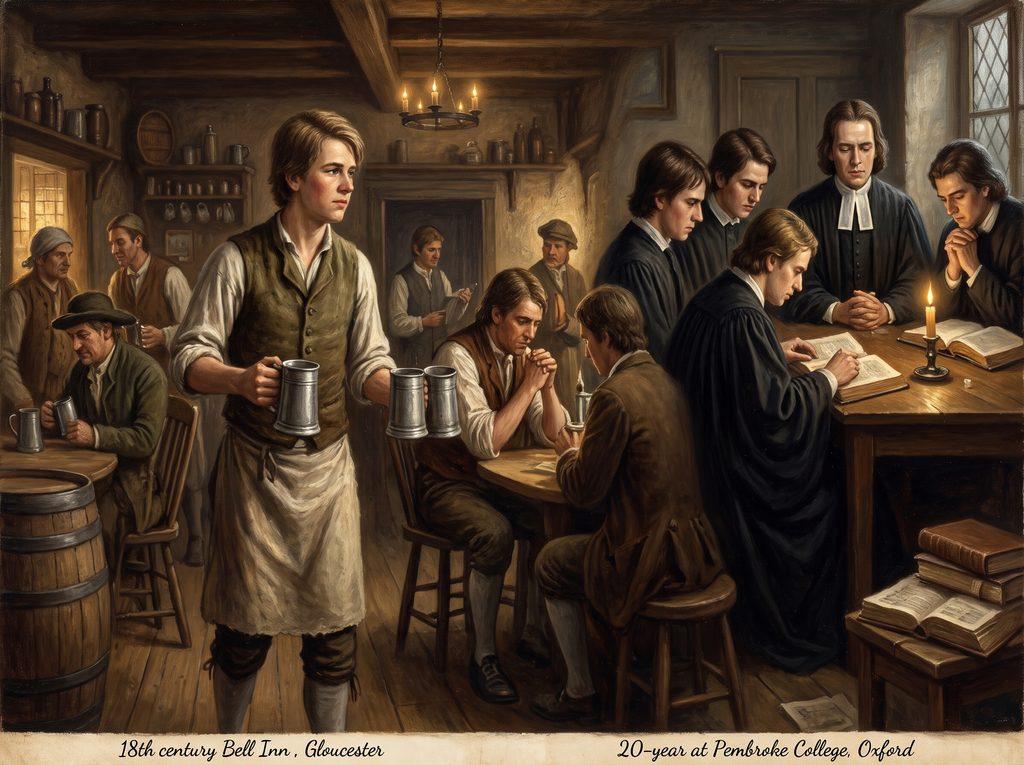
His path to Oxford was forged through service. Around the age of fifteen or sixteen, he gained admission to Pembroke College as a servitor, a student who paid his way by performing menial tasks for wealthier fellows. It was a humiliating position, but it placed him at the heart of the religious ferment that would change his life.
At Oxford, Whitefield encountered the Holy Club, a small band of earnest students gathered around the Wesley brothers. The group was devoted to methodical piety: fasting, Scripture reading, frequent communion, and visiting the sick and imprisoned. It was from this club’s disciplined methods that the “Methodists” took their name, at first as a term of mockery. Whitefield threw himself into these practices with characteristic intensity, fasting until his health broke down and his body became gaunt and weakened.
More importantly, this period produced his conversion. In the spring of 1735, confined to his sickbed and wrestling with a profound sense of sin, Whitefield passed through a prolonged spiritual crisis. He described himself as being under terrifying conviction, haunted by his own unworthiness and by the fear of eternal damnation. His diaries record the agonies of a soul struggling to find peace with God through his own efforts, and failing utterly.
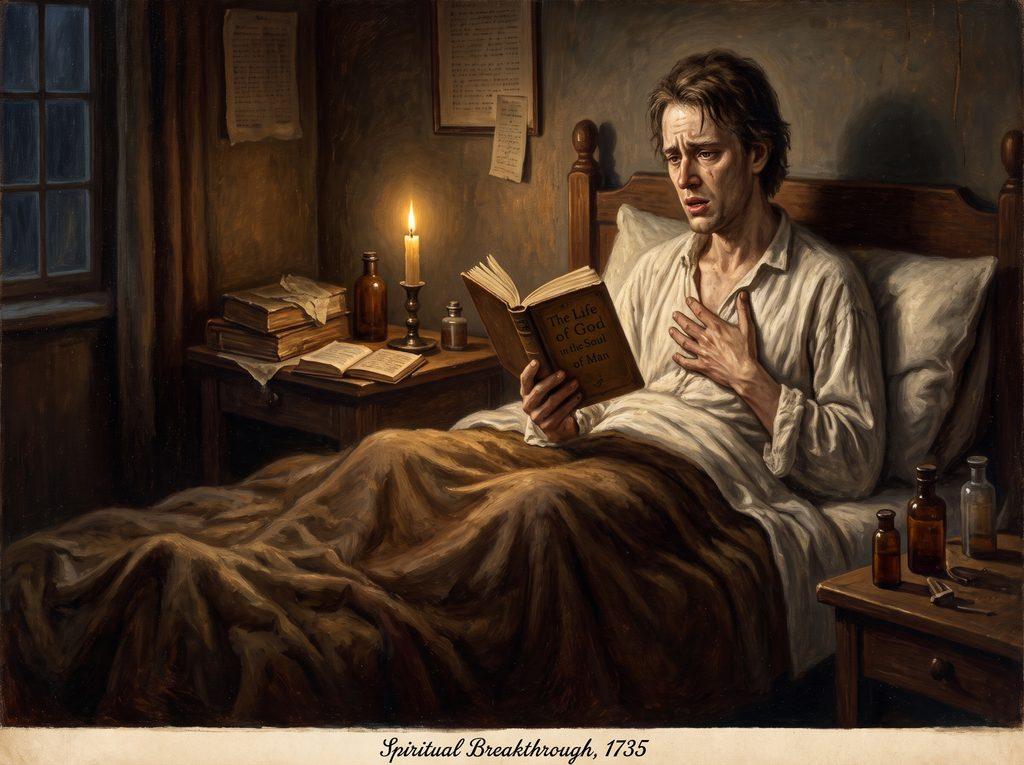
The breakthrough came through reading. A companion lent him The Life of God in the Soul of Man by Henry Scougal, and in that small book Whitefield discovered that religion was not a matter of external observance but of a vital union with Christ, a transformation of the heart by the Holy Spirit. He later wrote:
“God was pleased to remove the heavy load, to enable me to lay hold of his dear Son by a living faith… I now knew I was justified by faith in the Redeemer.”
The date was approximately 14 July 1735. Whitefield was twenty years old, born again, and the course of his life was irrevocably set. Within a year he had been ordained a deacon of the Church of England, and shortly thereafter a priest. His first sermon, preached at the church of St Mary de Crypt in Gloucester, was so powerful that he believed fifteen people in the congregation were driven to conviction of sin. His fame spread rapidly, and within months he was preaching to congregations across Gloucestershire, London, and Bristol, drawing crowds that overflowed the churches.
The Open-Air Ministry and the Great Awakening
The Anglican pulpit, however, proved too small for George Whitefield. As his fame grew, so did the opposition. Parish clergy, unsettled by his emotional intensity and his insistence on the new birth, began to refuse him their pulpits. It was this exclusion that drove Whitefield to the decisive innovation of his ministry: preaching outdoors.
The circumstances are well known. In February 1739, denied the pulpits of Bristol, Whitefield resorted to the open air. On 17 February he preached from a mound in the coal-mining district of Kingswood to a crowd of some two hundred miners. He described the scene vividly in his journal:
“I thought it might be doing the service of my Creator, who had a mountain for his pulpit, and the heavens for a sounding board, and who, when his gospel was refused by the Jews, sent it to the Gentiles.”
The effect on the miners, many of whom had never entered a church, was profound. Whitefield wrote of the “white gutters made by tears” running down their coal-blackened cheeks as the gospel of free grace was proclaimed. The open-air ministry was born, and with it the shape of mass evangelism as it would be practised for the next three centuries.
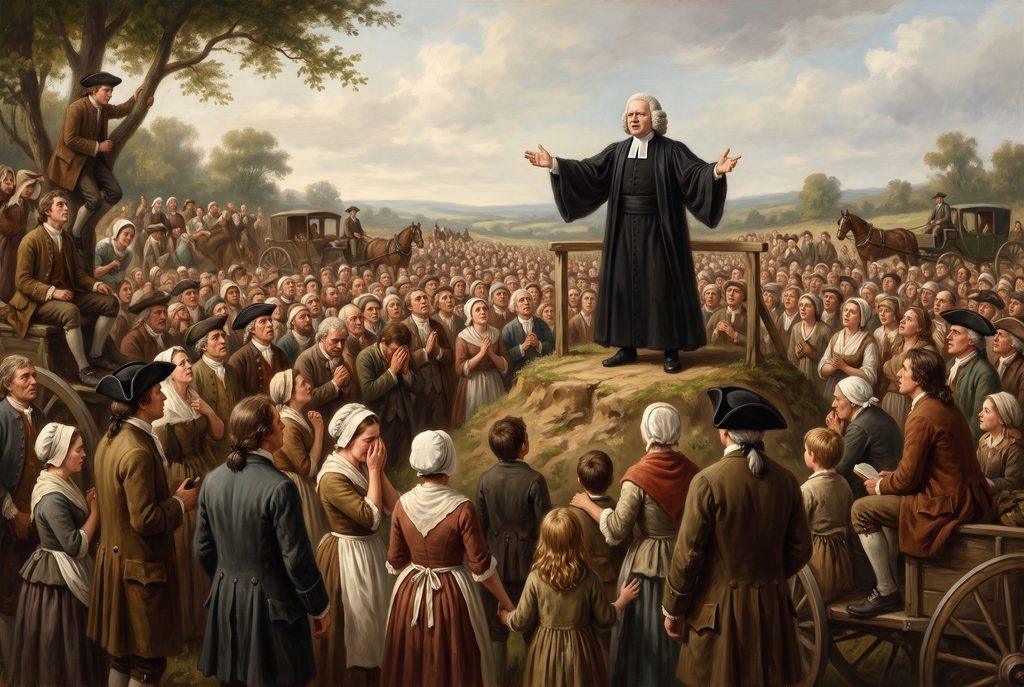
The following year, Whitefield took this ministry across the Atlantic. He arrived in Georgia in 1738, intending to establish an orphanage, which he eventually built at Bethesda, near Savannah, funding it through his preaching tours. It was in those American visits that Whitefield became the central figure of what historians later called the First Great Awakening. Between 1740 and 1770 he made seven extended tours of the American colonies, preaching from Georgia to New Hampshire, to crowds that often numbered in the tens of thousands, with no amplification beyond the force of his own extraordinary voice.
Benjamin Franklin, no friend to religious enthusiasm, attended one of Whitefield’s open-air sermons in Philadelphia and estimated that the voice carried to a crowd of some thirty thousand people — in an age before any electronic amplification. Modern acoustic analysis of open-air preaching in that era has broadly corroborated the historical reports: a trained, powerful voice of the type Whitefield demonstrably possessed could project to audiences in the tens of thousands under favourable conditions, with some contemporary listeners placing the upper reaches of his crowds at fifty thousand or more. Franklin, who had come determined to resist the collection for Bethesda Orphan House, found himself so moved that he emptied his pockets into the hat as it was passed round. He wrote the famous epitaph:
“It was wonderful to see the change soon made in the manners of our inhabitants. From being thoughtless or indifferent about religion, it seemed as if all the world were growing religious, so that one could not walk through the town in an evening without hearing psalms sung in different families of every street.”
Whitefield in Context: The Wider Reformation
George Whitefield did not arise in a vacuum. He stood in a long and living succession of reformers who, across two centuries, had sought to recover the biblical gospel from the accretions of medieval religion. His theological ancestry reached back through the Puritan divines of the seventeenth century — through John Owen, Richard Baxter, and the profound Jonathan Edwards, whose Northampton revival of 1734–1735 preceded and prepared the ground for Whitefield’s own ministry — to the continental Reformers whose names defined the movement: Martin Luther, who recovered justification by faith alone, and above all John Calvin, from whom Whitefield drew the marrow of his doctrine of grace. He was the heir of the English Reformation too, of the Thirty-nine Articles which, on his own telling, taught the same moderate Calvinism he preached, and of the great Anglican evangelists and pastors who had kept the flame of experimental piety alive within a church that had too often grown cold and formal. Around him, the revival he helped to detonate produced a constellation of fellow labourers — the brothers Wesley, George Whitefield’s friends and later his theological adversaries; Howell Harris and the Welsh revivalists; the Countess of Huntingdon, that remarkable patroness who built chapels for his preaching; and the seceders and evangelicals of Scotland who welcomed him at Cambuslang. Yet Whitefield was more than one bright figure among many. He was the hinge. It was he who carried the embers of the awakening from one shore of the Atlantic to the other, who bound the scattered sparks of revival into a single transatlantic fire, and who stood, at the critical moment, as the great Calvinist sentinel — holding the line for sovereign grace against the rising tide of Arminianism even as he embraced his Arminian brethren in love. In him, the Reformation’s deepest convictions found a voice that could move a continent.
Theology: The Great Calvinist Controversy
The theological heart of Whitefield’s ministry, and the doctrine that set him apart from his closest allies, was his unyielding Calvinism. The estrangement from the Wesleys came to a head over precisely this issue.
John Wesley, increasingly drawn to Arminianism, published a sermon in 1739 that attacked the Calvinist doctrine of predestination, and in 1740 he preached his notorious sermon on “Free Grace,” which denounced the idea that God had unconditionally elected some to salvation and passed over others. Whitefield, then in America, responded with a published letter to Wesley in which he respectfully but firmly defended the Reformed position:
“You say you have compassion on the doctrine of election… I am very sorry that you should run with such heedless and impetuous speed to the precipice of error… The doctrine of election and the final perseverance of those that are truly in Christ I am persuaded is a truth taught in God’s Word… Free-will, in the creature, so far as I can see, is a doctrine of the flesh.”
Whitefield’s Calvinism was not a cold determinism. He insisted that election was a doctrine of comfort, not of speculation; it was designed to humble the sinner and magnify the grace of God. He wrote:
“I believe that God did from all eternity elect some to everlasting life, and did leave others in their sins… This, I know, is a hard doctrine to the natural man, but I am persuaded it is a Scripture doctrine, and God will vindicate His own truth.”
Crucially, Whitefield refused to allow the controversy to shatter their friendship utterly. They remained personally affectionate, and Whitefield famously instructed that Watts’ hymns be sung alongside Wesley’s, and that Wesley’s works continue to be read. When asked whether he expected to see Wesley in heaven, Whitefield is reported to have replied: “I fear not, for he will be so near the eternal throne, and we at such a distance, we shall hardly get sight of him.” The remark is probably apocryphal, but it captures the spirit of his charity.
Whitefield’s theology was a full-orbed Reformed orthodoxy. He held to the five points of Calvinism: total depravity, unconditional election, limited atonement, irresistible grace, and the perseverance of the saints. He was a Trinitarian of the Nicene stamp, an upholder of justification by faith alone, and a firm believer in the substitutionary atonement of Christ. His sermons are saturated with the language of grace, the sovereignty of God, and the necessity of the new birth.
Yet his Calvinism was evangelistic in a way that later generations, in their arid scholasticism, often failed to replicate. Whitefield saw no contradiction between the absolute sovereignty of God and the free offer of the gospel to all. He preached to every creature, urged immediate decision, and insisted that faith was the duty of every hearer, all while maintaining that the ability to believe was the gift of God. He refused to allow logical tension to paralyse proclamation. “Our preaching,” he said, “is not to be limited by our notions of election.”
Preaching: The Anatomy of a Ministry
To understand Whitefield’s influence, one must attempt to understand his preaching. Contemporary accounts are unanimous: it was a phenomenon that defied explanation in merely human terms. He was not a tall man, nor was his voice naturally remarkable to begin with, though he trained it to extraordinary power. His genius lay in a combination of natural gifts and holy unction.
John Wesley’s epigram is often quoted: “He is a man of fire, and no wonder the people are so fond of him.” David Garrick, the greatest actor of the age, said that Whitefield could pronounce the single word “Mesopotamia” in such a way as to move an audience to tears.
His preaching was extemporaneous in delivery but not unprepared. He wrote out his sermons, often in full, and delivered them with a dramatic and emotional force that made even written texts come alive. He used his voice as an instrument: now a whisper that drew the crowd in, now a thunder that shook the square. He employed gestures, pauses, and impersonation, dramatising biblical scenes with such vividness that hearers reported seeing the events themselves.
Even his physical defect contributed to his power. Because of his squint, his eyes never tracked together, so that individuals scattered across a vast assembly each believed the great preacher was looking directly at them — a piercing, personal gaze that seemed to single them out for the message of judgment and mercy. Some contemporaries took the cross-eyed appearance as a mark of divine favour, and David Martin’s celebrated 1770 portrait shows the squint plainly. It never seemed to hamper him in the least; indeed, it became one of the very features that made him unforgettable.
The content of his sermons was relentlessly biblical. He preached through the great doctrines: the sinfulness of man, the holiness of God, the reality of hell, the sufficiency of Christ, the freeness of grace, the necessity of the new birth. He was not a speculative theologian; his sermons were designed for conversion and edification, not for intellectual display. He frequently addressed his hearers directly in the second person, dramatising the judgment scene or the approach of death, and pressing for immediate decision.
His preaching produced extraordinary effects. Swooning, weeping, and cries of anguish were common during his meetings. Critics accused him of encouraging hysteria, and there is no doubt that some of the phenomena were excesses. Whitefield himself, while defending the reality of religious affections, was careful to insist that emotional responses were not the test of true conversion; only a changed life would prove the reality of grace.
The Transatlantic Ministry and Expansion
Whitefield’s peculiar vocation was as an itinerant. He never settled into a single parish, and his ministry spanned three continents of the Anglophone world. His thirteen crossings of the Atlantic were remarkable feats of endurance, and they made him a unifying figure in an age before rapid communication, knitting together a shared religious and social consciousness across the scattered American colonies.
His impact on America was profound and lasting. It is no exaggeration to say that he helped to create a shared evangelical identity among the scattered colonies, a spiritual commonwealth that crossed denominational and geographical lines. He preached in the open air to the poor, in the pulpits of Congregationalist, Presbyterian, and Baptist ministers, and to the slaves of the southern plantations, whom he insisted had souls as precious as their masters’.
In Britain, his ministry was equally transformative. He ranged from Cornwall to Scotland, preaching wherever he could gather a crowd. In Scotland, he cooperated with the evangelical party within the Church of Scotland and with the seceders, preaching at Cambuslang in 1742 in what became a remarkable revival. In 1741 he had married Elizabeth James, a Welsh widow, a marriage that appears to have been more dutiful than romantic, and which produced one surviving son, who died in infancy.
Whitefield was ecumenical in a way that was remarkable for his age. He refused to be confined by denominational labels, insisting that the essential thing was the new birth and the sovereign grace of God. His friendliness toward the Moravians, and his willingness to preach in the pulpits of Dissenters, brought him into conflict with the Anglican establishment, which viewed him with increasing suspicion. He was, in a sense, a churchman without a church, simultaneously loyal to the Church of England in his ordination vows and committed to a ministry that outran its boundaries.
The Orphanage at Bethesda and the Widening of the Work
The permanent institutional expression of Whitefield’s compassion was the Bethesda Orphan House in Georgia. Conceived as a refuge for the orphans of the colony, it became the central project of his life, and its funding consumed vast amounts of his energy across three decades. He raised money for it in Britain and America, and it repeatedly drained his personal finances. It embodied his conviction that the gospel must issue in works of mercy, and it secured his place as a man whose piety was not merely verbal. Beyond Bethesda, his influence extended through the printed word; his journals, published in instalments, were among the most widely read religious works of the century, and his collected works nourished evangelical piety for generations.
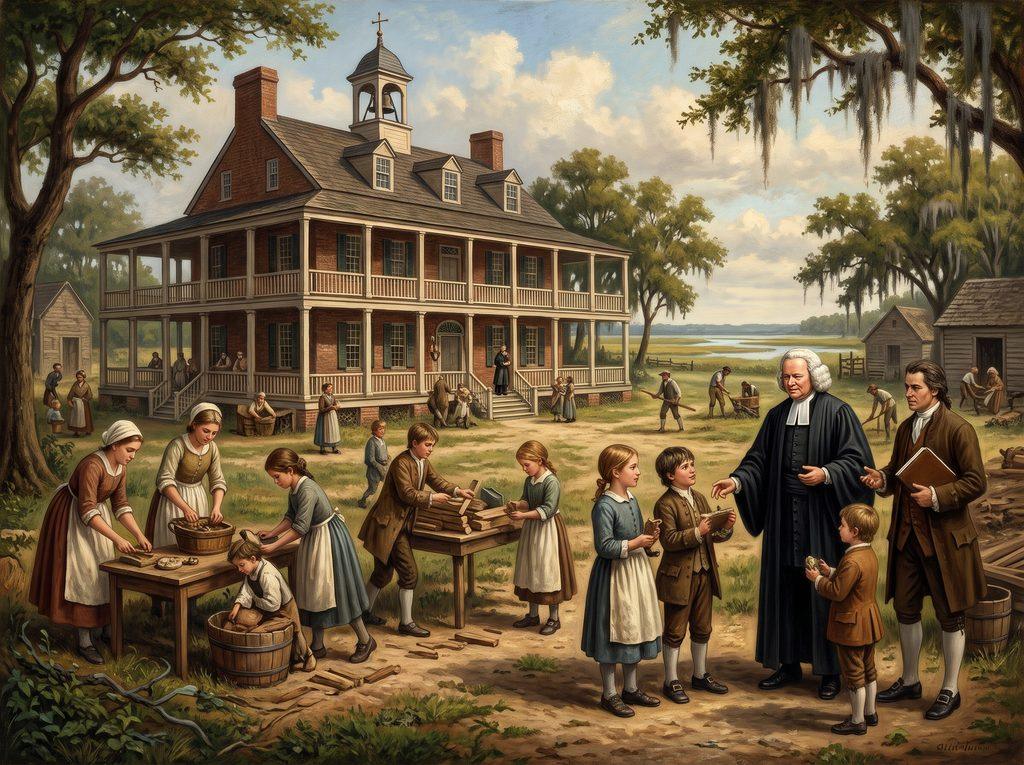
His record on the enslaved people of the colonies was, and remains, deeply conflicted. He must be heard with full honesty on both sides of the ledger. At his best, Whitefield was a prophetic voice against cruelty. His 1740 open letter to the slaveholders of Maryland, Virginia, and the Carolinas thundered: “God has a Quarrel with you for your Abuse of and Cruelty to the poor Negroes.” He condemned masters who treated their bondspeople worse than their livestock, who withheld food and clothing, who beat them without mercy. And he insisted, against the prevailing fear of the age, that the slaves had immortal souls worth the same gospel as their masters’ — that converting an enslaved person made them a better servant, not a more rebellious one. In this, he displayed a genuine, if limited, compassion: he preached to the enslaved, insisted on their spiritual equality, and denounced their mistreatment.
Yet his advocacy hardened with time. He campaigned to legalise slavery in Georgia specifically to sustain Bethesda, pressuring the colony’s trustees until slavery was permitted; he himself acquired, purchased, and bequeathed enslaved people; and Bethesda itself was eventually worked by enslaved labour. He never repudiated the institution, and unlike Wesley and Newton, never moved toward abolition. The contradiction between his message of spiritual equality and his acceptance of bodily bondage is the gravest stain on his memory, and no honest account can excuse it.
It is precisely here that the deepest lesson of Whitefield’s own gospel must be recalled. He never asked anyone to model their life on him. His entire ministry — to the last breath — pointed away from every human exemplar, including George Whitefield, and to Christ alone. “Look to Christ,” he urged his hearers to the end — not to the preacher’s virtue, his eloquence, or his works, but to the sinless Saviour. Whitefield knew himself to be a flawed Christian, a man in need of grace like any sinner; that is why his gospel was grace from first to last. He fastened the eyes of his congregations not on himself, but on the finished work of the Redeemer. The correct response to his failure on slavery is not to enshrine him as a model, but to do as he himself commanded: look past the man, in all his brokenness, to Christ.
The Terror and the Comfort of the Gospel
No account of Whitefield’s preaching is complete without confronting its most frightening element: his vivid proclamation of eternal punishment. To modern sensibilities, schooled in a sentimental religion that declines to mention hell, Whitefield’s sermons on the wrath of God are almost unbearable. He preached, with terrible power, of the sinner hanging over the pit of destruction by a thread, of the flames of perdition, of the everlasting conscious torment awaiting the unrepentant.
This was not sadism. It was, in Whitefield’s own mind, the necessary corollary of the gospel of free grace. The cross is only good news to those who understand their peril; the physician is only welcome to the sick. His aim in preaching terror was to drive sinners to Christ, to strip away the self-righteousness that keeps a soul from the Saviour. He preached hell out of love, not out of cruelty. He would often weep as he described the fate of the lost, and he urged his hearers, with tears, to flee from the wrath to come.
The terror, however, was always the prelude to the comfort. Whitefield’s gospel was a gospel of assurance. He preached that Christ had done everything, that salvation was complete in Him, that the believer could know, with certainty, that his sins were forgiven and that he was accepted before God. This assurance, rooted in the finished work of Christ rather than in the believer’s own experience, was the great gift of his Calvinism to those who sat under his ministry. It produced, in his converts, a stable and joyful confidence that survived the inevitable doubts and trials of the Christian life.
Later Years and Death
The later years of Whitefield’s life were marked by ceaseless labour and declining health. He suffered from asthma and a persistent cough, aggravated by his outdoor preaching in all weathers. His itineraries were punishing; in his final American tour, he preached two or three times daily, often in the open air, moving from town to town without rest.
His last sermon was preached on 30 September 1770, at Newburyport, Massachusetts, from an open-air scaffold, to a large crowd. He preached for nearly two hours, and his text was 2 Corinthians 13:5: “Examine yourselves, whether ye be in the faith.” It was a fitting message with which to end a ministry that had always pressed home the necessity of personal religion.
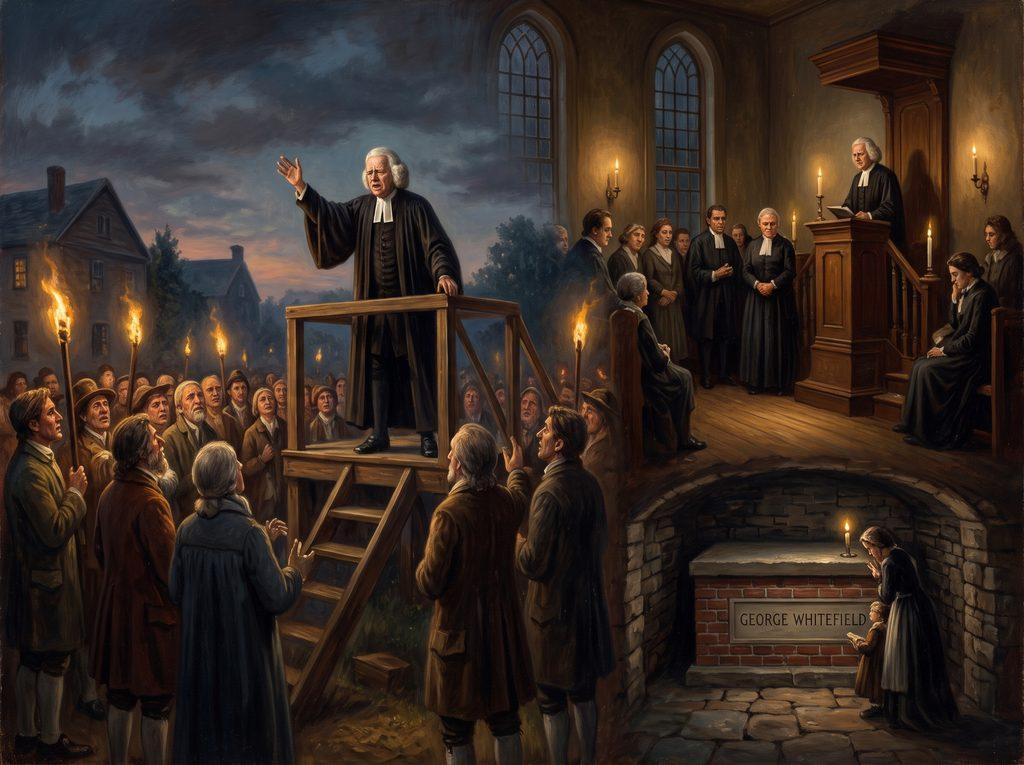
The following morning, 1 October 1770, George Whitefield died at the manse of the Presbyterian minister Jonathan Parsons. He was fifty-five years old. His body was buried in a vault beneath the pulpit of the First Presbyterian Church in Newburyport, where it remains to this day.
His death was mourned across the English-speaking world. In London, the news produced an extraordinary outpouring of grief. John Wesley, his old friend and theological opponent, preached his funeral sermon, and in a striking act of charity paid tribute to the man who had so often differed from him:
“Is it not possible, that the God of love, who hath more ways than one to bring souls to himself, may have over-ruled even this… I have taken some pains to prove that particular election and final perseverance are not the doctrines of the gospel… But let us keep close to the grand doctrines of the gospel, and not spend our time in contending about those things that are not essential to salvation.”
Legacy and Significance
The significance of George Whitefield can be measured in several ways.
First, he was the principal human instrument of the First Great Awakening, the revival that transformed the religious landscape of colonial America and laid the foundations for the evangelical movement that would dominate American Christianity for two centuries. His influence created a network of evangelical leaders, churches, and institutions that survived his death and flourished.
Second, he was the great Calvinist of the revival. At a moment when Arminianism threatened to capture evangelicalism in the person of John Wesley, Whitefield held the line for sovereign grace. His preaching demonstrated, once for all, that Calvinism is not inimical to evangelism but is, in fact, its surest foundation. The doctrines of grace did not paralyse his proclamation; they fuelled it. This is a lesson the Reformed church has repeatedly needed to relearn, and it is the lesson Whitefield embodies above all others.
Third, he pioneered the methods of mass evangelism. The open-air preaching, the itinerancy, the use of printed media, the cooperation across denominational lines, the urgent appeal for immediate decision, the institutional expression of mercy in the orphanage — all of these became the template for the great evangelists who succeeded him, from Wesley and Finney to Moody and Graham.
Fourth, he was a man of extraordinary holiness and sacrifice. His letters and journals reveal a man who lived for one thing alone: the glory of God and the salvation of souls. He died exhausted in the service of his Master, having spent himself without reserve. Whatever his failings of judgement, and they were real, his life stands as a rebuke to the comfort-seeking Christianity of our own age.
Conclusion: The Grand Itinerant as a Model
From a Reformed perspective, George Whitefield offers a model of ministry that the church urgently needs to recover — with one crucial caveat. He combined, in a single ministry, what is so often sundered: fervent evangelism and sound doctrine, heartfelt piety and theological rigour, the free offer of the gospel and the absolute sovereignty of God, the terror of the law and the comfort of grace, the word preached and the word lived.
He was not without faults, and they are real faults, not decoration. His record on slavery is a moral tragedy. His emotionalism could tip into excess. His ecumenical zeal occasionally outran his discernment. But these are the flaws of a man whose total consecration to Christ left him no room for the cautious reservations that mark lesser men.
The greatest tribute to Whitefield is not the statue erected to him, nor the biographies written of him, but the continuing power of the gospel he preached. He would want no other memorial. His own words, spoken at the height of his fame, remain the best summary of his life’s aim:
“Let the name of Whitefield perish, but Christ be glorified.”
That is the final word, and it is the correct one. Not George Whitefield as the model — but Christ, whom Whitefield spent his life holding before the eyes of a dying world.