
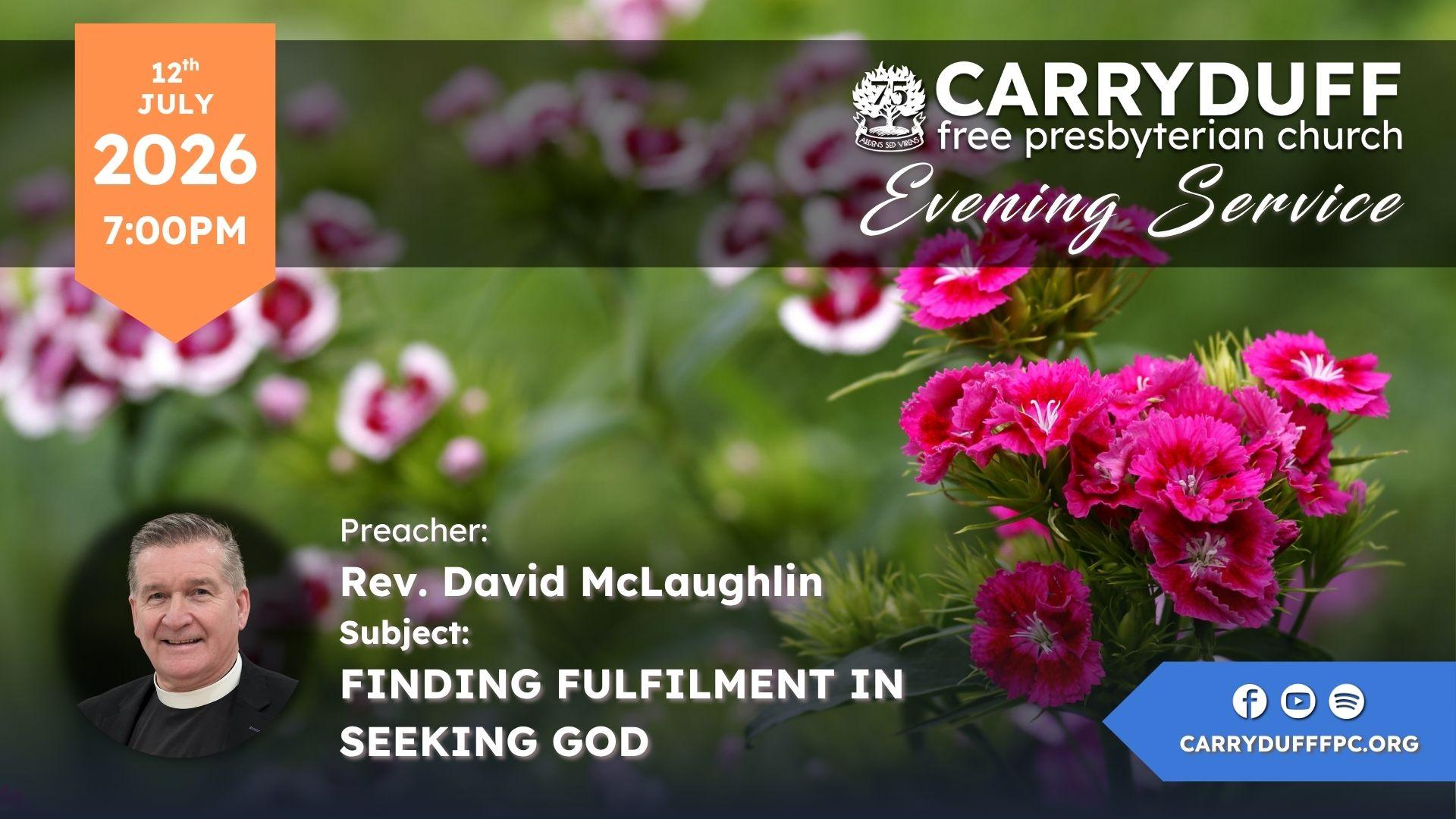

Date: SUN 7:00pm 12th July 2026
Preacher: Rev. David McLaughlin
Bible Reference: Jeremiah 29:13
Podcast
Sermon Summary
Introduction: The Context of Jeremiah 29
The sermon opens by establishing that Jeremiah 29 is one of the most misunderstood chapters in all of Scripture. It is frequently misapplied—quoted as though it were written to people living their best life here and now. The preacher calls this not merely an error but a lie.
The chapter was in fact addressed to God’s covenant people living under the blistering hand of Almighty God in Babylonian exile. These were the captives whom Nebuchadnezzar had carried away from Jerusalem to Babylon around 597 BC. False prophets were assuring the people that their captivity would end soon, but through Jeremiah, God declared the exile would last seventy years: “For thus saith the Lord, that after seventy years be accomplished at Babylon I will visit you, and perform my good word toward you, in causing you to return to this place.”
Jeremiah’s instruction was counter-intuitive: settle in Babylon, build houses, plant vineyards, make gardens, marry, seek the welfare of the city, and wait upon God’s appointed time.
The Theological Nature of the Exile
The preacher emphasises that the captivity was not merely political or societal—it was fundamentally theological. The children of Israel were in Babylon because they had:
- Forsaken the Lord and forgotten Him
- Embraced idolatry
- Rejected the authority of the Word of God
- Ignored all the repeated calls to repentance
Against this dark backdrop comes one of the greatest promises in Holy Scripture. Jeremiah 29:13—“And ye shall seek me, and find me, when ye shall search for me with all your heart”—reveals the heart of a true seeker. God is not found merely by the curious, the casual, or the religious. He is found by those who seek Him with their whole heart.
The Greater Exile and the Greater Restoration
The preacher draws a crucial theological distinction that elevates the message beyond its immediate historical context. He argues that the promise ultimately points beyond a mere return from Babylonian captivity to the great deliverance found in the redemptive purposes of the Lord Jesus Christ.
The greatest exile is not from Jerusalem to Babylon, nor from Canaan to Egypt. The greatest exile is being eternally separated from God because of sin. The preacher references Jesus’s words in John’s Gospel, where He states three times that if you die in your sins, where He is you cannot be.
The greatest restoration is not returning home to one’s homeland after seventy years. The greatest restoration is being restored to a right relationship with God, redeemed by the blood shed by the Lord Jesus Christ.
Part One: The Person We Must Seek
The text reads: “And ye shall seek me, and find me, when ye shall search for me with all your heart.”
Three times the word me appears, and the inspired commentary in verse 14 identifies the speaker: “I will be found of you, saith the Lord.”
The person to be sought is the true and living God. The preacher references Jeremiah 10:10—“But the Lord is the true God, he is the living God, and an everlasting king”—and Exodus 15:11—“Who is like unto thee, O Lord, among the gods? who is like thee, glorious in holiness, fearful in praises, doing wonders?”
What the Text Does Not Say
The preacher makes a pointed observation about what is absent from the text. It does not say:
- Seek blessings
- Seek peace and prosperity
- Seek answers to your questions
- Seek experiences
- Seek knowledge
- Seek religion or a church culture
It says, three times: seek me.
Contemporary Application
The preacher applies this directly to religious observance in Northern Ireland. Many attend the house of God on the Lord’s Day seeking the benefits of God—described colloquially as being “good living for a living.” Many want the gifts of the benefactor but do not know the God of the benefactor.
He references the district services held by the loyal orders, acknowledging they bring a sense of community, identity, and loyalty. There is a good feel factor about attending in health and strength and joining with one’s brethren. Yet he presses the question: why go to the house of God? There should be one answer, one reason—that we are brought into a right relationship with the true and living God.
Biblical Examples of Seeking God Himself
The preacher marshals several scriptural witnesses:
- Calvin’s dictum: the greatest knowledge in the world is the knowledge of God. The gospel urges men and women not to seek benefits from God but to seek God Himself.
- David in Psalm 27:4: “One thing have I desired of the Lord, that will I seek after; that I may dwell in the house of the Lord all the days of my life, to behold the beauty of the Lord, and to inquire in his temple.” The word “beauty” can be translated “delight.”
- David in Psalm 42: “As the hart panteth after the water brooks, so panteth my soul after thee, O God. My soul thirsteth for God, for the living God: when shall I come and appear before God?”
- Psalm 46:10: “Be still, and know that I am God.”
- Deuteronomy 33:26: “There is none like unto the God of Jeshurun, who rideth upon the heaven in thy help, and in his excellency on the sky.”
- Paul in Philippians 3:10: Even after thirty years of conversion and ministry, Paul could say, “That I may know him, and the power of his resurrection, and the fellowship of his sufferings, being made conformable unto his death.”
The supreme blessing of salvation is God Himself. Calvin stated that the chief good of man consists in union with God. The Lord Jesus Christ came into the world—born for us, living the sinless life for us, bleeding and dying for us on the cross—not merely to bring us to heaven (though that is a tremendous assurance and benefit) but to bring us to God, to bring us into a right relationship with Him, that we might be reconciled to Him.
Paul’s words in 2 Corinthians are invoked: “Now then we are ambassadors for Christ, as though God did beseech you by us: we pray you in Christ’s stead, be ye reconciled to God. For he hath made him to be sin for us, who knew no sin; that we might be made the righteousness of God in him.”
The prodigal son realised he needed something more than food—he needed to be reconciled to his father. Hence his resolve: “I will arise and go to my father, and will say unto him, Father, I have sinned against heaven, and before thee.”
Part Two: The Pursuit We Must Search
The text continues: “And ye shall seek me, and find me, when ye shall search for me.”
The Place of Seeking
The children of Israel were in captivity. They were experiencing life’s difficulties. They were there because of sin—sinful choices, sin’s wages. The preacher observes that God often allows trouble, pain, and difficulty to enter our lives to wake us up and to get us to look up. The children of Israel were to find God in captivity through repentance.
The prodigal son only came to himself in the pigsty, not in the pub when he was engaged in riotous living. Many only pray “Lord, help me” when everything else has failed.
The preacher addresses young people directly:
- Many feel pressure at school
- Many feel anxiety at work
- Many face problems in the home
- Many feel lonely in a crowd
- Many carry the guilt of some particular sin that nobody else knows about—but God knows
He offers a sharp illustration: many young people treat the God of the Bible like their mobile phone—they only plug it into charge when the red light is on, when the battery says one percent and is about to go out. Yet that trouble which comes into their life can be a mercy if it drives them to seek Christ.
The preacher then addresses three categories of hearers:
- The sinner burdened by guilt: sin promises freedom but leaves and binds chains about us
- The backslider: one whose heart once tended toward the things of God but who has left off reading the Bible, whose prayer life has faded to virtually nothing, who has stopped attending the house of God, where some sin has crept in and taken over, and the distance between them and God has produced a dryness—yet the wonderful message of Jeremiah is that God is married to the backslider, and in that backslidden state there is a mercy once you realise you are cold and not right with God and must return
- The struggling child of God: one with many problems, who can call upon the Lord and seek Him, saying “Help me, Lord; be gracious to me in this situation; let me see Your face in all of this.” The preacher references the Psalmist: “I will lift up mine eyes unto the hills, from whence cometh my help. My help cometh from the Lord, which made heaven and earth.”
The Pathway of Seeking
How do we seek? Not by popularity, not by good works, not by the church or religious ceremonies and rites—only through the Lord Jesus Christ. Salvation is of the Lord. Salvation is by grace alone, through faith alone, in Christ alone, as revealed in the Bible alone.
The preacher offers an illustration: think of a king’s palace. You are outside, covered in muck and dirt, feeling unworthy and ashamed to enter through the gates. That is how we as sinners stand before a holy God. Yet the Lord Jesus Christ, on the cross, shed His blood. The cross is not merely a religious symbol worn around the neck; it is the place where righteousness and peace have kissed each other, where holy justice and holy mercy have met together. On the cross, the Lord Jesus took the guilt and punishment for sin, and from that cross mercy and grace is dispensed. We can come as we are—as those who have fallen in the mud and dirt of sin, as guilty sinners, broken and needy and poor—and trust Him entirely.
The hymn writer is quoted: “View him prostrate in the garden; on the ground your Maker lies. On the blood-stained tree behold him; hear him cry before he dies: It is finished! It is finished! Sinner, will not this suffice?”
The Passion in Seeking
Seeking implies diligence—like a man hunting for treasure. The Bible does not preach a salvation earned by merit, but it always portrays sinners as earnestly coming to Christ.
The preacher references:
- The Sermon on the Mount: “Strive to enter in at the strait gate”
- Matthew 6:33: “Seek ye first the kingdom of God, and his righteousness”
- The continuous present tense of asking, seeking, and knocking
- The woman who searched diligently for her lost coin
- The shepherd who searched diligently for the lost sheep
- The merchant who searched diligently for the pearl
Diligent seeking involves genuine repentance, calling on God in prayer, receiving God’s precious Word, the gift of faith, the exercise of that faith, and a life of loving obedience. Faith comes by hearing, and hearing by the Word of God. God has ordained the preaching of the Word, prayer, and the dispensing of the sacraments as the very means of grace—God’s appointed pathways for seeking Him.
The Illustration of Augustine
The preacher tells the story of Augustine, born in the fourth century, raised in a Christian home by his godly mother Monica, who prayed daily for his salvation. Augustine was not interested. He pursued wine, women, and song; he loved the party lifestyle. He searched through different philosophies and beliefs, seeking satisfaction in the pleasures of the world and in ambition.
One day in Milan, in a garden, in a drunken state, he fell asleep. He awoke to the sound of a voice: “Tolle lege, tolle lege”—Latin for “take and read, take and read.” He looked around and on a garden table sat a Bible. He opened it at random and read Romans 13:11-14:
“And that, knowing the time, that now it is high time to awake out of sleep: for now is our salvation nearer than when we believed. The night is far spent, the day is at hand: let us therefore cast off the works of darkness, and let us put on the armour of light. Let us walk honestly, as in the day; not in rioting and drunkenness, not in chambering and wantonness, not in strife and envying. But put ye on the Lord Jesus Christ, and make not provision for the flesh, to fulfil the lusts thereof.”
As he read those words, Augustine was converted—born of the Spirit, by the gift of faith, with true belief and true repentance. He later became the Bishop of Hippo and wrote that there is a void, an emptiness in all our lives that only God can fill: “Thou hast made us for thyself, and our hearts are restless until they find rest in thee.”
The Principle of Seeking
The words are: “with all your heart”—not half-heartedly, not casually, not with a divided heart. This is the heart of the verse: not a perfect seeking, but a passionate seeking.
The heart refers to the real inner person—mind, affections, will, conscience, and emotions. It is not an outward seeking; it is an inward seeking. It is not a divided seeking—not a seeking of Jehovah and some idol at the same time. It is not a seeking merely with the lips while the heart is far from Him. True conversion affects and reaches the heart.
The preacher challenges young people: what are you most passionate about? In Northern Ireland, it might be sports, music, gaming, fashion, fitness, social media, the bands, the loyal orders. People chase after these things, but how little energy is expended in seeking to know God.
Hebrews 11:6 is quoted: “Without faith it is impossible to please him: for he that cometh to God must believe that he is, and that he is a rewarder of them that diligently seek him.”
The Lord is more important than anything else in the whole world—more than sports, music, gaming, fashion, fitness, social media, even the loyal orders. He is more important than popularity, pleasure, possessions, power, and pomp. The preacher quotes the hymn: “I’d rather have Jesus than silver or gold.”
He presses the point: if you find God through the Lord Jesus Christ, you will not regret the search. Even if friends and family call you weak, brainwashed, strange, and odd—take it on the chin and say, to God be the glory, because you have found the real meaning and purpose of life.
Part Three: The Promise That Must Satisfy
The text concludes: “And ye shall seek me, and find me, when ye shall search for me with all your heart.”
The Astonishing Nature of the Promise
It is astonishing—a sign of wonderful grace. God promises to be found. He says: “I will be found of you, saith the Lord: and I will turn away your captivity, and I will gather you from all the nations, and from all the places whither I have driven you, saith the Lord; and I will bring you again into the place whence I caused you to be carried away captive.”
Sovereign Grace in Seeking
God promises to be found not because man is naturally able to seek God and find Him in his own strength or power. Whenever this search is made for God, we actually discover that all the while He has been seeking us—ordering the circumstances, drawing us, revealing Himself to us.
Left to ourselves, apart from free sovereign grace, we would never seek God. The Bible says there is none that seeketh after God (Romans 3:10). How then can we seek? Grace makes us a seeker. God first seeks the sinner. God takes the initiative. The Son of Man has come to seek and to save that which is lost—just like the woman searched for the lost coin, just like the shepherd searched for the lost sheep, just like the father searched and longed for the lost son. The Lord Jesus does the seeking. Our seeking of Him is the first sign and evidence of sovereign grace at work in our heart.
Spurgeon is quoted: “We would never have sought him had he not first sought us.”
Fulfilment in Christ
This promise is perfectly fulfilled in Christ. To find Christ is to find God. The preacher references Isaiah 9:6: “For unto us a child is born, unto us a son is given: and the government shall be upon his shoulder: and his name shall be called Wonderful, Counsellor, The mighty God, The everlasting Father, The Prince of Peace.” Jesus Christ is explicitly called the mighty God.
Every promise in Jeremiah finds its fulfilment in Christ. The Christian life begins with seeking Christ and continues in the seeking of Christ. Paul, after thirty years saved and thirty years in ministry, said: “That I may know him.”
Conclusion: The Gospel Appeal
The preacher concludes with a series of urgent appeals:
- Seek Him now, if you have not already sought Him
- To find Christ is to find God
- Seek Him earnestly, with all your heart
- Seek Him seriously
- Seek Him while He may be found
He invokes George Whitefield’s preaching: “Come, poor, lost, undone sinners, come just as you are to Christ.”
He recalls John Newton, who came to Christ in the storm, and as a result “Amazing Grace” was produced.
Jeremiah is sending a letter to exiles. The whole race of the Jewish people are in spiritual exile from God. God’s answer is not to improve their circumstances, their environment, or their education. God’s answer is in His Word: “And ye shall seek me, and find me, when ye shall search for me with all your heart.”
The answer is found in Christ. Christ came to bring wandering sinners home to Himself.
The sermon closes with the Saviour’s words from John 6:37: “All that the Father giveth me shall come to me; and him that cometh to me I will in no wise cast out.”
The final appeal: come as you are. Come now. Come earnestly, seriously. Come while He may be found. Call on Him and say, “Lord, save me, I perish.” You will go home justified, with all the blessings that flow from being found in a right relationship with God. Do not merely enjoy the blessings—experience the Benefactor. Be right with God, reconciled to the Father, and all the blessings will be truly yours.