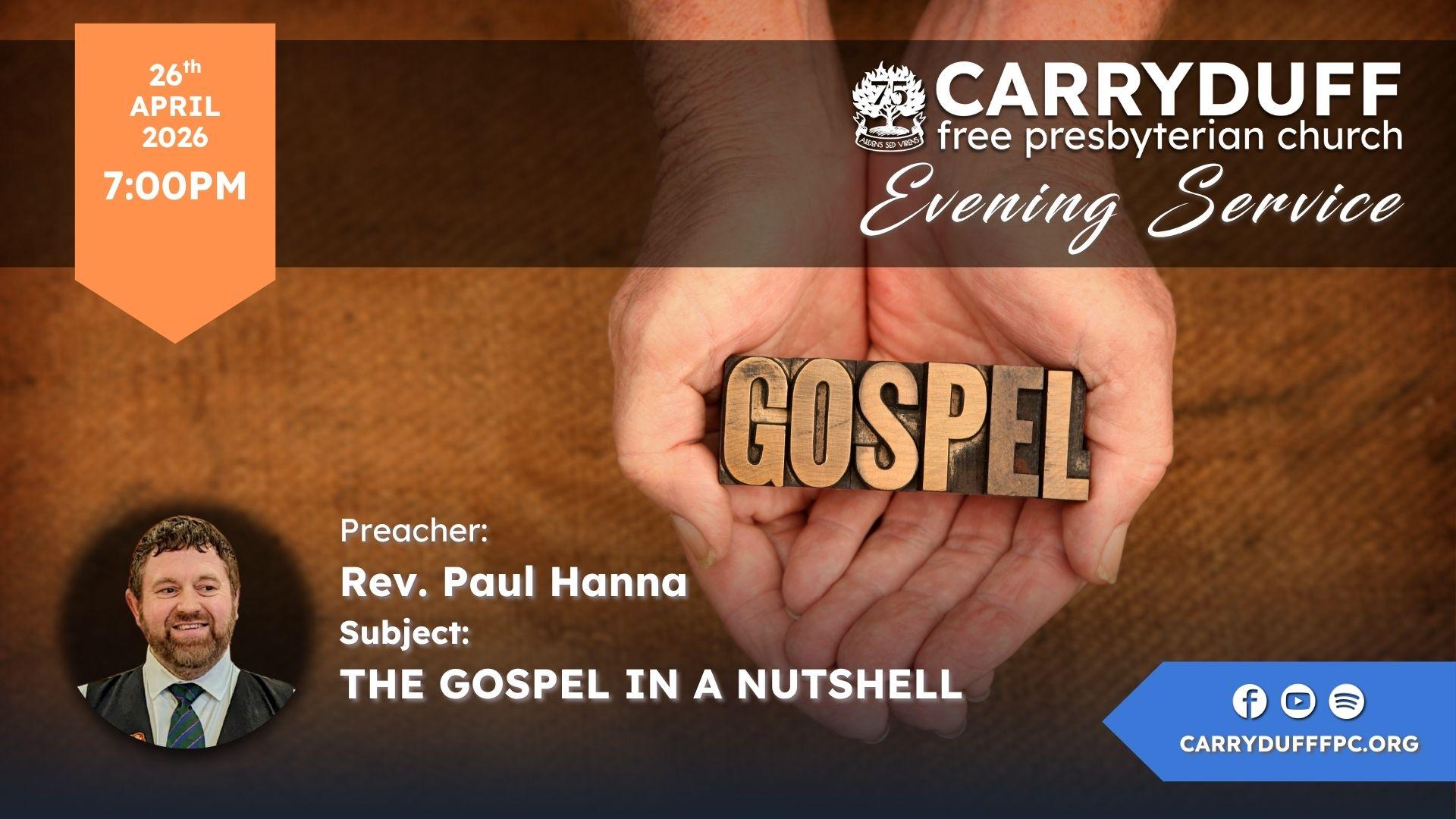

Date: SUN 7:00pm 26th April 2026
Preacher: Rev. Paul Hanna
Bible Reference: John 3:1-18
Podcast
Sermon Summary
This sermon, delivered with characteristic fervour and personal testimony, centres on the profound theological significance of John 3:16, a passage often described as the “Gospel in a nutshell” or the “mini-Bible”. The preacher, drawing upon his background as a minister in Northern Ireland with a history in engineering, weaves together biblical exegesis, personal anecdote, and a direct, urgent call to repentance.
Setting the Scene: The Encounter at Night
The sermon begins by contextualising the famous verse within the broader narrative of John chapter 3. The preacher highlights the encounter between the Lord Jesus Christ and Nicodemus, a Pharisee and a ruler of the Jews. Nicodemus, a man of great learning and status, approaches Jesus under the cover of darkness, prompted by a genuine, albeit confused, desire to understand the nature of the “teacher come from God.”
The preacher draws attention to the structural repetition found in the Gospel of John—specifically the phrase “verily, verily”—which Jesus uses to signal matters of supreme importance. The central theme of this exchange is the necessity of the “new birth.” Jesus reinforces this truth three times, emphasising that it is not through intellectual assent or religious pedigree that one enters the kingdom of God, but through being born of the Spirit.
The Central Event: The Crosswork of Christ
The preacher transitions to the theological core of the passage. He draws a direct parallel between the Old Testament account in Numbers 21, where Moses lifted up the bronze serpent in the wilderness to heal the Israelites, and the prophecy of Christ’s own death.
“As Moses lifted up the serpent in the wilderness, even so must the Son of Man be lifted up.”
This verse (John 3:14) is presented as the central event of all time—the crucifixion. The preacher argues that the love of God, described in the following verses, is not merely a passive emotion but an active, sacrificial commitment that culminated at Calvary. The sermon emphasises that Christ was not a victim of circumstances but was in full control, willingly enduring the cross out of an eternal, covenantal love for fallen humanity.
A Threefold Division: Past, Present, and Future
To make the weight of John 3:16 accessible, the preacher divides the verse into three temporal dimensions:
- The Past (The Council of Redemption): The opening words—”For God so loved the world that he gave his only begotten Son”—point back to eternity past. The preacher posits that within the Holy Trinity, a perfect plan of redemption was devised to rescue a fallen race. The “giving” of the Son is the physical manifestation of this eternal, divine council.
- The Present (The Personal Decision): The focus shifts to the immediate responsibility of the hearer: “that whosoever believeth in him.” The preacher stresses that this is not a matter for tomorrow, but for “right now.” He critiques the tendency of people to rely on church attendance, good works, or social standing, asserting that these are hollow substitutes for a personal, saving faith.
- The Future (The Reality of Eternity): Finally, the sermon addresses the chilling contrast between “perishing” and “everlasting life.” The preacher does not shy away from the reality of eternal separation from God, framing it as the motivation for his urgent appeal. The “but” in the text serves as a hinge—a contrast between the natural, fallen state of man and the promise of eternal life offered in Christ.
Personal Testimonies and Practical Application
Throughout the sermon, the preacher shares several deeply personal anecdotes to illustrate the gospel’s power:
- The City Hall Open-Air: He recounts a tense Friday afternoon in 2019 outside Belfast City Hall, where he preached alongside the late Clifford Black amidst a political protest. He speaks of using a “little black Bible” to confront the crowd with the necessity of the gospel, noting the providential opportunity to share the message of Christ even in a hostile environment.
- The Engineer and “3:16”: Another story involves his former colleague, Marty, who inquired about the meaning of “3:16” after seeing it displayed at a Gaelic Athletic Association (GAA) match. The preacher uses this to underscore that God provides gospel opportunities in the most unexpected places and that the message of the cross transcends cultural and sporting divides.
- The Story of Duncan Campbell: The sermon concludes with the poignant story of the 15-year-old pipe player Duncan Campbell, who, during a dance in 1913, was struck by such deep conviction of his lost state that he left the dance floor, never to return. The preacher contrasts this with the “chilling” response of Campbell’s friend, who chose to “wait”—a decision that haunted him into his twilight years.
A Final Urgent Call
The preacher’s tone throughout is one of compassionate urgency. He addresses the “baggage” that so many carry—past failures, hurts, and sins—and insists that these are no barrier to coming to Christ. He vehemently rejects the notion that one must “clean themselves up” before coming to the Saviour. Instead, he invites the hearers to come “just as you are.”
He concludes by challenging those who lack the assurance of salvation. Using the lyrics of traditional hymns, he asks the congregation if they can truly claim Jesus as their own. The sermon is not merely an academic exercise; it is a plea for a decisive, life-altering response to the gospel. The message is clear: the opportunity to get right with God is a present one, and to “wait” is a dangerous gamble with eternity.