
“The Lord thy God will raise up unto thee a Prophet from the midst of thee, of thy brethren, like unto me; unto him ye shall hearken.”
— Deuteronomy 18 : 15 – 18
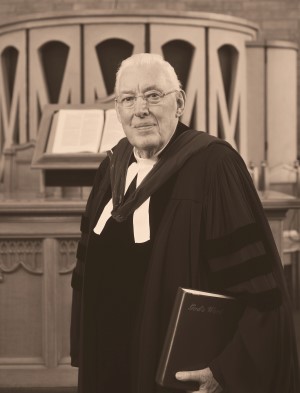
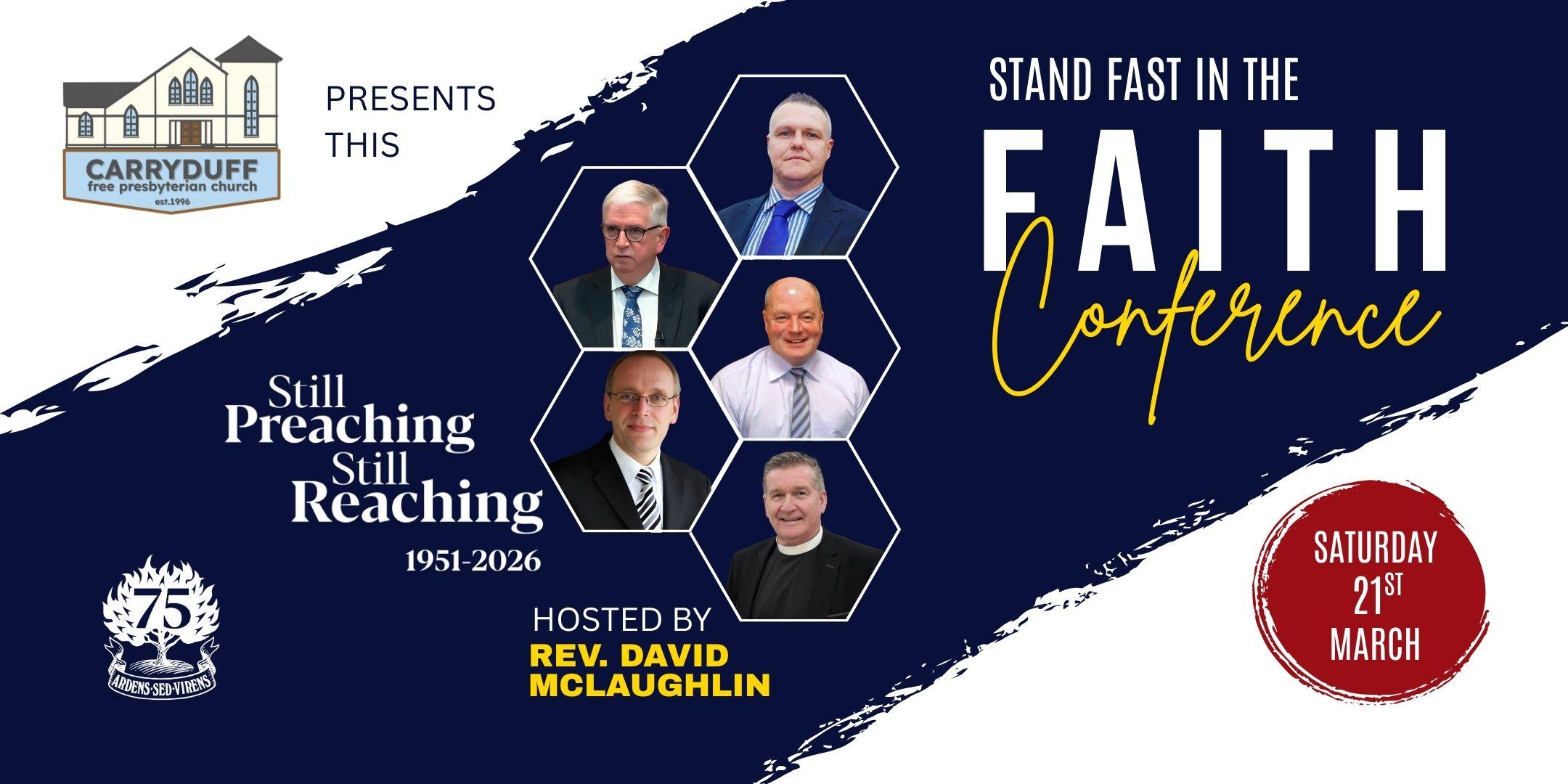
When Dr Ian Brown, Moderator of the Free Presbyterian Church of Ulster and minister of Martyrs Memorial FPC, opened the first session of Carryduff’s Stand Fast in the Faith Conference on Saturday 21 March 2026, he went straight to the heart of the Free Presbyterian testimony — the supreme and sufficient authority of the Word of God.
His chosen theme, “The Word Our Foundation – Why the Bible Alone and Why the Authorised Version,” reminded listeners that every doctrine, every duty, and every denominational principle rises or falls upon this one conviction.
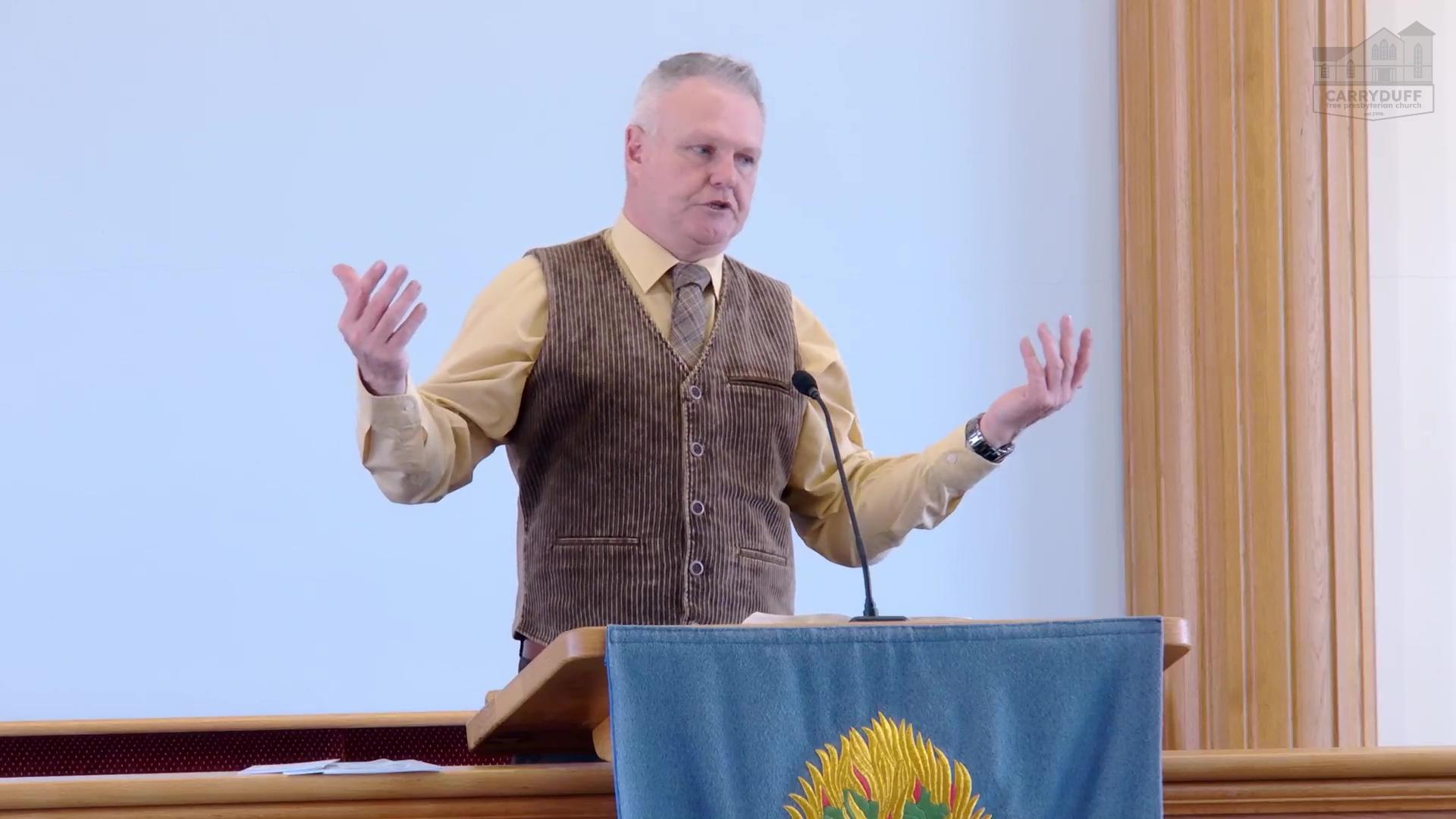
He began with characteristic humour, acknowledging a late discovery about the scope of his subject, but the levity soon gave way to gravity. Opening Deuteronomy 18, he declared that God’s Word comes with God’s own authority: “I will put My words in his mouth, and he shall speak unto them all that I shall command him.”
1. The Author Determines the Authority
“Ownership implies authority,” he asserted. “The artist signs his canvas; the inventor patents his design; and the Author of Holy Scripture has placed His name upon every line.”
The Bible, he explained, is not mankind’s reflection on religious experience but God’s revelation of Himself. “When I open the Word of God,” he said, “I am opening a book that carries the weight and the will of the God who speaks in it.”
If the Creator authored Scripture, then Scripture carries the Creator’s right to command obedience.
2. Prophets and Apostles as God’s Spokesmen
Dr Brown traced that principle through history. None of the Old‑Testament prophets spoke of personal ideas; they came as divine messengers. From Moses to Malachi, every prophet declared, “Thus saith the Lord.”
He contrasted that authority with the arrogance of false prophets who “prophesy out of their own hearts,” citing Ezekiel 13. Even the erring Balaam confessed, “I cannot go beyond the commandment of the Lord.” The lesson was plain: the messenger’s duty is faithfulness, not originality.
That same authority carried forward into the New Testament. Paul insisted that his words were taught “by the Holy Ghost.” Peter joined “the prophets” and “the commandments of the apostles of the Lord,” showing identical inspiration.
Christ Himself sealed it all: “The Scripture cannot be broken.”
3. The Apocrypha — History, Not Scripture
Turning from the prophets to the preservation of Scripture, Dr Brown addressed the question often raised about the Apocrypha — those additional writings sometimes printed between the Old and New Testaments.
He explained that when the Authorised Version of 1611 was first published, its translators included the apocryphal books only as historical material, never as inspired revelation. “They recognised some historical interest in those writings,” he noted, “but they did not belong to the canon that Jesus and His apostles received.”
By contrast, in the sixteenth century the Church of Rome formally declared the Apocrypha to be part of Scripture at the Council of Trent. “That decision,” he said, “was no accident of scholarship. It was a calculated move to defend false doctrine — for teachings such as purgatory and prayers for the dead find their only support in those human writings, not in the Word of God.”
Dr Brown reminded his audience that the Hebrew Bible, recognised by our Lord Himself, never contained those books, and none of the apostles ever quoted from them. They therefore hold historical value but no divine authority.
“What God inspired carries His signature,” he said; “what man composed, however noble, cannot be bound upon the soul.”
He concluded the point with characteristic brevity: “The Apocrypha may give insight into history, but it cannot give life to the sinner. For that, we need the sixty‑six inspired books and no others.”
4. A Modern Challenge — The Error of Mormonism
From ancient additions he turned to a modern counterfeit — the Book of Mormon. Calling it one of the clearest assaults on Scripture’s sufficiency, he stated that any claim to “another testament of Jesus Christ” contradicts Hebrews 1 : 1–2, where God declares that He has spoken finally and fully by His Son.
“Revelation is not a serial publication,” he said. “There are no chapters left to write.”
He referred to the widely‑circulated video of Charlie Kirk’s address at a Latter‑day Saints university, where Kirk commended cultural virtues but then asked, “Where is the archaeological evidence for the Nephite people?” The question, said Dr Brown, cut directly to the heart of Mormonism’s credibility — for none exists.
“Christianity is anchored in history we can trace — a crucifixion under Pontius Pilate, a tomb outside Jerusalem, a resurrection witnessed by hundreds. Mormonism offers imaginary peoples in imaginary places. It has no anchors in either archaeology or Revelation.”
The conclusion drew steady nods from the congregation: to add to Scripture is to overthrow it. “When men grow discontent with It is written,” he warned, “they soon invent Thus saith man.”
5. The Reformation and the Return to Sola Scriptura
The sermon then shifted to the sixteenth century. The medieval Church had exalted tradition and papal interpretation to the same level as Scripture. “But the Reformers refused to serve two masters,” Dr Brown reminded his audience.
Luther declared: “In all articles the foundation of our faith must be God’s Word alone.”
Calvin insisted that the Church does not create the Bible; the Bible creates the Church. “That reversal,” said Dr Brown, “changed history — and still defines authentic Protestantism.”
He observed that the Free Presbyterian Church stands in that same reforming line: every sermon, every separation, every stand must answer to Scripture, the “Supreme Judge … the Holy Spirit speaking in the Scriptures” (Westminster Confession 1:10).
6. Modern Erosion of Confidence
Dr Brown observed that the struggle for biblical authority did not end with the Reformation; it merely changed its clothing. “The popes are gone,” he remarked, “but professors have taken their place.”
Where once tradition sought to overrule Scripture, now intellectual fashion and cultural opinion attempt the same. Human reason, scientific dogma, and social consensus have become the new magisterium.
“Today,” he said, “the crowd bows not before the altar but before the algorithm, and it will trust a trending voice sooner than the timeless Word.”
He warned that this modern scepticism does not always announce itself as open hostility. It often hides behind gentler masks — academic restraint, literary critique, or even theological reform. Yet the end result is the same: Scripture is placed in the dock and man ascends to the judge’s seat.
“Whenever a preacher feels compelled to apologise before reading the Bible,” Dr Brown lamented, “the Church has already surrendered. We are not called to correct the Word but to convey it.”
He challenged believers to reject the notion that truth changes with time or taste. “Conscience,” he said, “must not be shaped by culture. God’s Word outlives every government, every ideology, every experiment in morality. The grass withereth, the flower fadeth, but the Word of our God shall stand for ever.”
The remedy to this erosion, he concluded, remains simple and ancient: open the Bible, believe it as written, and obey it without qualification.
7. Evidence That Confirms the Bible
While Dr Brown insisted that Scripture stands on its own authority and needs no human vindication, he graciously acknowledged that God has left abundant external confirmations of His Word — evidences that strengthen faith and silence the scoffer.
“Although we believe the Bible because of who wrote it, not because of what supports it,” he said, “the Lord has filled history and archaeology with reminders that His Book tells the truth.”
Archaeological Confirmation
Many monuments and discoveries once thought to disprove Scripture have, on closer inspection, proved it instead. Excavations have uncovered Hezekiah’s Tunnel, the Pool of Siloam, the Hittite Empires, and countless inscriptions bearing the names of kings and cities long doubted by critics.
“For over a century,” he observed, “men said these places never existed — until their spades found them exactly where the Bible said they would be.”
Manuscript Evidence
The documentary preservation of the Bible surpasses every work of antiquity. More than 5,800 Greek manuscripts, accompanied by over 24,000 ancient translations, attest to the same inspired message. “No other text, sacred or secular,” said Dr Brown, “has been copied, checked, and transmitted with such extraordinary precision. What we read today is what God breathed then.”
Fulfilled Prophecy
Prophecy, he continued, gives evidence beyond archaeology. “When prediction becomes history, scepticism becomes folly.” The prophets foretold Christ’s birth in Bethlehem (Micah 5:2), His virgin conception (Isaiah 7:14), His atoning death (Psalm 22), and His resurrection (Psalm 16). Each fulfilment marks divine authorship far beyond human foresight.
The Conversion of Critics
Dr Brown then cited the example of Sir William Ramsay, the nineteenth‑century archaeologist who set out to disprove Luke’s Gospel and ended by confessing its precision.
“He went digging for errors,” Dr Brown noted, “and unearthed evidence of inspiration. Those who study the Bible to refute it often end up bowing to the God who wrote it.”
He closed the section with an admonition: “The evidence is not given so that we might rest in science or stones, but so that we might confess, with deeper awe, that every Word of God is pure, tried in the furnace of earth, and found absolutely true.”
8. Why the Church Should Still Use the Authorised Version
The final movement of the sermon addressed the Bible’s English form. The Authorised Version, he affirmed, remains “the gold standard for a literary and accurate Bible.”
He listed seven reasons for continuing confidence in it:
- Reliability — built upon the preserved Masoretic and Textus Receptus manuscripts.
- Integrity — retaining key verses about the Trinity, Christ’s deity, and the resurrection that modern versions often bracket or omit.
- Precision — translated by formal equivalence, giving the nearest possible word‑for‑word rendering.
- Transparency — its use of italics and older pronouns marks clarity, not obscurity.
- Quality — its cadence and rhythm have shaped English literature and aid memorisation.
- Legacy — the Bible of revival across four centuries.
- Consistency — a single standard binding preacher and people.
Citing Dr Leland Ryken of Wheaton College, he noted that even modern translators acknowledge the KJV’s enduring influence. “When the preacher reads one text and five versions reply from the pews,” he remarked, “confusion rules where unity should reign.”
Clarity of language supports clarity of doctrine; for that reason, the Authorised Version continues to serve the Church as both fortress and foundation.
9. Agreement and Allegiance to the Word
Bringing the address to its close, Dr Brown called for more than intellectual assent. “The question is not whether the Bible is true, but whether we will obey it.” Agreement, he said, must blossom into allegiance.
Every believer is to live coram Deo — before the face of God — in thought, work, and worship. “Let every conviction and every separation be tested by the words ‘What saith the Scripture?’”
He ended quietly, quoting Luther’s words before the Diet of Worms as a summation of the Christian’s duty:
“My conscience is captive to the Word of God. To go against conscience is neither right nor safe. Here I stand; God help me.”
The congregation sat in reflective silence. There was no flourish, only the unshakable truth that the Bible stands supreme, and that faithfulness to God begins and ends with faithfulness to His Word.
A Concluding Prayer
Dr. Brown’s final prayer captured the spirit of the day:
“Lord, revive us again, that Thy people may rejoice in Thee. Let the fire of God burn brightly once more in our homes and churches. Help us to honor Thy Word—its truth, its power, its sufficiency. May the world know that we stand not on tradition, nor on the shifting sands of opinion, but upon the Rock of Thy eternal Word.”
As the congregation bowed in reverent silence, one truth settled upon every heart: The authority of the Bible is not a relic of the past; it is the living voice of Christ today.
To believe it is to obey Him.
To question it is to resist Him.
To stand fast upon it is to share the faith of apostles, martyrs, and reformers.
Conclusion
Dr Brown’s address set the theological spine of the entire conference. Every subsequent session — on separation, sanctification, and service — would flow from the conviction he articulated: God has spoken once for all, and His written Word remains the final authority for faith and practice.
In an age of ever‑multiplying voices, his exhortation was direct: the Church must return to “It is written.”
That simple phrase, he reminded the congregation, still has the power to steady every believer and to steer every church that dares to stand fast in the faith.