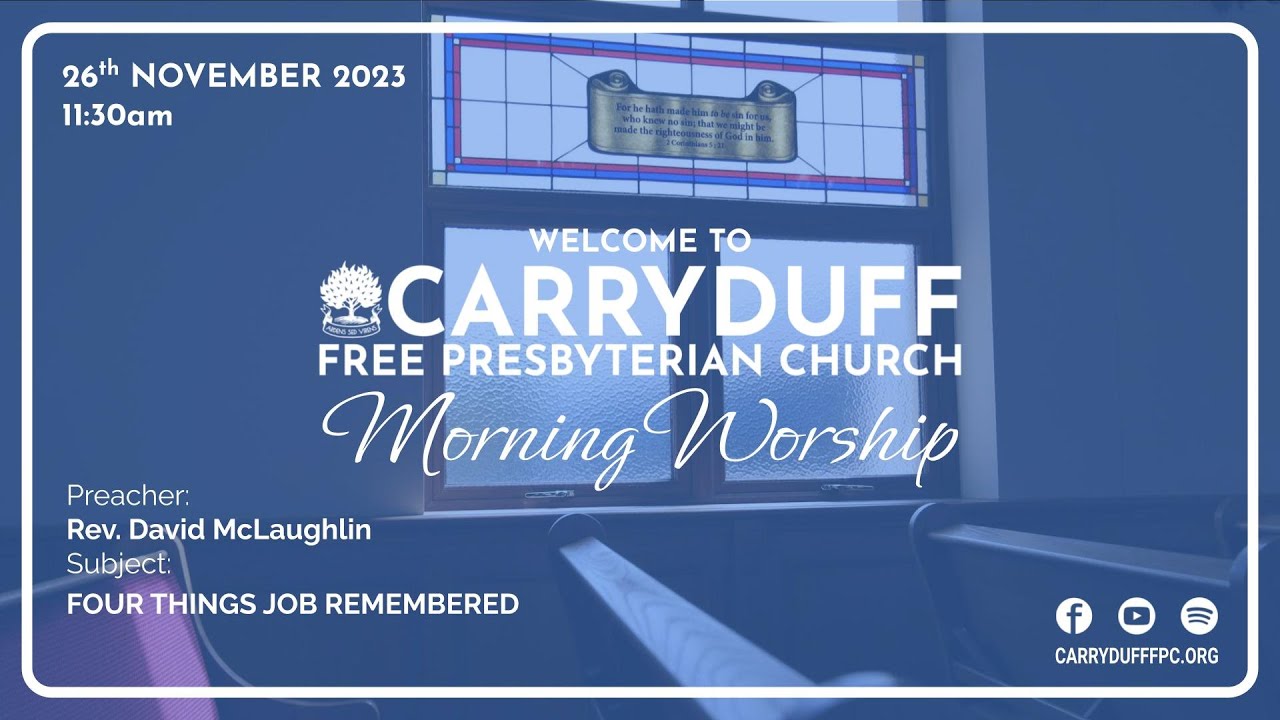


Date: SUN 7:00pm 22nd March 2026
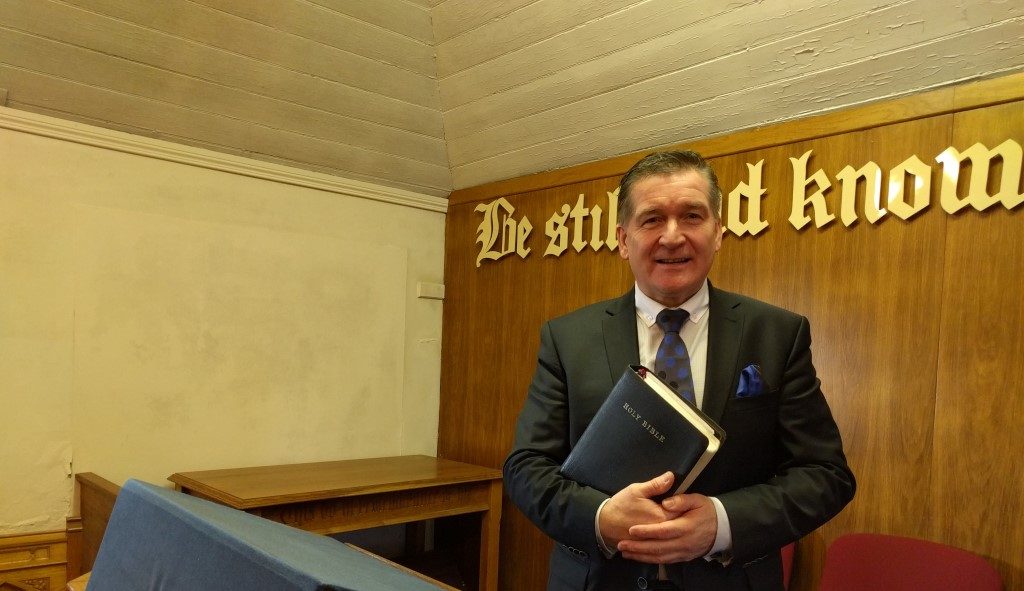
Preacher: Rev. David McLaughlin
Bible Reference: Job 10:6-7
Podcast
Sermon Summary
Assured and Acquitted: Job’s Confidence Before a Holy God
Reflections on Job 10:6–7 (KJV)
“That thou inquirest after mine iniquity, and searchest after my sin?
Thou knowest that I am not wicked; and there is none that can deliver out of thine hand.”
— Job 10:6–7, King James Version
Introduction: Job—The Tried and Tested Saint
Few figures in all of Scripture exhibit the profound depths of faith and trial as Job, the man whom God Himself described as “perfect and upright, and one that feared God, and eschewed evil” (Job 1:1). Yet it was this very man—righteous, reverent, and steadfast—who was permitted by divine sovereignty to experience sufferings greater than any mortal could conceive.
Job lost his ten children in a single catastrophic event. His possessions perished, his health failed, and his wife and friends misunderstood him entirely. And all this under the watchful providence of God—not by accident, but by divine permission for purposes far beyond man’s comprehension.
Here, in Job 10, we find the patriarch wrestling with the apparent contradiction between God’s justice and his own affliction. Job, conscious of his integrity, feels himself searched and scrutinized by the Almighty and pleads for understanding: “Show me wherefore thou contendest with me.” (v.2)
Yet even amid tears, Job utters one of the most profound theological truths in all the Old Testament: that God alone is both Judge and Justifier. As Job declares in verse 7, none can deliver out of His hand. And yet—astonishingly—Job still asserts, “Thou knowest that I am not wicked.” His assurance flows not from pride, but from faith in divine righteousness imputed by grace.
I. The Scrutiny of Jehovah’s Search
“That thou inquirest after mine iniquity, and searchest after my sin?” (v.6)
The God of Scripture is not indifferent to sin. He is never a passive spectator in the moral realm. He inquires, searches, and examines with penetrating holiness.
The Psalmist testifies, “The LORD searcheth all hearts, and understandeth all the imaginations of the thoughts” (1 Chronicles 28:9). Similarly, Hebrews 4:13 warns that “all things are naked and opened unto the eyes of him with whom we have to do.”
1. God’s Search is Perfect
There are no shadows before His sight. The Lord misses nothing. The sins that escape man’s judiciary are laid bare before omniscient purity. Every idle word, every secret inclination, every fleeting thought—He knows them all.
Sin is not merely what we do—it is what we are by nature. As Romans 3 declares:
“There is none righteous, no, not one.”
We sin, not because of external temptation alone, but because we possess inwardly a fallen will. “From within, out of the heart of men, proceed evil thoughts…” (Mark 7:21–23). The disease is congenital; the contagion universal.
2. God’s Search is Penetrating
Job likens the divine investigation to a doctor’s probing. The physician must expose the wound before he can heal it. So does the Spirit of God uncover sin to bring the sinner to repentance. True gospel conviction precedes justification.
John Calvin stated wisely:
“Man never attains to a true self-knowledge until he has first contemplated the face of God.”
Without divine exposure, the sinner would sleep undisturbed in self-deception.
But when the holy light of heaven’s scrutiny shines into the heart, pride crumbles and confession pours forth.
3. God’s Search is Personal
He searches you. Not humanity in general, but you individually. As He said through the prophet Amos, “I will set mine eyes upon them for evil, and not for good” (Amos 9:4).
To every soul comes the moment when God’s gaze pierces through all fabrication and religious pretense. The purpose, however, is not to destroy, but to deliver.
“Whom the Lord loveth he chasteneth” (Hebrews 12:6). Conviction is not cruelty—it is mercy’s scalpel cutting deep that grace may heal completely.
II. The Sincerity of Job’s Statement
“Thou knowest that I am not wicked.” (v.7)
Job here does not claim to be sinless. The context of the entire book exposes a man who mourns his sinfulness and laments his suffering. The word wicked is a forensic term, meaning guilty before the law or deserving of judgment.
Job is not boasting; he is asserting that he stands justified by grace. The Lord had Himself borne witness that Job was upright. God never condemned him. In fact, at the end of the book, He vindicated Job before his friends:
“Ye have not spoken of me the thing that is right, as my servant Job hath.” (Job 42:7)
Thus, Job’s assurance of acquittal rests not in himself, but in the covenant righteousness of God.
1. The Nature of True Assurance
True believers may, like Job, say confidently before God, “Thou knowest that I am not wicked.”
This is not arrogance, but faith in substitutionary righteousness.
Paul mirrors the same confidence:
“Therefore being justified by faith, we have peace with God through our Lord Jesus Christ.” (Romans 5:1)
The saint may tremble at his weakness but never doubt Christ’s sufficiency.
2. The Ground of Job’s Confidence—Free Grace
Job understood that only God can acquit, for none can deliver out of His hand. His acquittal is grounded in divine initiative, not human merit.
He knew himself to be a sinner by nature and practice, yet also one who feared God and hated evil (Job 1:1). His faith looked to the divine Redeemer, of whom he declared triumphantly:
“I know that my redeemer liveth.” (Job 19:25)
Here lies the Old Testament dawn of justification by faith alone—the same faith Abraham possessed when “he believed in the LORD; and he counted it to him for righteousness” (Genesis 15:6).
III. The Sovereignty of Jesus’ Sentence
“There is none that can deliver out of thine hand.” (v.7)
We come now to the awesome and comforting reality: God’s sovereignty in judgment and in grace. None can resist His verdict, none can appeal His decree, none can reverse His justification.
When God condemns, no man shall acquit; but when God justifies, no man can condemn. As Paul writes:
“Who shall lay any thing to the charge of God’s elect? It is God that justifieth.
Who is he that condemneth? It is Christ that died…” (Romans 8:33–34)
1. God the Judge, Christ the Advocate
In the heavenly court, the Judge and the Advocate are one—God Himself providing the righteousness He demands. The law pronounces death; grace provides the Deliverer.
“For he hath made him to be sin for us, who knew no sin; that we might be made the righteousness of God in him.” (2 Corinthians 5:21)
Christ fulfilled every precept, bore every penalty, and satisfied divine justice perfectly. None could deliver Job out of God’s hand, but the God who held him would also save him through His appointed Substitute—the Lord Jesus Christ.
2. The Certainty of Divine Judgment
Every soul shall stand before God. “So then every one of us shall give account of himself to God” (Romans 14:12).
The books will be opened (Revelation 20:12). Every sin not covered by the blood of Christ will testify against the sinner. And there will be no denial, no plea of ignorance, no self-defense. The only verdict for the unrepentant will be, “Depart from me, ye that work iniquity” (Matthew 7:23).
3. The Grace of the Divine Deliverer
Yet the gospel declares that the Deliverer has already come:
“There shall come out of Zion the Deliverer, and shall turn away ungodliness from Jacob.” (Romans 11:26)
Christ was born, lived, died, and rose—all for sinners.
He was “searched, examined, and found spotless.” And though sinless Himself, He bore our punishment that we might bear His peace.
This substitutionary exchange is the bedrock of Reformed soteriology: grace alone, through faith alone, in Christ alone, according to Scripture alone, unto the glory of God alone.
IV. The Assurance of Being Acquitted by God
This is the heart of Job 10:6–7. The believer’s acquittal does not arise from inner worth or outward ceremony, but from the imputed righteousness of another—Christ Jesus the Lord. The Reformed faith stands squarely here: justification is forensic, not experiential; it is a declaration by God the Judge, not a process within man.
Once pronounced righteous in Christ, there is no double jeopardy before heaven’s throne. “Their sins and their iniquities will I remember no more” (Hebrews 8:12).
Thus, every true believer may face the scrutiny of God’s search, rest in the sincerity of Christ’s righteousness, and rejoice in the sovereignty of Jesus’ sentence—an eternal verdict of acquittal sealed in His blood.
Conclusion: Resting in Christ Alone
Beloved, the question today is as urgent as it was in Job’s time: Will you be acquitted?
If you rest in your own goodness, you stand condemned; if you rest in the imputed righteousness of Christ, you stand justified.
When the books are opened and the Judge speaks, only one defense will stand: “Jesus thy blood and righteousness.”
Therefore, come to Him humbly but confidently, saying with Job:
“Thou knowest that I am not wicked; for there is none that can deliver out of thine hand.”
And when at last the righteous Judge calls your name, you shall hear not “Depart,” but “Come, thou blessed of my Father, inherit the kingdom prepared for you from the foundation of the world.” (Matthew 25:34)