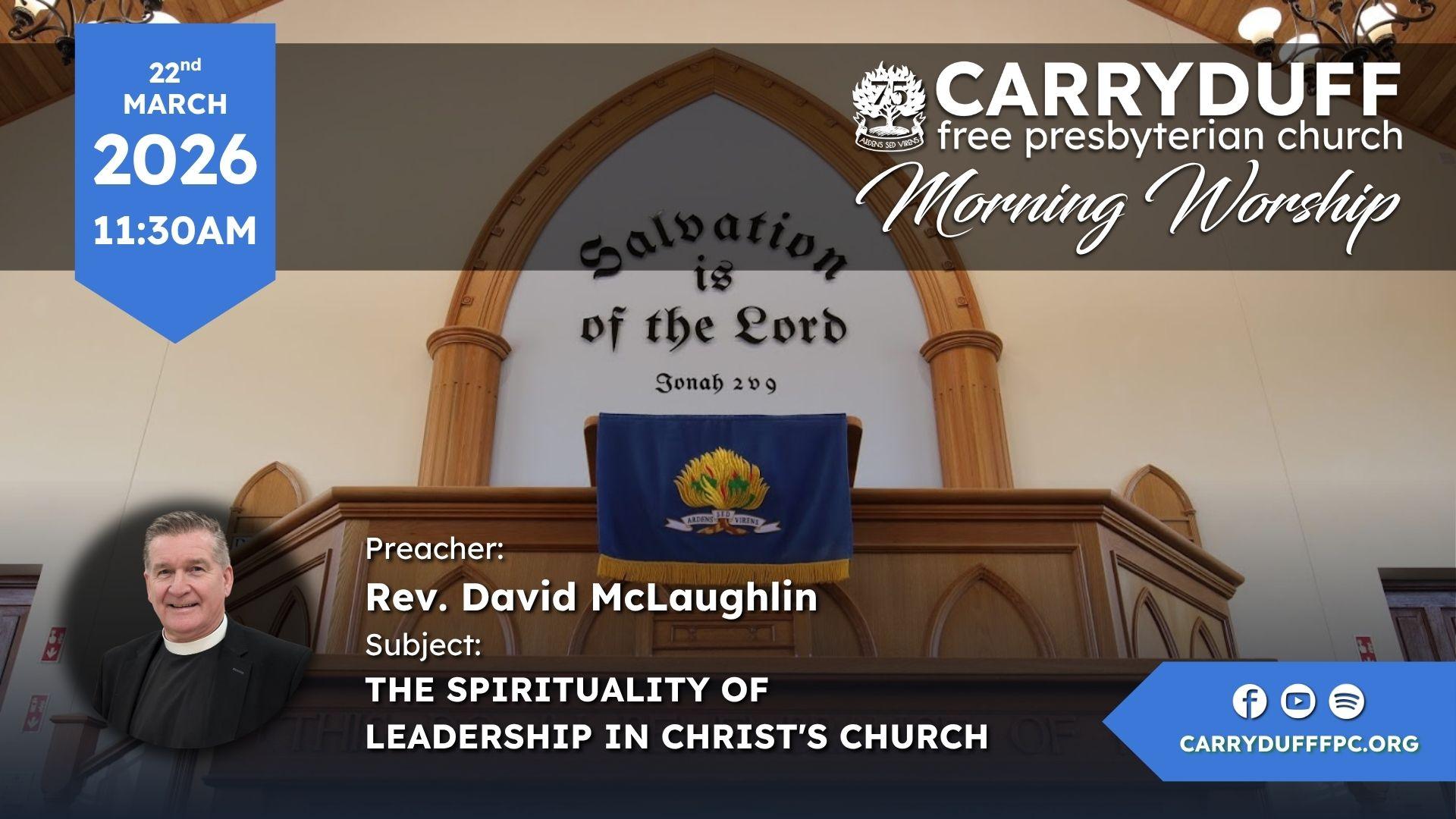

Date: SUN 11:30am 22nd March 2026
Preacher: Rev. David McLaughlin
Bible Reference: 1 Thessalonians 5:12-13
Podcast
Sermon Summary
The Spirituality of Leadership in Christ’s Church
An Expository Reflection on 1 Thessalonians 5:12–13 (KJV)
“And we beseech you, brethren, to know them which labour among you, and are over you in the Lord, and admonish you;
And to esteem them very highly in love for their work’s sake. And be at peace among yourselves.”
— 1 Thessalonians 5:12–13 (KJV)
Introduction: The Context of Paul’s Closing Exhortations
The Apostle Paul’s first letter to the Thessalonians stands as one of the earliest letters of the New Testament—written to a young, persecuted church only months after its formation. These believers lived amid a hostile pagan environment and faced both internal confusion and external opposition. Yet even in such infant stages of faith, Paul was not content to leave them without clear instruction regarding order, leadership, and peace within Christ’s Church.
First Thessalonians 5:12–13 therefore contains counsel not merely administrative, but profoundly spiritual. These verses anchor the theology of leadership within a distinctly Reformed ecclesiology—that Christ alone is Head of His Church, ruling through His Word and officers whom He has called, gifted, and ordained for the edification and sanctification of His people.
I. The Reality of Spiritual Leadership in Christ’s Church
Paul begins: “And we beseech you, brethren…”
The term beseech (Greek: erōtaō) conveys an urgent appeal rather than a casual suggestion. The Apostle is not merely offering advice—he is exhorting the regenerate “brethren” to acknowledge a divine order established by Christ Himself.
A. Leadership as Christ’s Appointment
Spiritual governance in the Church is not a human invention nor an historical development—it is a Christ-ordained necessity. As the sole Head and King of the Church (Ephesians 1:22; Colossians 1:18), Christ rules His Body through:
- The absolute authority of the Word of God,
which serves as the final arbiter of doctrine and life.
As the sermon rightly emphasized, “What God says, the Bible says; and what the Bible says, God says.”
Sola Scriptura remains the non-negotiable foundation of all Church authority. - The delegated authority of ministers and elders,
through whom Christ shepherds and governs His people.
This dual structure—Word and Eldership—constitutes the Reformed understanding of Church Government. The Westminster Confession of Faith (chap. 25.3) affirms that Christ has given “the ministry, oracles, and ordinances of God for the gathering and perfecting of the saints.” This ministry is not democratic in essence, but representative and spiritual; authority flows downward from the Head, Christ, to His servants—not upward from the people.
B. The Necessity of Order in the Church
The alternative to divinely ordered leadership is anarchy. Paul’s words tear down the modern notion that the Church functions as a corporation or social club catering to consumer preferences. Christ’s Church is an organism, not a business. The world may market religion; the Bride of Christ proclaims truth.
Believers are not “customers” but living stones, fitted together into a holy habitation (Ephesians 2:19–22). Therefore, the Church must exhibit both order and love—structure without tyranny, fellowship without confusion.
II. The Recognition of Spiritual Leadership in Christ’s Church
Paul calls the congregation “to know them which labour among you.” This phrase is simple yet profound. To “know” (eidō in Greek) means more than awareness—it implies recognition, respect, and relationship.
A. Recognition of Office
The very command implies that the office of eldership is both real and visible. Christ appoints men of spiritual calibre, proven in character and maturity, to watch over His flock. Every congregation must recognize these men as appointed “over you in the Lord.”
This phrase “in the Lord” qualifies their authority—it is neither personal nor absolute, but delegated and derivative. In the Reformed model, elders do not rule by fiat, but by Scripture. They act not as popes but as servants accountable to Christ and the whole Presbytery.
B. The Nature of the Elder’s Work
Paul uses three verbs: labour, rule, admonish.
- Labour among you
The word labour (Greek: kopiō) literally means toil unto weariness. True ministry is not ceremonial ease—it is sacrificial service. Preaching, prayer, visitation, counseling, administration—these are the unseen burdens carried daily by faithful shepherds. Such labor is spiritual travail for the birth and nurture of souls (Galatians 4:19). - Be over you in the Lord
The elder’s leadership is compared to a military officer’s oversight—not to command for pride, but to preserve order and protect the weak. Christ rules His people through spiritual stewards who act with vigilance and humility. - Admonish you
To admonish (noutheteō) is to “warn,” “instruct,” and “correct.” A faithful overseer does not flatter sin but reproves it with compassion and courage. He is a watchman on the walls, a guardian of doctrine, and a counselor of truth.
His admonition includes:- Warning against false teaching (Reformed polemic duty: to contend earnestly for the faith).
- Correcting immoral behaviour (church discipline for edification, not humiliation).
- Encouraging holiness, perseverance, and spiritual maturity.
Thus, the elder’s duty encompasses preaching, pastoring, protecting, and purifying the flock—each essential for the preservation of truth and peace.
III. The Responsibility of the Congregation Toward Their Leaders
Having described the work of leaders, Paul turns to the believers’ corresponding duty.
“And to esteem them very highly in love for their work’s sake.”
A. Esteem Through Understanding
The congregation must not measure its leaders by personality or popularity but by faithful labour in the Word. Esteem involves gratitude, prayer, and supportive cooperation. The Church’s health rarely exceeds the quality of its mutual respect between shepherd and flock.
To esteem “very highly” (Greek: huperekperissou) denotes an abundant valuation. This is not idolatrous exaltation, but Christ-centered appreciation for Christ’s work through human instruments.
B. Esteem in Love
This esteem must be rooted “in love,” not mere duty. Love governs Christian interaction at every level. The Church is not an institution of cold administration, but a family of faith. When love abounds, criticism fades, forgiveness reconciles, and unity thrives.
C. The Practical Outcome: “Be at Peace Among Yourselves”
Wherever leadership and membership walk together in humility—each submitting to Christ’s headship—peace prevails. Such peace is not merely the absence of conflict but the presence of divine harmony. It is the tranquility of a body functioning as Christ designed, animated by the Holy Spirit and directed by the Word of God.
IV. The Threats to Spiritual Peace
The Devil delights in disorder. Whenever leadership is challenged unrighteously, or when leaders themselves become lords over God’s heritage (1 Peter 5:3), peace is wounded. Modern churches often fall into two grave errors:
- Authoritarian abuse — leadership exercised as personal power or celebrity influence.
- Rebellious independence — members refusing biblical submission and accountability.
In both instances, the principle of Christ’s delegated rule through the Word is lost. The remedy is always the same: return to Scripture, repent of pride, and walk in mutual love.
V. The Fruit of Spiritual Leadership Rightly Ordered
When biblical leadership and godly submission coexist under the Lordship of Christ:
- The Church is edified in holiness.
- The Word is exalted as the supreme rule.
- The Spirit is unquenched in His sanctifying work.
- The peace of Christ rules the hearts of believers collectively.
This is the true spirituality of leadership: a Christ-centered, Word-governed, Spirit-filled ministry producing a people who live in love, gratitude, and peace.
Conclusion: Leadership and Peace in Christ’s Body
Paul’s teaching in 1 Thessalonians 5:12–13 is as urgent today as it was in the first century. In an age of congregational consumerism and pastoral burnout, the Holy Spirit confronts us with a simple call—to know, esteem, and love those who labour for our souls, that peace and unity might abound “among yourselves.”
Christ Himself has established the eldership for the good of His people. To honour faithful elders is to honour the Christ who appointed them. Likewise, leaders must remember their office is not of privilege but of service. The Church is no market, nor a stage—it is the flock for whom the Good Shepherd died.
Therefore, let all who name the name of Christ say with reverence and gratitude:
“Faithful is he that calleth you, who also will do it.”
(1 Thessalonians 5:24, KJV)