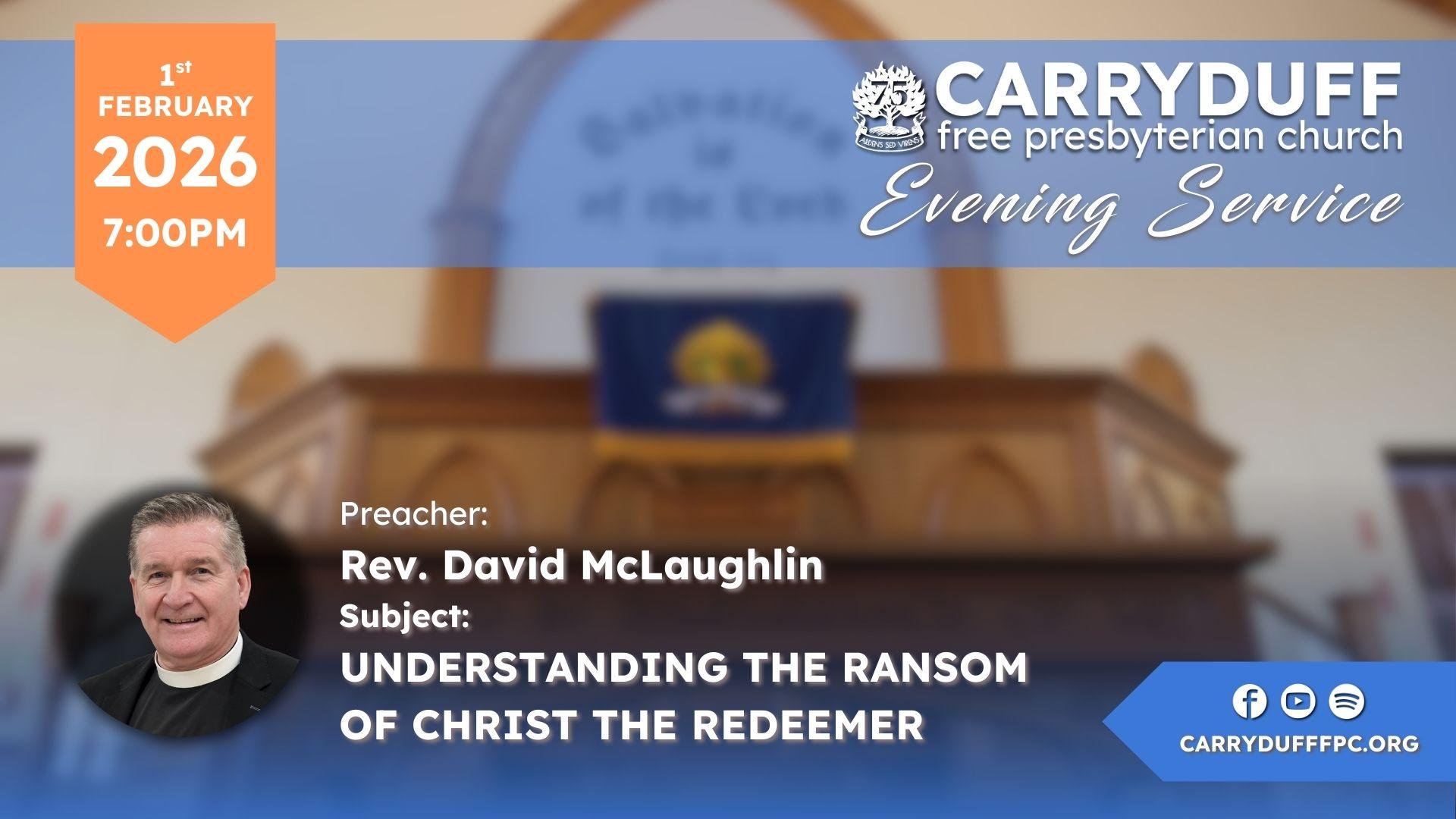

Date: SUN 7:00 PM 1st February 2026
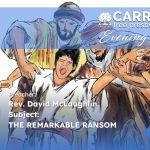
Preacher: Rev. David McLaughlin
Bible Reference: Mark 10:45
Podcast
Sermon Summary
“For even the Son of Man came not to be ministered unto, but to minister, and to give his life a ransom for many.”
The preacher sets the scene in Mark chapter 10, where Jesus is on the road to Jerusalem, with the cross now looming large. He has just predicted his suffering, death, and resurrection for the third time (verses 33–34), yet the disciples are preoccupied with status and honour. James and John request prominent positions in Christ’s kingdom, provoking indignation among the others. Their attitudes reflect the world’s notions of greatness, power, and prominence. It is precisely in this context of pride and misunderstanding of His mission that Jesus delivers one of the clearest statements in the Gospels about His true purpose.The preacher describes Mark 10:45 as a redemptive declaration (repeated almost verbatim in Matthew 20:28), not merely a moral example. It reveals who Christ is, why He came, what He came to do, and what true greatness looks like in His cross-shaped kingdom. Salvation is accomplished not by human effort, religious rites, or ceremonies, but solely through Christ’s atoning work on the cross.The sermon unfolds in four main points drawn from the text:
- The Person Presented: “For even the Son of Man”
Jesus deliberately uses the title “Son of Man” (around 80 times in the Gospels, mostly self-referentially) as His primary self-designation.- It emphasises His true humanity: He is a real man of flesh and blood, born, weary, hungry, tempted, weeping, suffering, and born to die. Only a true human could die as a ransom for humans (cf. 1 Corinthians 15:22; Hebrews 2:14; Hebrews 10:12).
- It also points to His divine, messianic kingship, drawing from Daniel 7:13–14, where “one like the Son of Man” receives everlasting dominion, glory, and a kingdom that all peoples will serve.
The title unites the cross and the crown: Christ is the suffering servant, the crucified Saviour, and the eternal King and Judge. He claims authority (e.g., to forgive sins, Lord of the Sabbath) while revealing that His path to the throne is through sacrifice and resurrection.
- The Purpose Proclaimed: “…came…”
The word “came” highlights the intentional, voluntary incarnation. Christ came deliberately according to God’s eternal plan and in the fullness of time (Galatians 4:4–5).
He is not merely a good man, a great teacher, or a moral example (as some liberal or modern views suggest). He is the God-man — “God was manifest in the flesh” (1 Timothy 3:16) — born of a virgin by the Holy Ghost (Luke 1:35).
His ultimate purpose was not social reform, environmental care, teaching love, or improving human behaviour (though these flow from the gospel). He came to give His life as a ransom for sinners, offering Himself as the atoning sacrifice for sin. This is the heart of the gospel, often missing in contemporary liberal or modernist teaching. Salvation is entirely of God’s sovereign grace, accomplished solely through Christ’s person and work. - The Price Paid: “…and to give his life a ransom…”
Christ’s entire life of sinless obedience, service, and ministry led inexorably to His voluntary, sacrificial death on the cross. This was no accident, tragedy, or mere martyrdom; it was a vicarious, substitutionary atonement.
He “gave” His life deliberately (Philippians 2:5–8; Isaiah 53:4–10). On the cross, He satisfied God’s wrath, justice, law, and holiness against sin. He bore the full penalty of death that the law demanded, shedding His blood to obtain eternal redemption (Hebrews 9:12; Hebrews 13:20).
God made Him “to be sin for us” (2 Corinthians 5:21); our sins were imputed to Him, and He endured divine forsakenness (“My God, my God, why hast thou forsaken me?”) so that believers might receive God’s righteousness. His death reveals the horror of sin, satisfies divine justice, and secures actual redemption for His people. - The People Purchased: “…a ransom for many”
“For many” is not a limitation but a declaration of intent and efficacy. Christ’s ransom is sufficient and efficient for all who trust Him as Lord and Saviour. He did not merely make salvation possible; He actually accomplished redemption.
He is the Good Shepherd who lays down His life for the sheep (John 10:11). The preacher asks: Are you one of His sheep? Have you bowed before the Son (Psalm 2:12), repented, and trusted Him?
He illustrates with the dying thief on the cross, who entered paradise through simple faith (“Lord, remember me”) despite a life of crime and no good works. In heaven, the answer to “How did you get here?” will always be: “The Man on the middle cross said I could come.” Salvation is by grace alone through faith in Christ’s finished work.