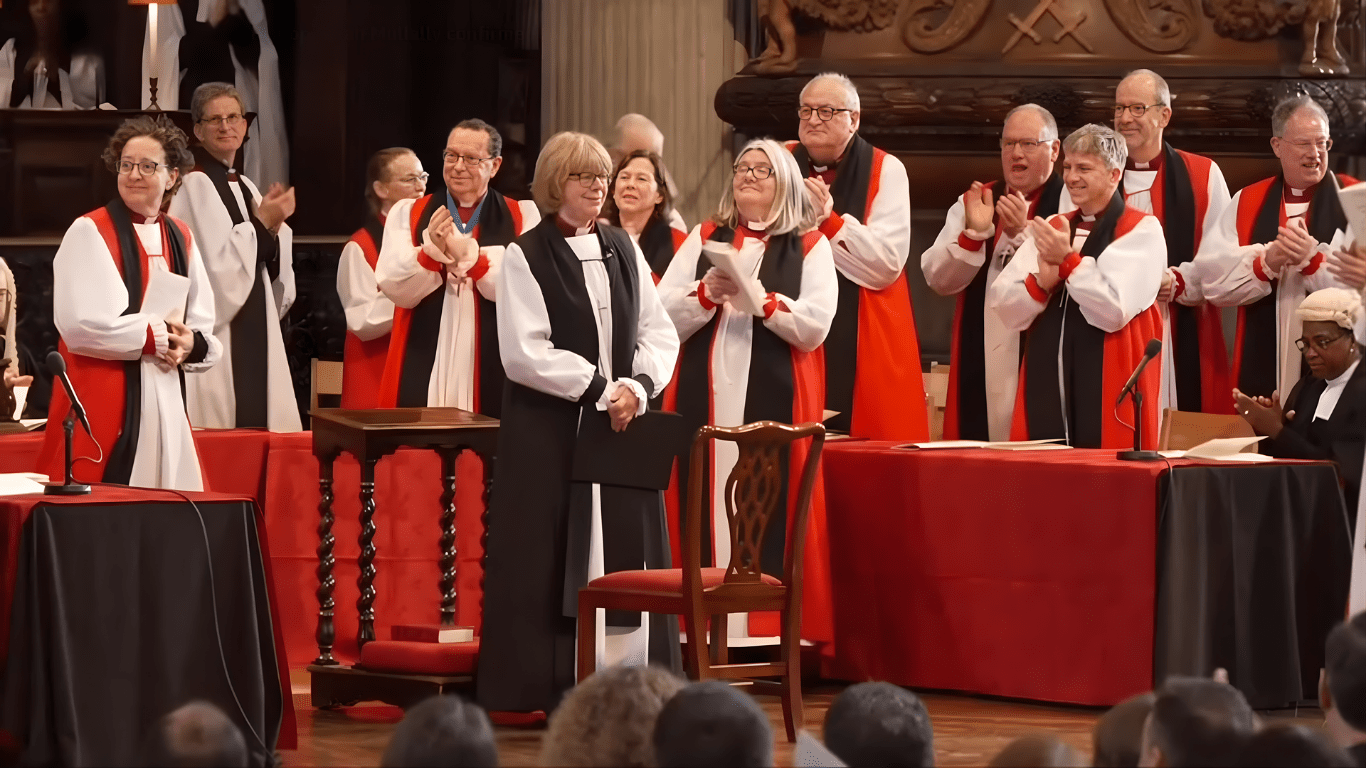

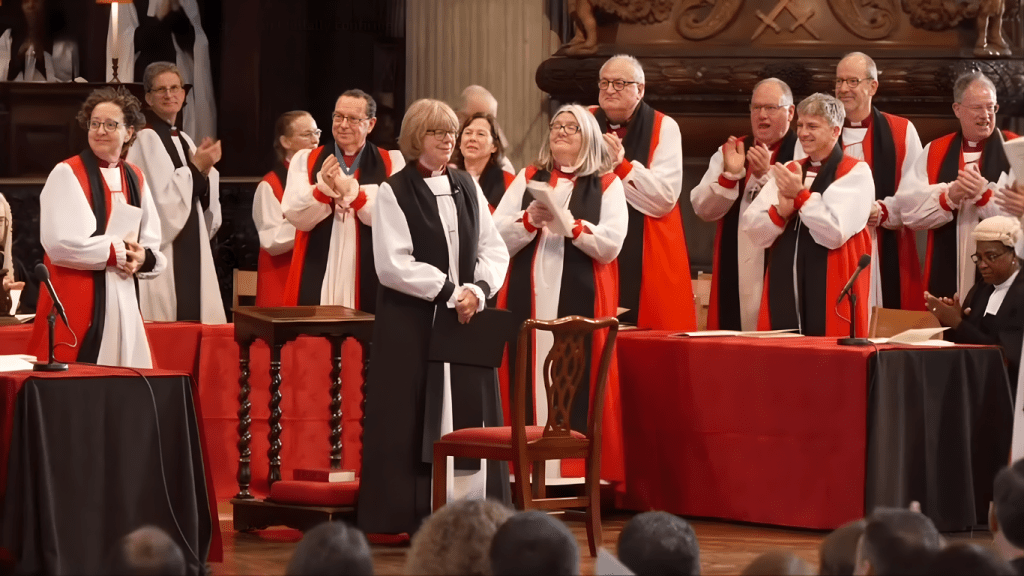
On Wednesday 28th January 2026, Dame Sarah Mullally’s Confirmation of Election ceremony took place at St Paul’s Cathedral, where she vowed to “speak out on misogyny” and make the Church more welcoming and inclusive. Yet her very presence as the first woman ever to hold the office of Archbishop of Canterbury stands as a profound rejection of the clear biblical pattern of male headship in church governance.
What she frames as courageous opposition to prejudice is, from the standpoint of Scripture and the Westminster Confession of Faith, an elevation of cultural ideology over divine order — equating God’s creational design (1 Timothy 2:12–14; Ephesians 5:23) with the very “misogyny” she pledges to confront. This is not mere personal conviction brought to light; it is a public commitment to challenge structures that Scripture itself establishes for the Church’s good order and fidelity to Christ, its sole Head.
As the visible Church drifts further from sola Scriptura, the faithful are reminded: true inclusion is found not in conforming to the spirit of the age but in humble submission to the unchanging Word of God. The Church of England, instead of leading Europe back to biblical orthodoxy, has once again yielded to the ideology of the age — feminism, moral relativism, and worldly accommodationism.
📖 God’s Design for Church Leadership
“But I suffer not a woman to teach, nor to usurp authority over the man, but to be in silence.”
— 1 Timothy 2:12 (KJV)
“A bishop then must be blameless, the husband of one wife.”
— 1 Timothy 3:2 (KJV)
These verses are not remnants of an ancient patriarchy; they are creational decrees. The Apostle grounds them in Eden itself: “For Adam was first formed, then Eve. And Adam was not deceived, but the woman being deceived was in the transgression.” (1 Timothy 2:13–14)
Christ confirmed this order not by omission but by intention. Although He elevated women with profound dignity, He did not appoint them to the apostolic office. Spiritual headship is not a prize of merit but a symbol of covenant representation: as Christ is the Bridegroom and the Church His Bride, so ordained male ministers stand in representative headship under Him.
🕇 The Qualifications of an Elder
The Word of God leaves no room for ambiguity regarding the spiritual and moral prerequisites of those who govern the flock. The Apostle Paul delineates them with exquisite clarity:
“A bishop then must be blameless, the husband of one wife, vigilant, sober, of good behaviour, given to hospitality, apt to teach; not given to wine, no striker, not greedy of filthy lucre; but patient, not a brawler, not covetous; one that ruleth well his own house.”
— 1 Timothy 3:2–4 (KJV)
These are not optional ideals but divinely imposed requirements. By these standards, the present candidate for Canterbury falls manifestly short. She fails the very first condition — to be the husband of one wife, implying male headship — and, more critically, she has given no testimony of regeneration. The Lord Jesus declared: “Except a man be born again, he cannot see the kingdom of God.” (John 3:3) Without the new birth that unites a sinner to Christ through repentance and faith, no amount of charity, intellect, or institutional probity can make one a true pastor of souls.
The tragedy is compounded by the Church’s refusal even to ask the question. Spiritual qualifications have been displaced by bureaucratic procedure; passion for Christ has been replaced by compliance with policy. In enthroning a woman who speaks as a moral reformer but not as one who has been redeemed by grace, the Church of England demonstrates that it esteems appearance above regeneration — administrative competence above apostolic conviction. The office survives, but the Spirit’s witness is absent.
⛪ The Confessional Standard
The Westminster Confession of Faith teaches that:
“Unto this catholic visible Church Christ hath given the ministry, oracles, and ordinances of God, for the gathering and perfecting of the saints.” (WCF 25.3)
That ministry is instituted by Christ Himself, not by social fashion or parliamentary decree. To engineer offices beyond the biblical pattern is to substitute democratic preference for divine prescription. Every church that does so forfeits its claim to be the “pillar and ground of the truth.” (1 Timothy 3:15)
🚫 The False Battle against “Misogyny”
Archbishop Mullally’s vow to “tackle misogyny” may sound noble to modern ears, yet it betrays a category error at the heart of contemporary theology.
Misogyny, properly defined, means hatred, contempt, or devaluation of women. It is indeed sin — a corruption of love and a denial of the image of God in humanity (Genesis 1:27; Matthew 22:39). Scripture condemns such cruelty without hesitation. Yet Mullally has expanded the term to encompass biblical headship itself, as though the divine pattern of male leadership and female submission were the root of human harm.
The Bible is neither misogynistic nor patriarchal in any worldly sense. It is realistic about creation and glorious in complementarity.
“For the husband is the head of the wife, even as Christ is the head of the Church.”
— Ephesians 5:23 (KJV)
To label this order “misogyny” is to call good evil, imputing injustice to the Creator for establishing what He pronounces very good. God’s headship structure is not domination but servant‑leadership patterned after Christ, who “loved the church, and gave himself for it.”
Reformed theology, in harmony with the Westminster Confession, distinguishes between sinful misogyny, which despises women, and righteous headship, which honours them through self‑sacrificing care. The former flows from the fall; the latter from divine ordinance.
When Mullally vows to eradicate “misogyny”, she does not mean merely hatred of women — a sin Scripture already abhors — but the dismantling of hierarchy itself. The battle she promises is not against sin but against structure — against the very stewardship instituted by God. In the world’s lexicon hierarchy is hate; yet in God’s revelation hierarchy is holiness.
By redefining obedience as oppression, the new Archbishop portrays the Word of God as the aggressor and cultural ideology as deliverer. What she calls liberation is, in truth, a subtler form of bondage — submission not to Christ but to the fashions of the age.
💔 The Erosion of Biblical Authority
When “progress” requires contradiction of Scripture, progress ceases to be Christian.
“To the law and to the testimony: if they speak not according to this word, it is because there is no light in them.”
— Isaiah 8:20 (KJV)
The authority of the Church stands or falls with its submission to divine revelation. Replace revelation with sociology, and the lampstand is removed. The Church of England now risks proving the prophet’s rebuke: “they have healed the hurt of the daughter of my people slightly, saying, Peace, peace; when there is no peace.” (Jeremiah 6:14)
🕊️ Unity without Truth
The Archbishop‑designate pledges to “bridge divisions” across the Communion. Yet Reformed faith insists that unity divorced from truth is counterfeit.
“Can two walk together, except they be agreed?”
— Amos 3:3 (KJV)
Authentic unity is not negotiated; it is revealed — granted by the Spirit through adherence to the Word. Any unity achieved by abandoning doctrine is peace without purity.
⚖️ A Call for Faithful Separation
As the Reformers taught, “Christ is the only Head of the Church.” (WCF 25.6) Faithful believers cannot remain silently loyal to leadership that repudiates His authority. To do so is complicity, not humility.
Movements such as GAFCON and the Global South Fellowship therefore stand in the line of the true Reformation, declaring that Canterbury’s authority, having been surrendered to culture, can no longer represent biblical Christianity.
🕯️ Conclusion — “Choose You This Day”
“Choose you this day whom ye will serve… but as for me and my house, we will serve the LORD.”
— Joshua 24:15 (KJV)
The Church now faces a choice between two masters: Christ or the crowd. The appointment of Sarah Mullally is not the triumph of equality, but the exposure of unbelief.
Dame Sarah Mullally, for all her ceremony and reputation, stands as every person does before the cross — a sinner in need of a Saviour. Her mitre and robes cannot veil the fact that “all have sinned, and come short of the glory of God” (Romans 3:23). Yet the peril of her position lies not merely in private sin but in public stewardship of sacred trust. She now presumes to lead the flock of God while denying the authority of His Word. Scripture is explicit: “My brethren, be not many masters, knowing that we shall receive the greater condemnation.” (James 3:1). If she persists in blessing what God has cursed and cursing what God has blessed, she will stand before the Great Shepherd not as a faithful servant but as one who has scattered His sheep. The Lord Himself will “judge the shepherds, and require His flock at their hand” (Ezekiel 34:10). Her only hope, as with us all, lies in repentance and in the cleansing blood of Christ — the one true Shepherd who laid down His life for the sheep and who will one day call every false shepherd to account.
Unless repentance follows, the candle of orthodox Anglicanism in England will be extinguished, leaving only the faithful remnant to bear witness. Yet Christ’s promise endures: He will build His Church, and the gates of hell shall not prevail against it.
“Remember therefore from whence thou art fallen, and repent, and do the first works.”
— Revelation 2:5 (KJV)