
Introduction
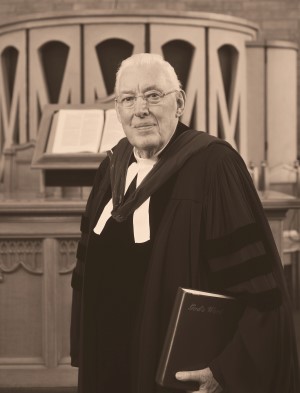
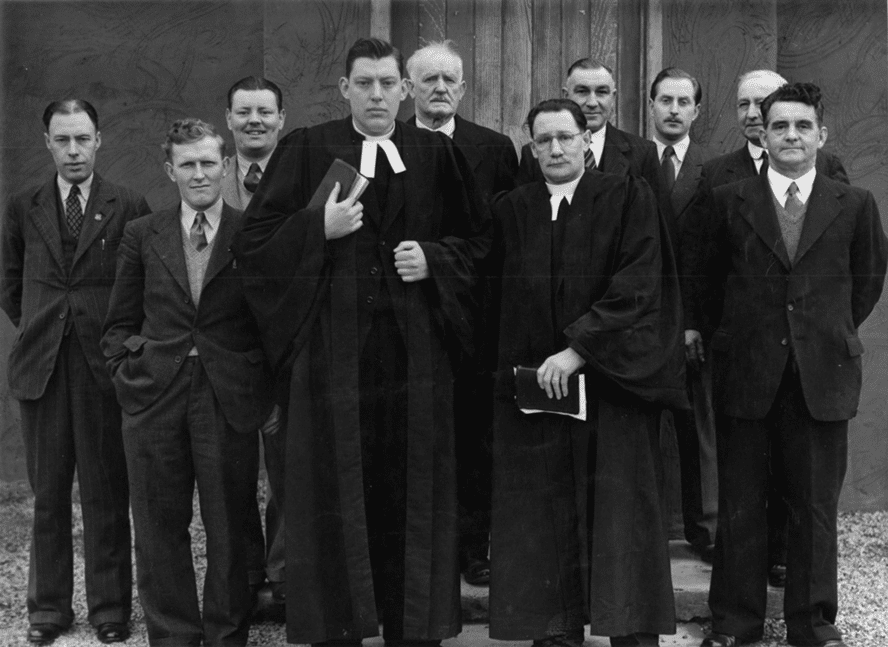
In February 1951, elders from Lissara Presbyterian Church were suspended by the Down Presbytery for wishing to hold a Gospel mission in their church hall led by a young evangelist, Ian Paisley. This rift resulted in the mission going ahead in Killyleagh Street Mission Hall with 94 precious souls saved and professing faith in the Lord Jesus Christ. Following the mission, the Free Presbyterian Church of Ulster was founded on 17th March 1951 in Crossgar by Rev. Ian Paisley and a committee of local members pictured below.
They used the word “Free” in a definite historical and theological sense. It does not mean non-denominational or casual; it means free from the compromises that had overtaken the mainstream Presbyterian bodies.
1. Free from State Control
The Church rejects any union of church and state, following the old Scottish Covenanter conviction that Christ alone is Head of the Church.
It stands independent of political interference and refuses any subordination of spiritual matters to civil authority. The established Presbyterian Church in Ireland was judged to have surrendered too much to government influence and to the Anglican establishment through state and ecumenical entanglement.
2. Free from Liberal Theology
By mid‑century, Presbyterianism in Ireland and Britain had been deeply affected by theological modernism—higher criticism, denial of miracles, and reinterpretation of Scripture. The Free Presbyterian Church arose in protest against this drift. Its ministers insisted on the inerrancy of the Bible, the necessity of personal conversion, and the full authority of Scripture over tradition, scholarship, and ecclesiastical hierarchy.
3. Free from Ecumenism
The denomination was established in opposition to the World Council of Churches and to the growing ecumenical movement that sought unity with Rome and liberal Protestantism at the expense of biblical truth.
Paisley and the founding elders regarded such alliances as spiritual betrayal and reaffirmed the Protestant doctrine of separation from error—“free from fellowship with unbelief.” The Church remains distinct from the Presbyterian Church in Ireland, which still requires formal allegiance to the Westminster Confession yet tolerates ministers and practices incompatible with it.
4. Free to Uphold the Historic Reformed Faith
The Free Presbyterian Church stands in continuity with the Westminster Confession of Faith and the Presbyterianism of the Scottish Reformation.
Its freedom is not rebellion but fidelity—freedom to worship, preach, and govern according to conscience and the unchanging Word of God. It seeks to preserve doctrinal purity, moral integrity, and ecclesiastical independence in the face of modern compromise.

Summary
The Free Presbyterian Church of Ulster is “free” in the same sense as the Free Church of Scotland (1843): free from state control, theological liberalism, and ecumenical corruption; and free to proclaim the Gospel of Christ in its unadulterated Reformed form—or, as Ian Paisley often said, “free from apostasy in the pulpit, and corruption in the pew.”