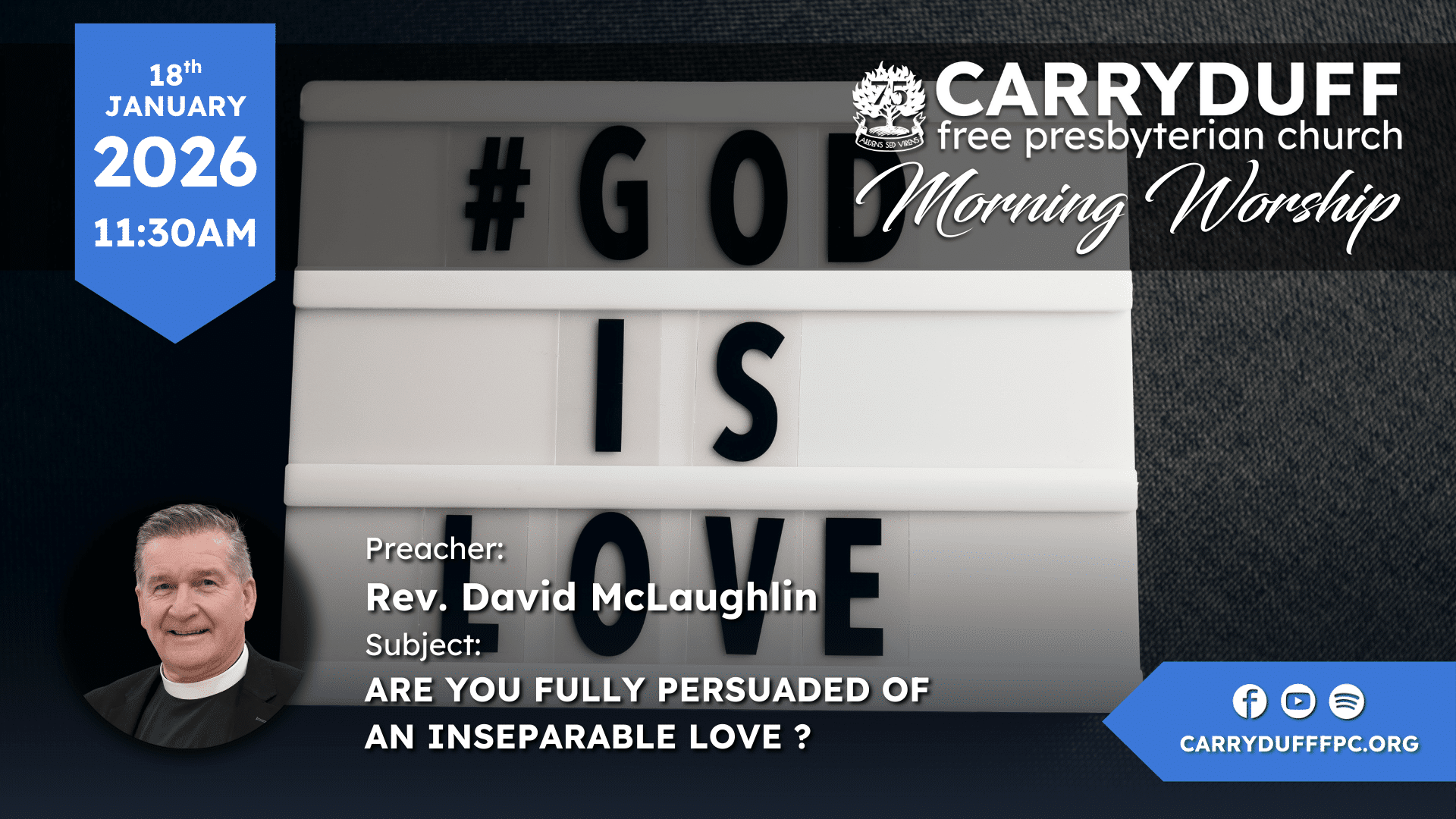

Date: SUN 11:30am 18th January 2026
Preacher: Rev. David McLaughlin
Bible Reference: Romans 8:38-39
Podcast
Sermon Summary
The preacher opens by reading Romans 8:28–39, noting that the church will soon return to its series in 1 Thessalonians. He describes Romans 8 as one of the greatest chapters in Scripture, beginning with “no condemnation” (v. 1) and culminating in “no separation” (vv. 38–39). The chosen text forms the triumphant summit of the chapter, exalting the unsearchable, unchangeable, eternal, and life-transforming love of God for His people in Christ Jesus our Lord.
Central Question & Mountain-Top Analogy
Paul’s declaration — “For I am persuaded that neither death, nor life, nor angels, nor principalities, nor powers, nor things present, nor things to come, nor height, nor depth, nor any other creature, shall be able to separate us from the love of God, which is in Christ Jesus our Lord” — is presented as a question to the congregation:
Are you fully persuaded of an inseparable love?
The preacher employs two powerful illustrations:
- A mountain climber secured by an unbreakable rope to an infallible guide (Christ), who never slips.
- A ship sailing from the harbour of birth towards the harbour of death, held fast by the anchor of God’s love amid violent storms.
He stresses that Paul writes these words not from a place of naïve comfort, but from the midst of real affliction, suffering, weakness, persecution, and the reality of death — yet he rises to this ringing note of gospel certainty.
The Seven Rhetorical Questions (Romans 8:31–35)
Paul ascends the mountain through seven searching questions that demolish every possible ground of fear or doubt:
- What shall we then say to these things?
- If God be for us, who can be against us?
- How shall he not with him also freely give us all things? (after giving His own Son)
- Who shall lay any thing to the charge of God’s elect?
- Who is he that condemneth?
- Who shall separate us from the love of Christ?
- Shall tribulation, or distress, or persecution, or famine, or nakedness, or peril, or sword?
After quoting Psalm 44:22 (“For thy sake we are killed all the day long; we are counted as sheep for the slaughter”), Paul declares believers are “more than conquerors” through Him who loved us (v. 37).
Three Main Points on Paul’s Persuasion
- A Settled Conviction (“For I am persuaded”)
Paul speaks with absolute certainty, not mere hope or feeling. The Greek verb is passive — he has been persuaded through a process of testing, trials, suffering, and near-death experiences. The foundation is God’s sovereign purpose (v. 28) and the unbreakable “golden chain” of salvation (vv. 29–30): foreknown → predestinated → called → justified → glorified. - A Scriptural Conviction
Nothing in creation — death, life, angels (holy or fallen), principalities, powers, present circumstances, future events, height, depth, or any other creature — can sever the believer from God’s love in Christ.
The preacher contrasts biblical Christianity with other world religions: only in Scripture is acceptance with God granted at the beginning of the Christian life, in Christ the Beloved (Ephesians 1:6), through grace alone, by faith alone, not earned by works at the end. - A Spiritual Conviction
This love is:- Divine — originating in God Himself
- Demonstrated — supremely in Christ’s atoning death (Romans 8:32,34)
- Defined — it is always and only known in and through Christ Jesus
- Durable — eternal, unbreakable, unchangeable, unfathomable
Pastoral Application & Challenge
The preacher warns against superficial notions of “God is love” divorced from Christ, His incarnation, virgin birth, sinless life, atoning death, resurrection, and exclusive claims. True knowledge of God’s love comes only through the biblical Christ.
Trials (tribulation, distress, persecution, famine, nakedness, peril, sword — even martyrdom) do come, often because we belong to Christ. Yet they do not indicate God’s abandonment; rather, they are evidences of sonship. They:
- expose self-reliance
- drive us to prayer and deeper trust
- conform us to Christ’s sufferings
- purify faith like fire refines gold
- enable us to be more than conquerors
Even our own sins, failures, coldness, or worldliness cannot ultimately separate us, because the love in view is God’s love to us, not our love to Him. Christ’s purposeful, electing, redeeming love guarantees perseverance.
Closing Appeal
The preacher urges every true believer to be fully persuaded — not because life is easy, but because God’s sovereign, electing, redeeming, eternal love in Christ is unbreakable. He prays that these truths would settle deeply in the hearts of the hearers, enabling joyful perseverance amid trials.