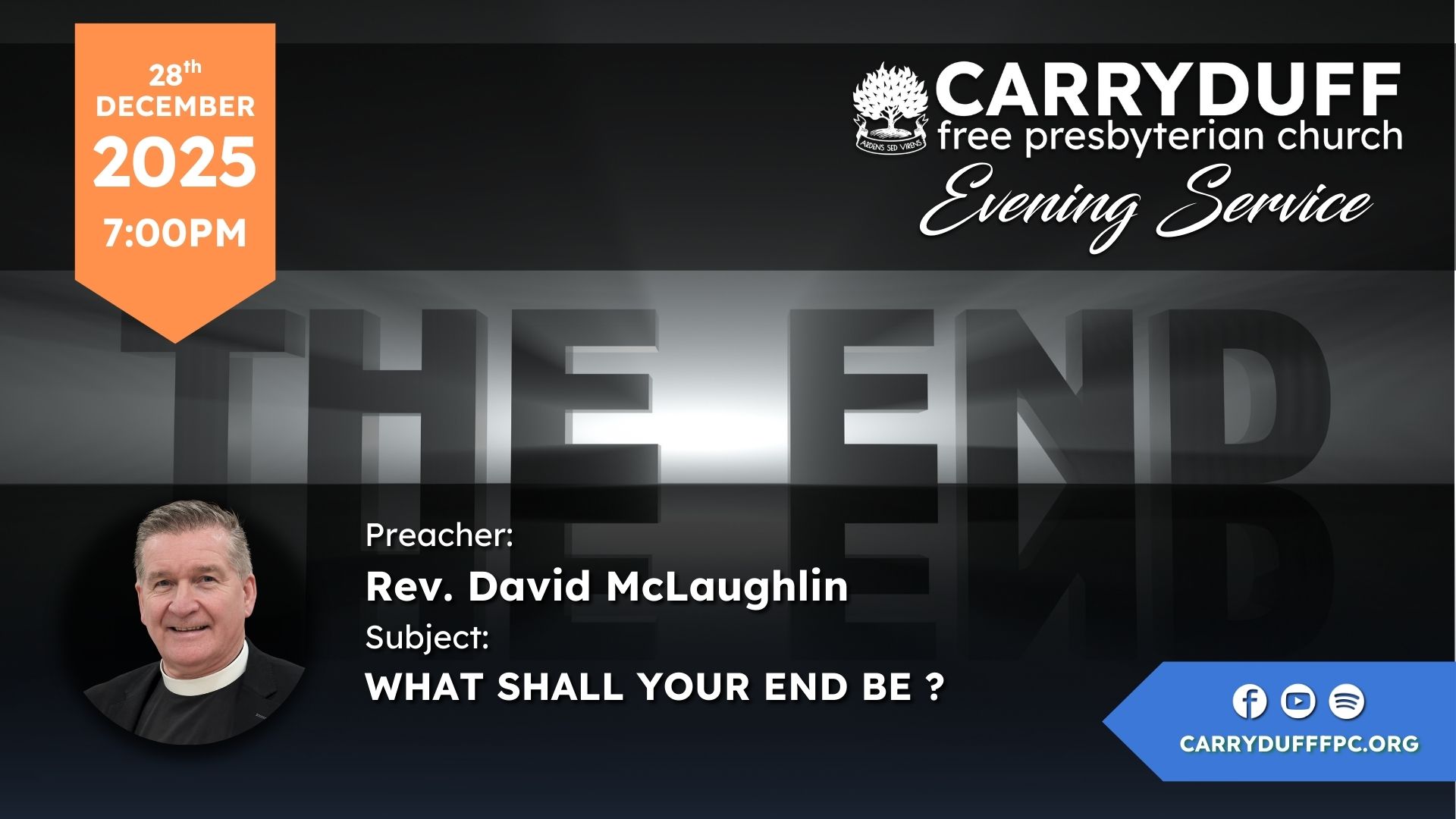

Date: SUN 7:00pm 28th December 2025
Preacher: Rev. David McLaughlin
Bible Reference: 1 Peter 4:17
For the time is come that judgment must begin at the house of God: and if it first begin at us, what shall the end be of them that obey not the gospel of God?
Podcast
Sermon Summary
The sermon is delivered on the last Sunday night of 2025. It is based on 1 Peter 4:12–19 (read from the King James Bible), with the primary text being verse 17:
“For the time is come that judgment must begin at the house of God: and if it first begin at us, what shall the end be of them that obey not the gospel of God?”
The preacher titles the message “What Shall Your End Be?” and uses the closing of the year as a solemn opportunity to confront listeners with the question of their eternal destiny.
Structure and Main Sections
- Scripture Reading and Context (1 Peter 4:12–19)
The passage addresses Christians suffering “fiery trials” and persecution. Peter urges them not to be surprised by suffering, to rejoice in sharing Christ’s sufferings, to glorify God even when reproached, and never to suffer for wrongdoing. The key idea is that judgment begins with God’s house (believers), raising the urgent question: if God judges His own people, what will be the fate of those who reject the gospel? - The Urgency of the Moment
- 2025 is ending; all its moments, mercies, and opportunities will soon be history.
- Listeners have heard the gospel repeatedly throughout the year: Christ’s virgin birth, sinless life, atoning death, resurrection, and the call to repent and believe.
- Offers of full pardon, peace with God, adoption into God’s family, and everlasting life have been extended.
- Yet some remain unresponsive due to ignorance, procrastination, willful delay, or open rebellion.
- Every sermon heard has been an act of God’s grace, patience, and mercy through the Holy Spirit. No one is promised another year, another sermon, or even another day.
- Peter as an Example of Faithful Ministry
- Peter, despite his faults, loved Christ deeply and was called to be a “fisher of men.”
- He faithfully preached to people who often rejected or remained ignorant of Christ, even amid fierce persecution (including martyrdom).
- The Core Question: “What Shall the End Be?”
The preacher structures the bulk of the sermon around four key aspects of rejecting the gospel:a. The Greatest Message That Is Rejected – The Gospel of God- “The gospel of God” (a phrase used multiple times in the NT) is good news originating from God Himself – not invented by man, angels, the church, or scholars.
- There is only one true gospel (not multiple different gospels); varying titles (gospel of the kingdom, of grace, of Christ, etc.) emphasize different facets of the same message.
- Content/Subject: Centers on the person and work of Christ – His incarnation, sinless life, substitutionary death, burial, resurrection, and appearances.
- Strength/Power: It is the “dynamite” (dunamis) of God for salvation, able to cleanse, transform, comfort, and counsel sinners.
- The preacher shares his personal testimony: at age 18, convicted after hearing John 10:10, he cried out to God in a Roman Catholic lodging house in Coleraine and was saved.
- b. The Greatest Mistake That Is Revealed – “Obey Not” the Gospel
- The gospel commands two things (Mark 1:15): repent (turn from sin with godly sorrow) and believe (trust fully in Christ).
- Common excuses rejected: too young, too busy, too sinful, too old, or too late.
- Condition: Come as you are, come now (John 6:37; Matthew 11:28; 2 Corinthians 6:2).
- Root cause of refusal (John 3:19): Men love darkness and sin more than the Savior; they prefer the voice of self, others, or conscience over Christ’s call.
- c. The Guilty Misery That Is Recognized – The State of the Ungodly and Sinner
- Ungodly: Deliberately live without God; the carnal mind is enmity against Him (Romans 8:7).
- Sinner: All have sinned in Adam and continually fall short of God’s glory (Romans 3:23; 5:12).
- Many have a high view of self (“I’m a good person”) and a low view of God’s holiness and perfect law.
- Only Christ perfectly kept the law on behalf of believers.
- d. The Solemn Destiny That Awaits
- Judgment and separation at Christ’s return (2 Thessalonians 1:7–9; Matthew 25:31–46).
- Christ will return in flaming fire, taking vengeance on those who “know not God” and “obey not the gospel.”
- Final separation: sheep (believers) on the right → inherit the kingdom; goats (unbelievers) on the left → “depart from me” into everlasting fire.
- Good works are evidence of salvation, not the ground.
- Many will profess Christ on that day but hear “I never knew you” because they loved sin more than the Savior.
Closing Appeal
The preacher urges listeners not to reject the greatest message, make the greatest mistake, remain in guilty misery, or face this solemn destiny. He pleads with them to respond to the gospel while it is still the day of grace, emphasizing that rejecting Christ means choosing a Christless eternity in hell.
The sermon ends with prayer that God would bless His Word to the hearts of the hearers.