
Date: SUN 7:00pm 21st December 2025
Preacher: Rev. David McLaughlin
Bible Reference: Luke 2:10
And the angel said unto them, Fear not: for, behold, I bring you good tidings of great joy, which shall be to all people.
Podcast
Sermon Summary
Delivered on Christmas Sunday evening, 21st December 2025, the preacher’s message was entitled “The Significance of the Christmas Story.” His primary text was Luke 2:10-12, where the angel proclaims to the shepherds:
“Fear not: for, behold, I bring you good tidings of great joy, which shall be to all people. For unto you is born this day in the city of David a Saviour, which is Christ the Lord. And this shall be a sign unto you; Ye shall find the babe wrapped in swaddling clothes, lying in a manger.”
The preacher opened by directly confronting the congregation with a searching question: “Why Christmas? What is so special and so significant about this season?” He observed that, for centuries, Christmas has been marked and celebrated across the Western world and far beyond, and that even today it is cherished and enjoyed by millions. He alluded to the popular sentiment captured in the song “Oh, I wish it were Christmas every day,” highlighting the widespread affection for the season.
He painted a vivid picture of the appealing side of Christmas: a time of wholesome fun, especially for children, filled with party games, laughter, and excitement; a season of abundant food and special meals – the traditional Christmas dinner with roast turkey, Brussels sprouts, and all the trimmings; a precious opportunity for families to reunite, with loved ones travelling great distances to “come home for Christmas.” Gifts are thoughtfully chosen and exchanged, greetings cards and messages are sent, shops close (prompting a humorous “Hallelujah!” from the men), and people enjoy a rare chance to relax, unwind, and step away from the daily routine and the mundane pressures of life. In short, Christmas is often experienced as a thoroughly pleasant, positive, and uplifting time of year.
Yet the preacher was careful not to romanticise the season unduly. With pastoral sensitivity, he acknowledged the shadow side that many face: Christmas can also be deeply painful. Bitter disappointments arise when plans fall apart; financial pressures mount, and debt becomes a harsh reality for numerous households; expectations remain unfulfilled; serious illness or sudden hospitalisation strikes; sharp, wounding words are exchanged, leading to family fallouts; and for some, the season brings the grief of bereavement or the aching absence of departed loved ones, triggering painful memories. In the midst of these contrasting experiences – the pleasant and the painful – he pressed the question home: “What does Christmas really mean to you personally? Why do we greet one another with ‘Happy Christmas’? What is it that makes this season truly special and significant?”
He insisted that a definitive answer exists, and that it is entirely possible to experience “the best Christmas ever.” Crucially, he told the young people present that this has nothing whatsoever to do with alcohol, wild parties, drugs, or even a lottery win. Rather, the deepest joy comes from grasping the greatest good news of all time – the gospel message proclaimed in the Scripture readings and carols of the season.
The preacher then presented three interconnected points that reveal the profound significance of the Christmas story, centring on the “sign” given to the shepherds: a babe wrapped in swaddling clothes, lying in a manger.
- The Promise of Jesus Christ’s Coming
Jesus Christ is the long-promised One. From the very earliest pages of Scripture, God foretold His arrival. The preacher traced the first gospel promise back to Genesis 3:15, where God declares that the “seed of the woman” would bruise the serpent’s head, even as the serpent would bruise His heel – poetic language depicting a decisive victory over evil. This promise is explicitly linked to Christ in Galatians 4:4: “When the fullness of the time was come, God sent forth his Son, made of a woman…” He showed how the entire Old Testament builds upon this initial promise: prophecies concerning Abraham’s seed, Isaac, Jacob, the tribe of Judah (Genesis 49:10 – “The sceptre shall not depart from Judah… until Shiloh come”), the virgin birth and the name Emmanuel (Isaiah 7:14), and the precise birthplace in Bethlehem (Micah 5:2). Every detail was fulfilled with astonishing precision in Jesus: His Davidic lineage (Matthew 1), His entry into Jerusalem on a donkey (fulfilling the imagery in Genesis 49:11), and even the timing and location of His birth, orchestrated by God through Caesar Augustus’s taxation decree that brought Mary and Joseph from Nazareth to Bethlehem. The preacher stressed that Jesus did not appear randomly or unexpectedly. God planned every aspect, prophesied it centuries in advance, and brought it to pass down to the smallest detail. This demonstrates beyond doubt that God is utterly faithful, always true to His word, and entirely trustworthy. As Jesus Himself declared, “I am the truth,” and the Scriptures all testify of Him (John 5:39). - The Person of Jesus Christ
The Christmas message centres not merely on a promised child, but on the glorious Person who came: “a Saviour, which is Christ the Lord.” Jesus is the anointed Prophet who authoritatively reveals the way of salvation; the great High Priest who offered Himself once for all as the perfect sacrifice for sin and now ever lives to intercede for His people; and the rightful King who summons sinners to repentance and invites them into His eternal kingdom. Drawing on titles such as “Mighty God” and “Emmanuel” (“God with us”), the preacher affirmed the foundational doctrines of the incarnation and the virgin birth. He declared that it is impossible to be a genuine Christian or a faithful gospel minister without believing these truths. He cited 1 Timothy 3:16 (“God was manifest in the flesh”) and John 1:14 (“The Word became flesh and dwelt among us… full of grace and truth”). The unique wonder of Christianity, he argued, is that God did not remain distant or hidden; He entered our world, became one of us, lived among us, and revealed the Father perfectly: “He that hath seen me hath seen the Father” (John 14:9). Through Christ alone we truly know God (2 Corinthians 4:6). Christianity stands utterly apart from all man-made religions: it offers not a system of rituals or rules, but a living, personal relationship with the living God. This relationship begins in the new birth, when the repentant believer receives the indwelling Holy Spirit (Romans 8:9). - The Purpose of Jesus Christ’s Coming
The angelic announcement is a message of global and eternal importance: “Unto you is born… a Saviour.” Humanity is universally lost in sin – “All have sinned and come short of the glory of God” (Romans 3:23); “All we like sheep have gone astray… and the Lord hath laid on him the iniquity of us all” (Isaiah 53:6). We are guilty, spiritually blind, and in desperate need of deliverance. Jesus declared His mission clearly: “The Son of man is come to seek and to save that which was lost” (Luke 19:10). There is only one Mediator, only one name under heaven by which we must be saved (1 Timothy 2:5; Acts 4:12). While Christmas rightly involves fun, fellowship, feasting, and acts of kindness – even random generosity to strangers – many tragically miss its deepest meaning because they remain ignorant of the promised Saviour and unaware of who He truly is.
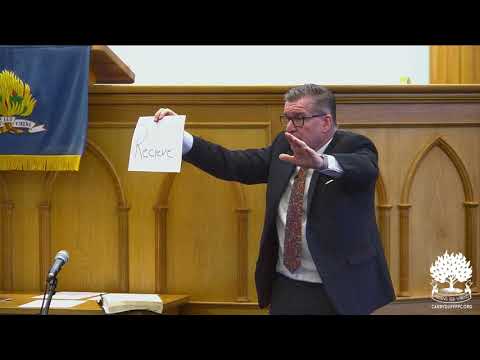
The preacher closed with a poignant illustration: years ago, after giving his young daughters an expensive doll’s house or play kitchen for Christmas, he found them on Boxing Day happily playing inside the large cardboard box, cutting holes for windows, while the actual gift sat neglected. In the same way, countless people occupy themselves with the “packaging” of Christmas – the food, presents, and festivities – yet ignore the priceless gift of the Saviour Himself.
He issued a heartfelt gospel appeal: to receive this gift, one must repent – acknowledge personal guilt and sinfulness before God, confess it honestly, and cry for mercy like the publican: “God be merciful to me a sinner.” Then, by faith, trust wholly in the Lord Jesus Christ for forgiveness and new life. The result is full, free, and everlasting pardon; sins remembered no more; peace with God and the peace of God amid life’s storms; a transformed heart and lifestyle; and the certain hope of eternal life as adopted sons and daughters of God.