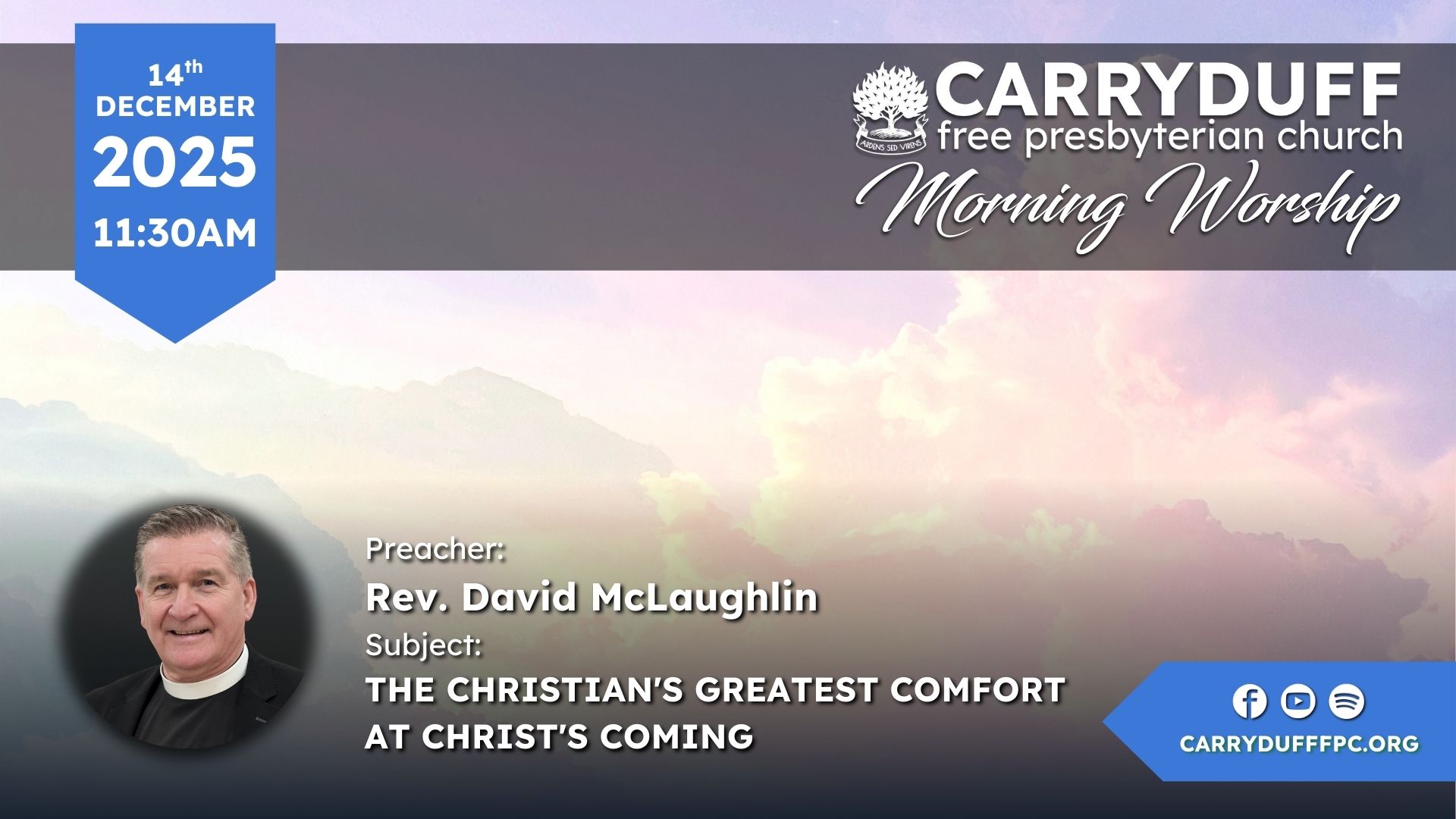

Date: SUN 11:30am 14th December 2025
Preacher: Rev. David McLaughlin
Bible Reference: 1 Thessalonians 4:13-18
But I would not have you to be ignorant, brethren, concerning them which are asleep, that ye sorrow not, even as others which have no hope. 14 For if we believe that Jesus died and rose again, even so them also which sleep in Jesus will God bring with him.
Podcast
Sermon Summary
The preacher delivers an expository sermon on 1 Thessalonians 4:13–18, entitled “The Christian’s Greatest Comfort at Christ’s Coming.” Addressing a congregation working through Paul’s first epistle to the Thessalonians, he seeks to comfort believers grieving the loss of loved ones who have died in Christ, particularly in light of first-century persecution and martyrdom. The passage is presented as divine revelation intended to dispel ignorance and hopelessness, offering genuine hope rooted in the resurrection and return of Jesus Christ.
The sermon is structured around three main points emerging from the text: a word of explanation, a word of exhortation, and elements of practical application.
1. A Word of Explanation
Paul writes to correct misunderstanding (“I would not have you to be ignorant,” v. 13) among the Thessalonian believers. The word “ignorant” here means uninformed or lacking knowledge, not rude or ill-mannered. The church was troubled by questions about the state of their deceased loved ones, especially those martyred for the faith. They feared that the dead in Christ might miss out on the Lord’s return, remain forgotten in the grave, or be disadvantaged compared to living believers.
Paul contrasts Christian sorrow with the hopelessness of pagans and false religions, who have no doctrine of resurrection or genuine comfort regarding death (“that ye sorrow not, even as others which have no hope,” v. 13). Christians, however, possess real hope because they serve the “God of hope” (Romans 15:13). The preacher emphasises that it is natural to grieve, but believers should not grieve as those without hope.
The primary purpose of the passage (disclosed in v. 18: “Wherefore comfort one another with these words”) is pastoral comfort for living saints mourning the dead in Christ. Paul employs the doctrine of Christ’s second coming not primarily to teach eschatology or to support a specific rapture timing (e.g., pre-tribulation), nor to construct elaborate prophetic charts, but to assure believers about the future of their departed loved ones.
The prospectus (future hope) is declared with certainty:
- Grounded in the historical fact of Christ’s death and resurrection (“if we believe that Jesus died and rose again,” v. 14 – better translated “since”).
- Believers who “sleep in Jesus” (a euphemism for death, not soul sleep) will be brought with Him at His return.
- Death for the Christian is likened to sleep: temporary, restful, free from penal suffering (unlike Christ’s substitutionary death), and implying awakening. The body rests in the grave while the soul is immediately with the Lord (citing 2 Corinthians 5:8; Philippians 1:23; Luke 23:43).
- Christ’s resurrection guarantees the believer’s resurrection (“because I live, ye shall live also,” John 14:19).
- This revelation comes “by the word of the Lord” (v. 15) – new information not found in the Old Testament, directly inspired for the church’s comfort.
- Living believers have no advantage over the dead; the dead in Christ rise first.
2. A Word of Exhortation
Christ’s coming will reunite believers with their deceased loved ones in Christ, providing the greatest comfort. Key elements include:
- The Return of Christ (v. 16): The Lord Himself descends from heaven “with a shout, with the voice of the archangel, and with the trump of God.” The preacher argues this event is public and audible, not secret or silent.
- The Resurrection: The dead in Christ rise first – their souls (already with Christ) reunited with glorified bodies raised from the grave, regardless of how the body died or decayed (even cremation or violent death).
- The Relationship (v. 17): Living believers are “caught up together with them” (the rapture) to meet the Lord in the air. This brings:
- Unification: The entire redeemed company (Old and New Testament saints) gathered together for the first time.
- Identification: Believers will recognise and know one another in glorified bodies, akin to Christ’s resurrection body.
- Restoration: Eternal fellowship with the Lord (“so shall we ever be with the Lord”) – the ultimate purpose, surpassing even reunion with loved ones. Christ is central; all sin, suffering, and conflict cease.
3. Practical Application and Exhortation
Believers are urged to “comfort one another with these words” (v. 18). This truth provides real hope in life and death, countering modern hopelessness (e.g., depression, economic woes, godlessness). Grief is normal and should not be suppressed, but it must be tempered with biblical hope.
The preacher closes with an evangelistic appeal: there are only two ways to die – in one’s sins (leading to eternal separation) or in the Saviour (blessed rest and future resurrection). He urges the unsaved to repent, trust Christ alone for salvation, and live in light of His return.