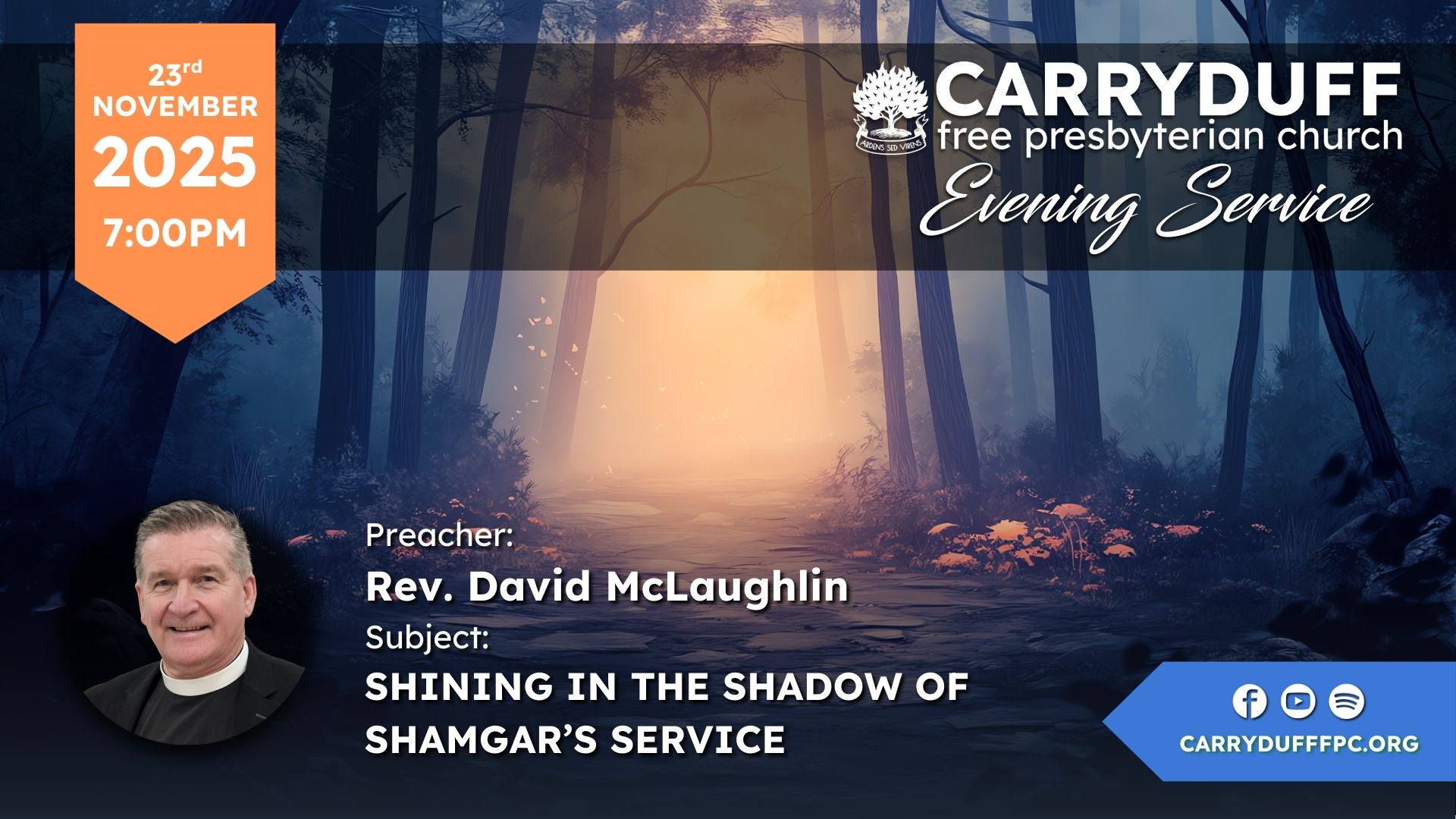

Date: SUN 7:00pm 23rd November 2025
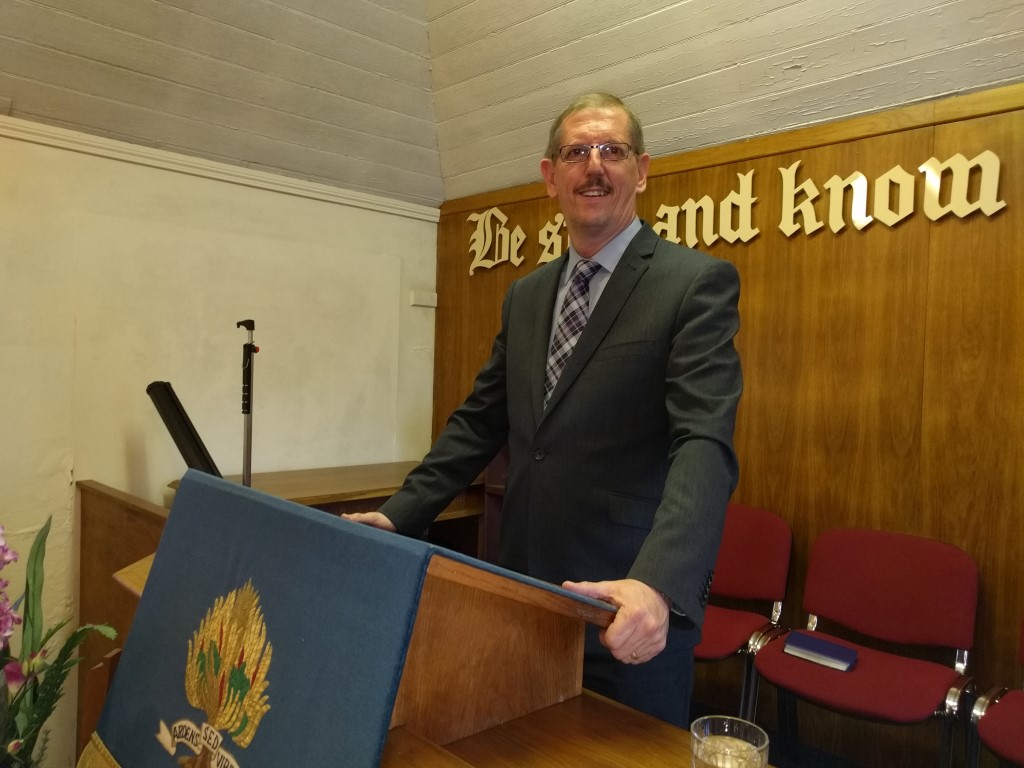
Preacher: Rev. David McLaughlin
Bible Reference: Judges 3:31
And after him was Shamgar the son of Anath, which slew of the Philistines six hundred men with an ox goad: and he also delivered Israel.
Podcast
Subscribe to the podcast here:
Spotify Podcasts | Apple Podcasts | Pocket Casts
Email | RSS | more information here
Sermon Summary
The preacher begins by explaining how the Lord laid the obscure figure of Shamgar upon his heart after prayer. Shamgar is mentioned in only two verses of Scripture (Judges 3:31 and 5:6), yet the preacher insists he stands among the greatest of Israel’s judges. The book of Judges is characterised by a repeated cycle: Israel’s rebellion against God, resulting retribution through enemy oppression, repentance, and God raising up a deliverer. Shamgar was the third such deliverer, coming after Othniel and Ehud.
Who was Shamgar?
An unknown farmer, not a trained soldier. His name appears as “Shamgar the son of Anath”. The name Anath is linked to a prominent Canaanite goddess, suggesting Shamgar was not born an Israelite but came from a pagan background. The preacher emphasises that Shamgar was therefore a converted man who had forsaken idolatry to follow the true God of Israel. God called him to salvation, to take a stand, and to serve.
The dark days in which he lived
Israel faced intense Philistine raids from the Gaza region. Villages were plundered, crops stolen, and travellers so terrified that the main highways were deserted; people crept along hidden byways (Judges 5:6). Spiritually, the nation was in deep apostasy: they had “chosen new gods” (Judges 5:8), and the Philistines had so disarmed Israel that no sword or spear was seen among 40,000 men, and no blacksmith was allowed in the land (cf. 1 Samuel 13:19-20).
Shamgar’s courageous stand
One day a band of 600 armed Philistines descended on Shamgar’s farm. With no conventional weapon available, he seized the only thing at hand—an oxgoad (a long wooden pole with a sharp metal tip for prodding oxen and a small spade at the other end for cleaning ploughs). Against impossible odds (600 to 1), this lone farmer fought and killed all 600, delivering Israel. His exploit was so remarkable that Deborah celebrated “the days of Shamgar the son of Anath” in her victory song.
Lessons drawn from Shamgar
- The Call – Like Shamgar, believers today are called to stand in a time of violence, spiritual declension, and hostility to biblical truth. The preacher laments the ravages of post-war liberal theology that denied the supernatural elements of Christianity (virgin birth, atonement, resurrection, etc.), and the rise of postmodern “cancel culture” that rejects absolute truth, the authority of Scripture, and the gospel itself.
- The Courage – Shamgar used what he had. God delights to work through weak, unlikely instruments when they are consecrated to Him. “Little is much when God is in it.” The preacher urges the congregation to use whatever is in their hand—conversation with a neighbour, a gospel tract, an invitation to church, prayer, a smile—for God’s glory.
- The Comparison – Shamgar foreshadows the Lord Jesus Christ:
- An unlikely deliverer (a Canaanite farmer // Jesus from despised Nazareth with Gentile and “questionable” ancestors in His human line).
- An unlikely weapon (oxgoad // the wooden cross).
- An unlikely stand (one man alone // Christ alone on Calvary).
Yet Christ won an eternal victory over sin, Satan, death, and hell through His sacrificial death and resurrection.
- The Confidence – Shamgar did not wait for better circumstances or more training; he acted with what God had given him. Believers today must do the same: sow gospel seed, speak the Word, stand firm, and trust that God will honour even small faithfulness.
The sermon closes with an earnest appeal: in an age when churches are closing, truth is scorned, and many are fearful, where are today’s Shamgars? Fathers, mothers, young people—every believer is called to personal salvation, to courageous witness, and to consecrated service. The preacher quotes Hebrews 4:12 on the power of God’s Word and reminds the hearers that it is not great talent God uses, but great likeness to Jesus.
In essence, the message magnifies an almost forgotten biblical hero to stir the church to faith-filled, bold action in dark and difficult days, pointing ultimately to the far greater Deliverer, the Lord Jesus Christ.