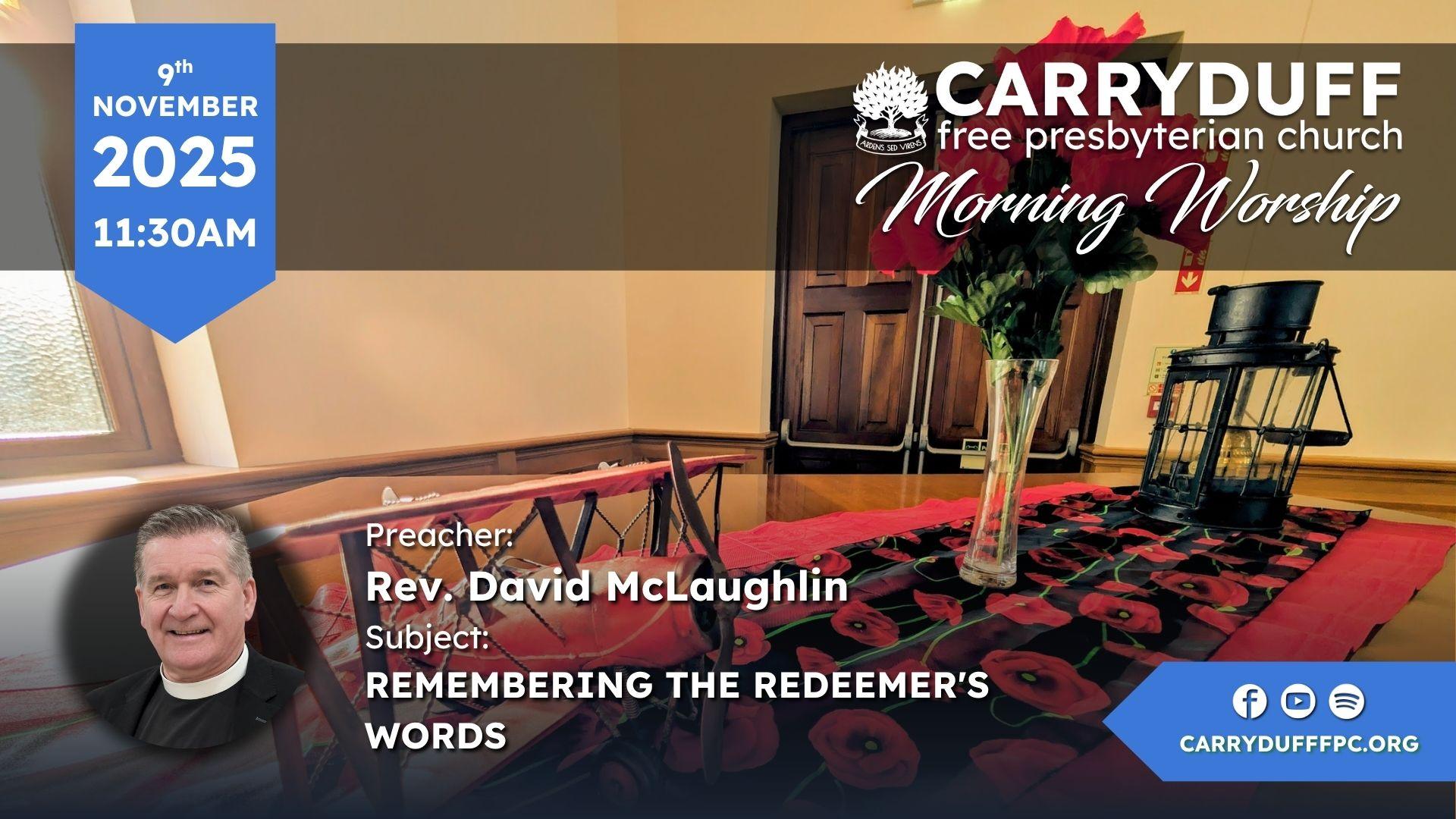

Date: SUN 11:30am 9th November 2025
Preacher: Rev. David McLaughlin
Bible Reference: Luke 24:7-8
7 Saying, The Son of man must be delivered into the hands of sinful men, and be crucified, and the third day rise again. 8 And they remembered his words,
Podcast
Subscribe to the podcast here:
Spotify Podcasts | Apple Podcasts | Pocket Casts
Email | RSS | more information here
Sermon Summary
The sermon begins with the reading of Luke 24:1–12, recounting the events of the resurrection morning. A group of devoted women, who had followed Jesus in life and mourned Him in death, come early to the tomb with spices to anoint His body. Instead of finding Him, they find the stone rolled away and the tomb empty. Two angels appear in radiant garments and rebuke their confusion with the words: “Why seek ye the living among the dead? He is not here, but is risen.” They remind the women of what Jesus had already said in Galilee — that He would be delivered into the hands of sinful men, be crucified, and rise again on the third day. At that moment, the Scripture says, “They remembered His words.”
1. Remembrance and Its Biblical Importance
The preacher connects this passage with Remembrance Sunday, noting that just as nations remember the fallen who secured earthly freedom, Christians are called to remember the Redeemer who secured eternal freedom. Throughout Scripture, the act of remembering is a sacred duty; the term “remember” appears over two hundred times from Genesis to Revelation. The Lord’s command at the Last Supper — “Do this in remembrance of Me” — makes remembrance not merely a sentiment but an act of faith.
Thus, remembrance in the biblical sense means recalling the truth and promises of God with conviction, gratitude, and renewed action. It anchors the believer’s heart in divine reality amid grief, doubt, and the pressures of the world.
2. The Women’s Problem — Forgetting the Words of Christ
The preacher turns to the emotional state of the women approaching the tomb: they are sorrowful, confused, mourning, and fearful. They expect to find a corpse, not a conqueror. Their problem, the preacher explains, is not lack of devotion but lack of remembrance. They had heard Christ’s promises but had not stored them in faith. Forgetfulness of God’s Word led them into unnecessary despair.
This, he insists, is a spiritual mirror for every Christian. Believers often face life’s “tombs” — losses, fears, temptations, and afflictions — and respond with the same hopelessness. Yet the problem lies not in the circumstances but in the heart’s failure to recall the promises of God. Forgetting Christ’s words leads to spiritual darkness; remembering restores light.
3. The Divine Solution — Remember the Word
The angels, notably, do not focus attention on themselves — their shining garments, heavenly origin, or miraculous presence. Instead, they direct the women back to what Jesus had said. “Remember how He spake unto you,” they declare. The preacher emphasizes that the angels’ authority derives from the Word of God, not from mysticism or vision. All true comfort flows from Scripture, not from feeling or spectacle.
Faith, he asserts, must be grounded in the verbal revelation of God. The same method used by the angels was later exemplified by Jesus Himself on the road to Emmaus. There, Jesus explained the Scriptures “in all the things concerning Himself,” thereby replacing confusion with understanding. Whether by angel or by the risen Lord, the message is consistent: the believer’s confidence must rest on the written Word.
4. The Nature and Power of the Redeemer’s Words
From this, the preacher develops a threefold meditation on the veracity, the value, and the victory of Christ’s words.
- Veracity — Christ’s words are entirely true. He spoke truth about history, about humanity, and about Himself. When He cited Adam, Noah, Moses, and the prophets, He affirmed their reality, not myth or allegory. His authority stems from His very identity: “I am the Truth.”
- Value — The Word of God illumines the path of life: “Thy word is a lamp unto my feet and a light unto my path.” It reveals sin, warns of danger, and points to the remedy — salvation through Christ’s blood. The preacher uses the metaphor of a miner’s lamp under a policeman’s uniform to show how the Word shines in dark places, giving guidance, correction, and restoration.
- Victory — The Word brings light to those in mental anguish and despair. It conquers fear and replaces gloom with joy. Just as the women left the tomb rejoicing, believers can emerge from inner darkness through renewed confidence in God’s Word. Scripture is not mere literature but the living, God-breathed truth that purifies, sanctifies, and consoles.
He quotes Peter’s testimony in 2 Peter 1:16–19 — “We have not followed cunningly devised fables, but… a more sure word of prophecy.” Even Peter’s eyewitness experience of the Transfiguration, the preacher notes, was deemed secondary to the written Scriptures, which are a firmer foundation for faith than sight or personal experience.
5. The Exalted Person — Christ Himself
Finally, the sermon returns to the pronoun “His” in “They remembered His words.” The true object of remembrance is not merely Scripture as text but the living Christ who spoke it. “He is not here, but is risen.” Christianity stands or falls on that proclamation.
Jesus had repeatedly foretold His suffering, death, and resurrection, yet His disciples often refused to listen. Peter’s objection in Matthew 16 — “Not so, Lord!” — exemplifies human resistance to divine truth. The preacher likens this to losing a broadcast signal: God’s message is still going forth, but spiritual deafness creates “dead spots” where the heart no longer receives. Many attend worship and even enjoy the prayer or fellowship, he warns, yet “cut out” spiritually when the Word demands response.
To hear Christ’s words rightly requires a tuned and humble heart. Those who listen truly, as the women finally did, find that remembrance brings revival — turning tragedy into triumph and despair into delight.
6. The Broader Application — From Forgetfulness to Faith
The sermon closes with pastoral exhortation. Each generation faces its own tombs: loss, injustice, uncertainty, temptation. The same cure applies — a return to the Book, to the words of Jesus. The Bible alone carries saving and sanctifying power; it checks sin, restores peace, and leads to assurance. When believers feed on it daily, they gain stability of soul and strength for every trial.
Remembrance, then, is not passive nostalgia but active renewal. Remembering Christ’s words is the spiritual discipline that transforms mourning into mission. The women who remembered went forth proclaiming, “The Lord is risen indeed.” Their testimony still calls the Church to live in the light of resurrection faith.
7. Conclusion — Remembering the Living Word
In closing, the preacher unites the two commemorations — national remembrance and spiritual remembrance. Just as citizens honour those who gave their lives for freedom, Christians honour Christ, who died and rose to give eternal liberty. Forgetfulness leads to despair, but remembrance brings life and hope.
Christ, he declares, is the Man of Sorrows who bore humanity’s sin and shame, yet also the Risen Lord who grants victory over death. His mercy and grace are sufficient for every soul, and His Word remains the surest light for every traveler through darkness.
The lingering message is simple yet profound:
When life seems defeated, return to His words.
When the heart is weary, remember His voice.
When hope feels buried, look again into the empty tomb.
For the risen Christ still speaks — and still gives life — to all who remember.
“And they remembered His words.”
Remembrance Day Photos