

Date: Sun PM 4th August 2019
Soloist: Mr. Graham Murphy
Testimony: Dr. Frank McClelland
Bible Reference: Proverbs 3v5-6
Trust in the Lord with all thine heart;
and lean not unto thine own understanding.
In all thy ways acknowledge him,
and he shall direct thy paths.
Podcast
Subscribe to the podcast here:
Spotify Podcasts | Apple Podcasts | Pocket Casts
Email | RSS | more information here
Testimony
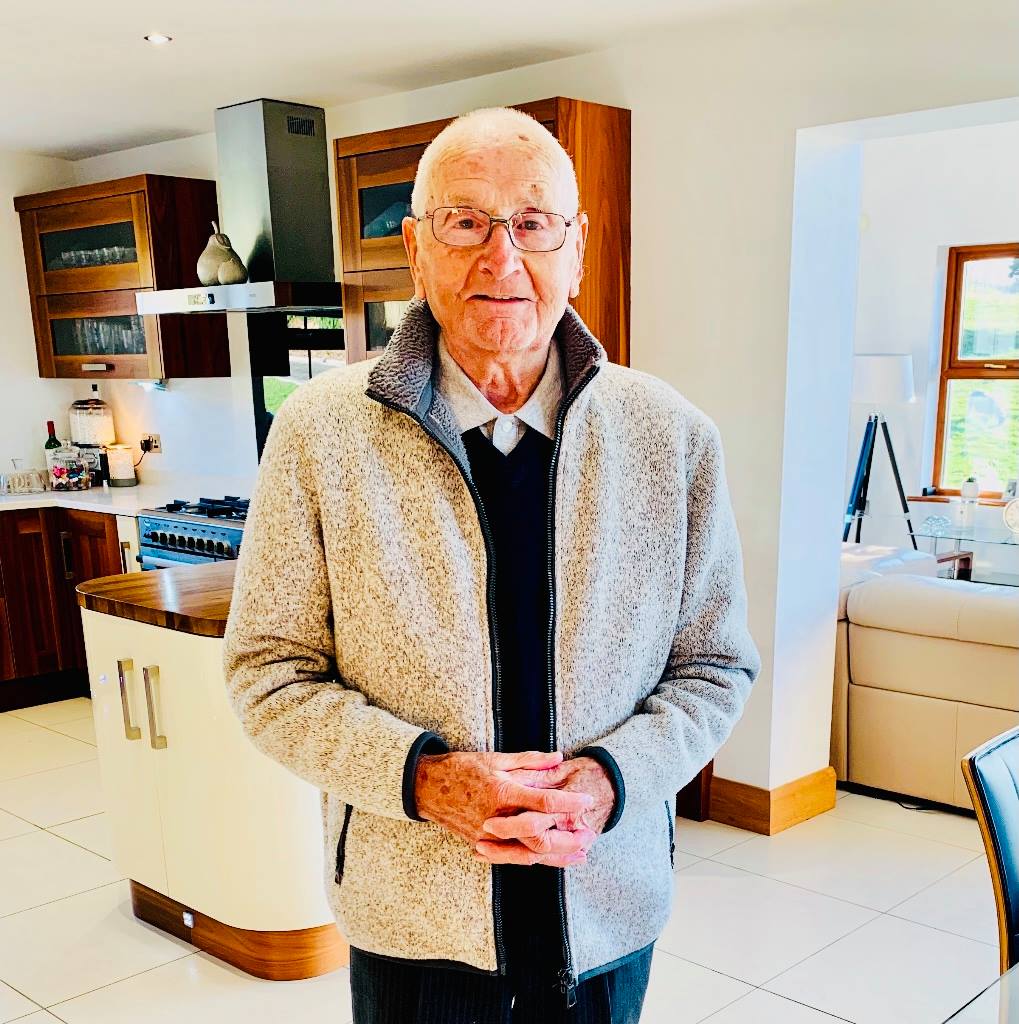
A Life Led by Grace: The Testimony of Dr. Frank McClelland
It is a rare privilege to sit across from a man whose life has been so vividly marked by the sovereignty of God. Frank McClelland, a name synonymous with steadfast faith and unwavering service to the Free Presbyterian witness, recently shared his life’s testimony with us. At eighty-three years of age, he possesses the clarity of a man who has spent decades walking in the light of the Scriptures, yet he speaks with the humility of a “dyslexic thirty-eight-year-old,” as he playfully describes his own ageing process.
Frank’s story is not a simple linear progression; it is a tapestry woven with threads of tragedy, miraculous provision, and the undeniable hand of the Almighty. To understand his service, one must begin with his origins in the Ligon Valley, where the lessons of life and death were learned in the shadow of a father’s passing and the flames of wartime conflict.
The Gravity of Life and the Certainty of Death
Born in 1936 at the Lagan Valley Hospital, Frank’s childhood on a small farm in Northern Ireland was abruptly interrupted just two days after his fourth birthday. The death of his father left an indelible mark on his young mind. He recalls the vivid memory of being lifted to the coffin in the farmyard, placing a sprig of primrose upon it, and learning the profound gravity of mortality. “Life is not forever,” he reminds us. “Everyone here someday will be dead.”
This lesson was reinforced in 1942. As a boy looking out of a window toward Belfast, Frank witnessed the terrifying glow of flares dropped by German bombers. He heard the whistle of bombs falling toward the shipyards and aircraft factories—a sound he would never forget. The following morning, his stepfather, John, took him to the markets in Belfast, where he saw the bodies of nearly seven hundred victims piled in the wake of the blitz. These early experiences forged within Frank a serious perspective on the brevity of life and the wickedness of man, a perspective that has only sharpened in light of the mass-casualty events he observes in our modern, turbulent world.
The Ravenhill Influence and the Danger of False Profession
Frank’s spiritual journey began within the Reformed Presbyterian Church in Knockbracken. While the household was religious, Frank candidly admits that, initially, neither he nor his family were truly saved. The shift occurred in 1948, when a local farmer, Joe Stevens, encouraged Frank’s father to hear a young, dynamic preacher. This led them to the Ravenhill Evangelical Church, where they encountered a twenty-two-year-old minister who would change the course of their lives.
“The singing was hearty, the preaching was forceful, and he prayed with power I had never experienced,” Frank recalls. However, this period also introduced Frank to a struggle that many in our pews today might recognise: the “futility of a false profession.” For five years, Frank attended services, stood when the believers were called to stand, and even went through the motions of an inquiry room, all while knowing in his soul that he was not right with God. “My heart was still as black as sin,” he confesses. He warns our readers today: do not settle for a Sunday facade. If you are holding onto a false profession, do not wait until it is too late to seek the real thing.
The Tranquility of Conversion and the Lesson of Backsliding
The turning point came in 1955 during a mission in the King’s Hall, conducted by the American evangelist Jack Schuler. Frank’s future wife, Yvonne, came to the Lord first, and her transformed life served as the most powerful sermon he had ever heard. Frank followed suit on the 17th of June, 1955. Yet, his journey was not without its pitfalls.
He speaks with profound vulnerability about a period of backsliding that followed his conversion, during which he returned to his worldly ways. “If you are a backslider, you are living the most miserable life on God’s earth,” he warns. The Lord, in His mercy, allowed Frank to taste the emptiness of the world after having tasted the blessing of God, a lesson that would eventually lead him to a firmer, more permanent surrender in 1956. This surrender was forged in the heat of conviction during powerful gospel preaching, and it marked the beginning of a lifetime determination to put the Lord first.
A Trial by Fire: The Seattle Tragedy
Perhaps the most harrowing chapter of Frank’s life occurred while he was serving as an elder in a fledgling congregation in Seattle, Washington, in 1969. The church had been struggling with a member who had been denied membership due to a lack of a credible confession of faith. When this individual later confronted the minister and Frank in Frank’s kitchen, the situation escalated into a moment of pure, unadulterated evil.
The man produced a derringer pistol and aimed it at the minister, declaring that he was “dead.” In the ensuing struggle, a shot was fired, and Frank, believing his own end had arrived, saw the minister fall. Frank’s reaction to this trauma was not to retreat, but to turn to the Word of God. He found solace in Philippians 1:12, which states that the things that happen serve to further the gospel. “Why Lord?” he had asked. The answer was a strengthening of his call to full-time ministry.
He recounts the aftermath as a masterclass in faith. Facing the impossible task of selling a house in which a murder had taken place, Frank and his wife chose to step out in faith and return to Ulster. Upon their arrival in Toronto, they discovered the house had been sold—a powerful reminder that when we trust the Lord, He often acts only after we take the first step of obedience.
Planting Seeds in Toronto
Frank’s return to Ulster was brief, as he was eventually led back to Toronto to establish a Free Presbyterian Church. He describes this period as a “maelstrom of opposition.” When the ecumenical leaders learned of the new church, they mobilized against it. Their rented building was demolished at the behest of ecumenical forces—ostensibly to build a tennis court. “Tennis begins with ‘love all,'” Frank quips, “but they did not love us.”
Despite this, the congregation thrived, spending two years in a rented high school before eventually purchasing a building on Warden Avenue. Frank’s commitment to education was a natural outflow of his concern for the next generation. When the public school system in Toronto banned the Lord’s Prayer, the Ten Commandments, and eventually the Bible, Frank knew he could not sit idly by. He spearheaded the creation of the Whitfield Christian Academy, starting with sixteen pupils in 1989.
The Lord’s Provision and the Multitudes
Frank shares a remarkable story regarding the purchase of the current church and school property. The asking price was two and a quarter million dollars, an impossible sum for the congregation. Frank recalls the struggle of setting a hard limit of one and a half million dollars, only to receive a call from the owner accepting their offer moments after he had resigned himself to losing the building.
The provision came through a member who had recently inherited money from investments in the pharmaceutical industry—money that had been sitting in relative obscurity for decades, preserved by the Lord for this specific purpose. The donor provided a personal cheque for the exact amount needed. It is a testament to the fact that God makes no mistakes; He prepares the way long before we arrive.
A Legacy and a Challenge
Today, the church Frank founded is a vibrant, multicultural reflection of the city it serves. With congregants from China, India, Pakistan, Lebanon, and across the globe, the church stands as a testament to the unifying power of the gospel. While Frank officially retired in 2009, he remains active, acknowledging that for a servant of the Lord, retirement is a myth.
As we conclude our look at his life, Frank’s message to the young people of our church remains urgent. “You don’t know what is ahead of you,” he says. “You don’t know who you will marry or what job you will have. But the Lord does.”
Frank McClelland’s life serves as a beacon for us all. Whether through the tragedy of a kitchen shooting or the triumph of establishing a Christian school, his testimony remains consistent: trust in the Lord with all thine heart, and lean not unto thine own understanding. In all thy ways acknowledge Him, and He shall direct thy paths. It is our prayer that this account serves as a means of encouragement to every reader, reminding us that we serve a great, loving, and sovereign God who is worthy of our total surrender.